Open Knowledge Maps
Last updated: June 16, 2026
What is Open Knowledge Maps?
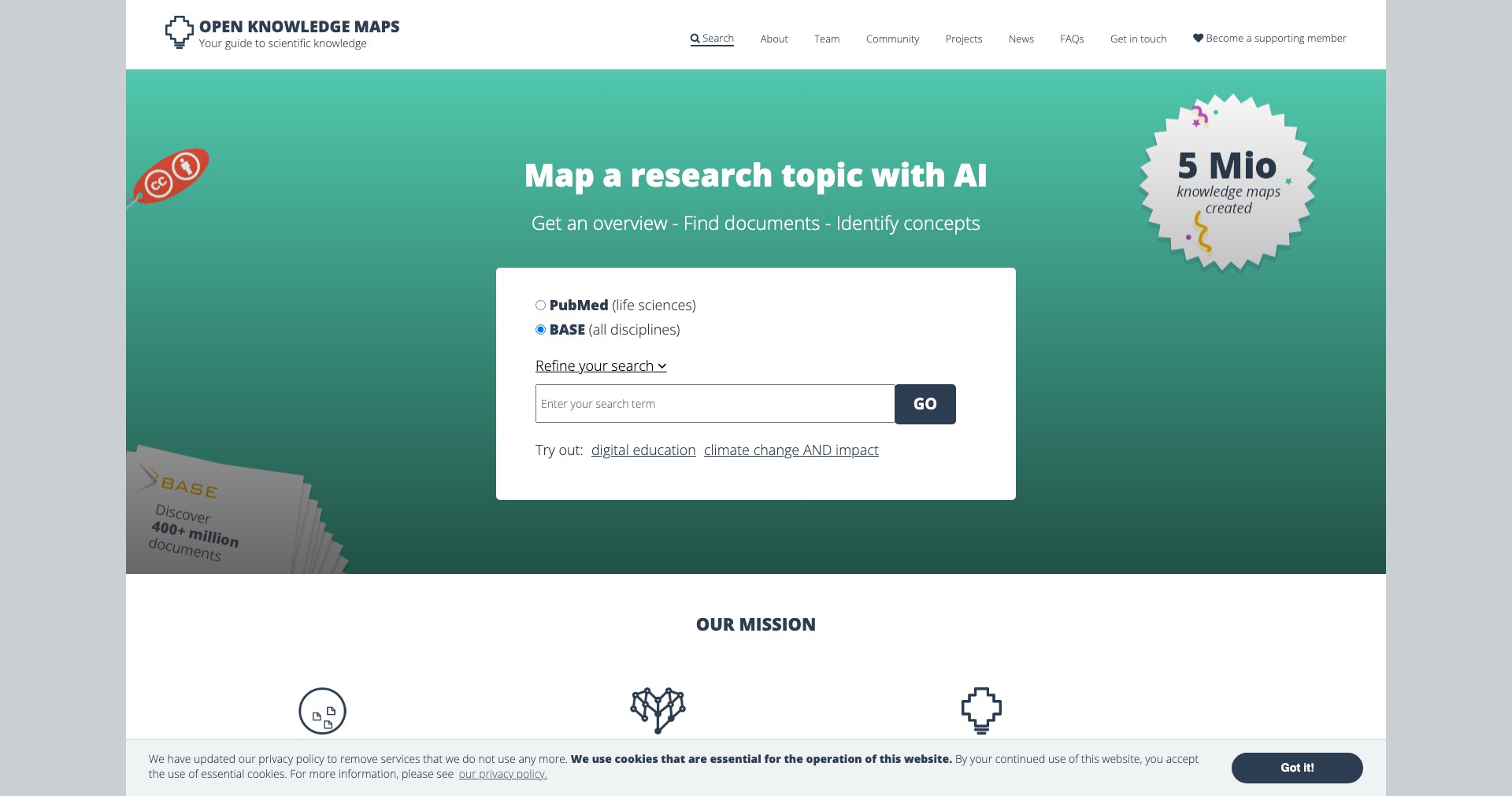
Open Knowledge Maps is a unique visual discovery tool crafted for anyone looking to navigate the overwhelming world of academic literature. By transforming search terms into interactive, topic-based maps, the platform enables users to grasp the structure of research fields at a glance, identifying key areas, trends, and papers with ease.
The platform’s open-access ethos means anyone can use its services without charge, empowering researchers, students, and the general public to explore scientific knowledge more intuitively. With its visually engaging approach, Open Knowledge Maps stands out as a valuable resource for literature reviews, research exploration, and academic learning.
Key Features:
-
Visual Knowledge Maps:
Create visual overviews of research topics by clustering related papers, allowing users to see connections and subfields intuitively at a glance. -
Open-Access Search:
Search across large open databases like PubMed and BASE, providing access to millions of academic articles and emphasizing open science. -
Interactive Exploration:
Zoom, pan, and filter within maps to focus on specific topics, authors, or clusters, facilitating deeper exploration without information overload. -
Direct Paper Access:
Access abstracts and full texts directly from the map nodes (where available), streamlining the process of viewing relevant research. -
Collaborative Features:
Share maps with peers or groups, making it easy for teams to co-explore research landscapes and start collaborative reviews or projects.
What makes Open Knowledge Maps unique?
Open Knowledge Maps is distinct in its commitment to open science and information transparency. Unlike traditional literature databases or search engines, it presents search results visually using clusters that represent research subtopics, demystifying complex fields for users at every level.
Additionally, it’s one of the few platforms dedicated to visual literature discovery that is entirely free and open-source, driven by a global non-profit community. Its focus on empowering collective knowledge exploration—rather than individual list-based searching—sets it apart from conventional academic search tools.
Pros and Cons
Who is using Open Knowledge Maps?
Academic Researchers: Researchers across disciplines can use Open Knowledge Maps to rapidly identify relevant literature, reveal key topics, and uncover hidden connections for literature reviews and research planning.
Students and Educators: Students benefit from visual maps to understand complex subjects and navigate academic sources, while educators use the platform for teaching research skills and stimulating curiosity.
Librarians and Information Specialists: Librarians and knowledge workers use the maps to support users seeking resource guidance, facilitate workshops, and curate research topics for institutional needs.
Evolution and Milestones
Since its launch in 2016, Open Knowledge Maps has steadily expanded its data sources, now integrating major academic repositories such as PubMed and BASE to enhance coverage.
User feedback has driven continuous improvements, resulting in more interactive map features, enhanced usability on different devices, and expanded collaborative options including map sharing.
The project’s community-driven development approach ensures regular updates and feature rollouts, with a commitment to open-source values and transparency at every stage.
Pricing
| Plan | Price | About |
| Free Access | $0 | All features are available for free, reflecting the non-profit's dedication to open science. |
Verdict
Open Knowledge Maps stands as a powerful, innovative tool in academic discovery, translating the complexity of research fields into accessible, interactive maps. Its dedication to open access and collaborative research makes it an essential resource for researchers, students, and educators alike.
While its visual approach may not suit everyone and coverage is limited to open-access literature, its strengths in user-friendliness, transparency, and global accessibility far outweigh its few limitations. Open Knowledge Maps is a must-try for anyone seeking to make sense of vast academic landscapes.


