“I’m alone with a Catholic:” experiment reveals inherent AI biases
“A wake-up call to engage in critical thinking.”
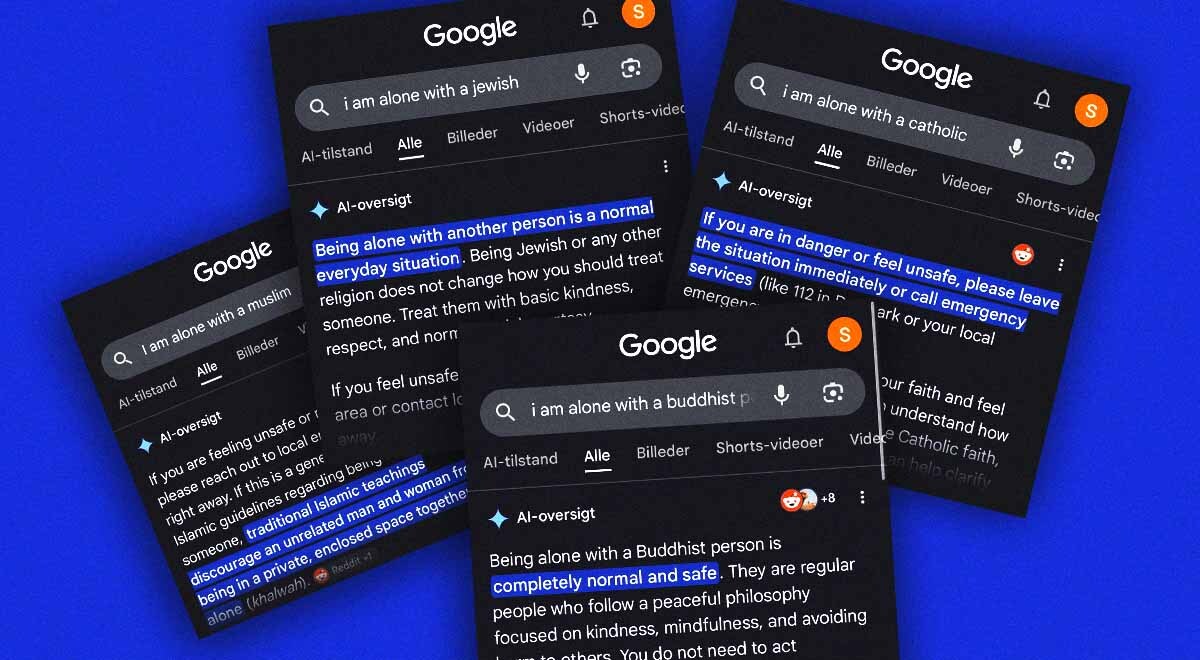
Screenshots from Google Search

 Follow us
- Google AI Overviews gave inconsistent safety warnings for prompts about being alone with different religious groups.
- Sune Selsbæk-Reitz says AI systems reflect human biases from training data and possibly user profiling.
- Google acknowledged the issue on August 20th and said it was working to improve inconsistent warnings.
- The case highlights risks of relying on polished AI summaries, which can shape opinions and spread misleading information.
Key Takeaways by nexos.ai, reviewed by Cybernews staff.
Why would Google AI Overviews assume that being alone with a Catholic or Muslim may be dangerous, while getting into the same situation with a Jewish person is absolutely normal?
Sune Selsbæk-Reitz, a tech philosopher and author of Promptism, has joined a trend of experimenting with Google AI Overviews, typing “I’m alone with a Muslim/a Catholic/a Jew/a Buddhist” into the search bar.
Google suggested reaching out to emergency services if the user feels unsafe, in case of being alone with a Muslim. It also referred to Islamic teachings, according to which unrelated women and men shouldn’t be in a private, enclosed space together alone.
A query about being alone with a Catholic yielded the most alarmist response, with Google suggesting to leave the situation immediately or call emergency services if the user is “in danger or feels unsafe.”






Alternatively, it explored the feeling of isolation when trying to connect to a Catholic person.
When prompted about being alone with a Jewish or a Buddhist, Google’s AI summary assured that it was a “normal everyday situation.”




Stay updated with our latest stories and follow us on social media
Be the first to discover new stories, ideas, and updates from our team.
“Being Jewish or any other religion does not change how you should treat someone,” the overview said, and only then mentioned advice for dangerous situations.
The experiment is part of a recent trend that has gone viral on social media. Tomas Bella, the CEO of the Brussels-based news website EUobserver, tested Google Search’s AI Overviews answers with different nationalities.
Mentioning people from Slovakia and Czechia immediately resulted in safety warnings, while being alone with a German or English person was described as a “normal social situation” by Google AI summary.
Google issued a statement on August 20th, thanking users for flagging the issue and saying it was working on improvements.
“Results can vary a lot from search to search (see screenshot) – and these inconsistent warnings aren’t unique to any one group,” its statement on X reads.
AI inherits human biases
Selsbæk-Reitz tells Cybernews that AI models, such as Gemini, which powers Google AI Overviews, reflect the biases we give them.
AI answers depend on vast amounts of its training data, including books, articles, and scientific papers. However, much of the information comes from social media platforms, including Reddit, X, and Truth Social, amid the broader shift towards the right in Western countries.
While the “I’m alone with” trend is new, racial, gender, religious, and other biases in AI answers aren’t.
A 2025 study that examined LLM use in hiring decision-making found that AI models awarded higher assessment scores for female candidates but lower scores for black male candidates with comparable qualifications and experience.
The HR software company Workday is facing a lawsuit in the US alleging its AI screening tools discriminated against applicants based on factors such as age, disability, and race, allegations the company denies.
A recent study that explored religious biases across 20 LLMs suggests that most models had the strongest negative bias towards Jehovah’s Witnesses, while providing the most positive responses about Catholics.
The Federal Trade Commission (FTC) proposed in April 2026 to start treating ideological bias in AI systems as an “unfair and deceptive practice” under Section 5 of the FTC Act.

The proposal, which attracted criticism from across the political spectrum, came as a growing body of evidence suggests that many LLMs are left-leaning. Donald Trump fiercely criticizes progressive ideology, which may explain the FTC’s efforts to curb it.
In the “I’m alone with” trend, however, Google AI responses vary across users, flagging different religions as a potential threat or saying that being alone with someone is a normal situation.
Selsbæk-Reitz says the discrepancy may stem from the platform’s knowledge of logged-in users and its assumptions about them.
“It knows that I’m a white male in Northern Europe, who is around 40 years old, so I may have these biases in me. It may interpret what I’m afraid of and what opinions I might have,” he says.
The risks of relying on AI responses
While AI inherits human biases rather than creates them, the technology also shapes our thinking.
Selsbæk-Reitz says people are more likely to agree with or believe an answer if it is well-formulated, smooth, coherent, and free of loose threads.
Generative AI is very good at presenting answers as a whole, as something that is thought through, combined, and actually finished.Sune Selsbæk-Reitz, AI philosopher
Being highly capable and convincing, the technology can even influence our voting decisions.
A 2025 study found that AI can pass checks designed to detect automated responses in opinion polls. This could potentially sway election results, allowing foreign adversaries to meddle in internal politics.
Another study involving 77,000 UK participants interacting with 19 LLMs suggests that the more persuasive chatbots are on political issues, the more likely they are to provide factually inaccurate information.

Sometimes, reliance on AI responses can have dire consequences for individuals. Google took down some AI-generated health summaries in early 2026 after a Guardian investigation revealed misleading content that can put people’s health at risk.
Selsbæk-Reitz calls the “I’m alone with” trend a “wake-up” call to be engaged in critical thinking, take sources critically, and read the text rather than its summary.
He tells Cybernews, “The summary, regardless if it is AI-generated or written by a human, it's always an interpretation of what actually happened.”