Fly brains were uploaded to AI-generated Matrix. Should we worry?
The Matrix has a new, six-legged resident.

Image by Cybernews

 Follow us
- Odyssey says it placed a fruit fly brain inside AI-generated virtual worlds.
- The company shared videos of the digital fly moving through a marina and a market.
- Uploads became possible with AI, as scientists spent decades mapping a fruit fly's brain with about 139,000 neurons and 54.5 million synapses.
- However, human brain uploads remain far out of reach because the human brain is vastly more complex.
Key Takeaways by nexos.ai, reviewed by Cybernews staff.
An AI lab says it has placed a fruit fly's brain inside a virtual world that doesn't exist.
The brain was uploaded to a realistic but entirely artificial world that’s generated live on the go with the help of AI.
No developers built its surroundings. The scenery is imagined by a machine, while the fly's digital brain does the flying. Welcome to the Matrix.
“We placed the fruit fly brain inside Odyssey-3, a frontier world model. The lil’ guy is now flying around totally imagined, simulated worlds all by itself,” wrote the Odyssey AI lab in a post on X.






The company shared the video of the fly wandering around an AI-generated marina. The company’s CEO, Oliver Cameron, also shared a video of a fly in an AI-generated market.
“He’s enjoying the market,” Cameron wrote in the X post.
The experiment brings together 2 rapidly advancing fields – brain simulation and AI-generated virtual worlds. The result is a digital fly navigating environments that are generated on the fly.
However, the company has not provided any more details about the experiment.
The company is backed by Amazon and Google investors
Odyssey is an AI research lab building AI systems designed to understand, predict, and simulate the physical world.
Potential applications include robotic arms, humanoid robots, autonomous vehicles, and drones. If AI systems can learn how objects move and how environments respond to actions, they could be trained in simulated settings before deployment in the real world.
The technology could also have implications for gaming, where real-time world generation might allow players to explore environments that are not entirely scripted or prebuilt.
Based in Palo Alto, California, Odyssey has attracted significant investor interest. The startup raised $310 million in Series B funding and was valued at $1.45 billion, with backing from Amazon and Google.
Scientists spent years mapping the fly’s brain
This isn’t the first time a fruit fly has had the honor of entering the Matrix. The underlying science has taken years to develop.
Because fruit flies have relatively simple brains and share many genes with humans, scientists have used them for decades to study how neurons work.
For the past couple of decades, scientists have been mapping the fly’s brain, and AI has become crucial to finally accomplishing it.
In 2024, scientists completely mapped the brain, reconstructing an example containing about 139,000 neurons and 54.5 million synapses. This model is known as the FlyWire connectome.
In other key research, Philip Shu found a way to simulate the entire fly brain on a computer.
Earlier this year, scientists at biotechnology startup Eon Systems uploaded a fruit fly’s brain into a digital 3D world.
They took a connectome of the central brain, consisting of roughly 140,000 neurons and 50 million synaptic connections, and uploaded it into a digital body called NeuroMechFly.
At this point, it’s unknown whether Odyssey Lab used the FlyWire connectome in its latest fly upload into the digital worlds.
Cybernews has reached out to the company for comment.
Should we be worried about machines putting humans into the Matrix?
After reading such news, you might imagine doomsday narratives inspired by the 1999 movie The Matrix, in which human brains were plugged into a simulated world.
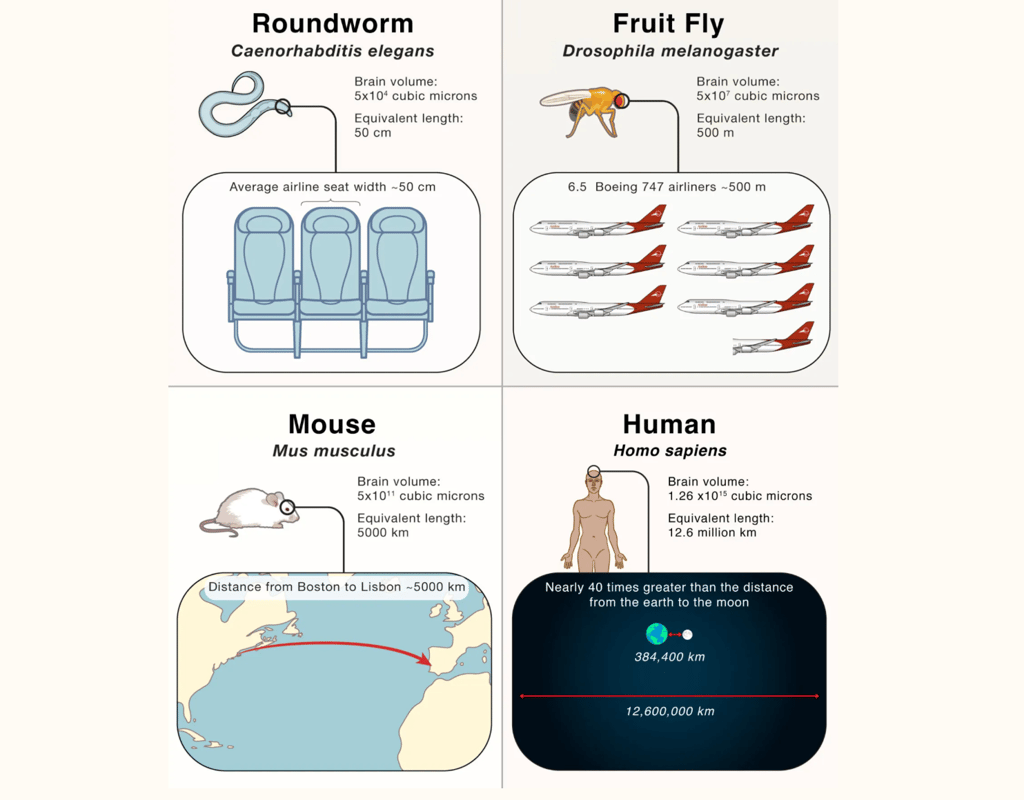
However, while the fly brain has been successfully uploaded to a digital environment, we’re less likely to see human brains do the same anytime soon. Scaling from a fruit fly to a human one is a logistical mountain of staggering proportions.
A fruit fly brain has roughly 140,000-167,000 neurons and tens of millions of synapses, and took decades to map. Human brains have 86 billion neurons with trillions of synapses.
Researchers at Harvard-affiliated labs note that the human brain is “depressingly complex” and not feasible to map. Currently, scientists are working on mapping mouse connectomes, an intermediate step.
Another important note in such experiments is that FlyWire connectome data is not "uploading a fly's brain" in the sense of transferring a living mind somewhere.
Researchers mapped the fly's neural wiring diagram, showing which neurons connect to which. This information was used to build a simulation.
A software model mimics the fly's neural circuitry and can then be used to predict behavior, control virtual characters, or drive simple robots.
So, the fly in the simulation is not sentient. We’re still a hell of a long way from anything resembling the Matrix in terms of human brains.