The internet is buzzing about a digital fly brain: Are humans next?
Scientists have created a digital fruit fly brain simulation using a mapped connectome and AI. But does it really mean that uploading the human brain has gotten closer?


 Follow us
Scientists have created a digital fruit fly brain simulation using a mapped connectome and AI. But does it really mean that uploading the human brain has gotten closer?
A video of a fruit fly is rapidly spreading online. At first glance, the footage looks like a clip from a 2000s-era video game.
The digital fruit fly twitches and navigates a sparse 3D arena, but this isn't a pre-programmed character. Beneath the 3D mesh lies what researchers are calling a historic milestone in neuroscience – the world’s first "embodied" digital brain.
Scientists at biotechnology startup Eon Systems claim that it’s a whole-brain emulation, or a digital recreation of the biological "wiring diagram" of a fly, plugged into a physically simulated body.
“Eon Systems PBC, demonstrating what we believe is the world's first embodiment of a whole-brain emulation that produces multiple behaviors,” wrote the company’s co-founder Alex Wissner-Gross, on X.





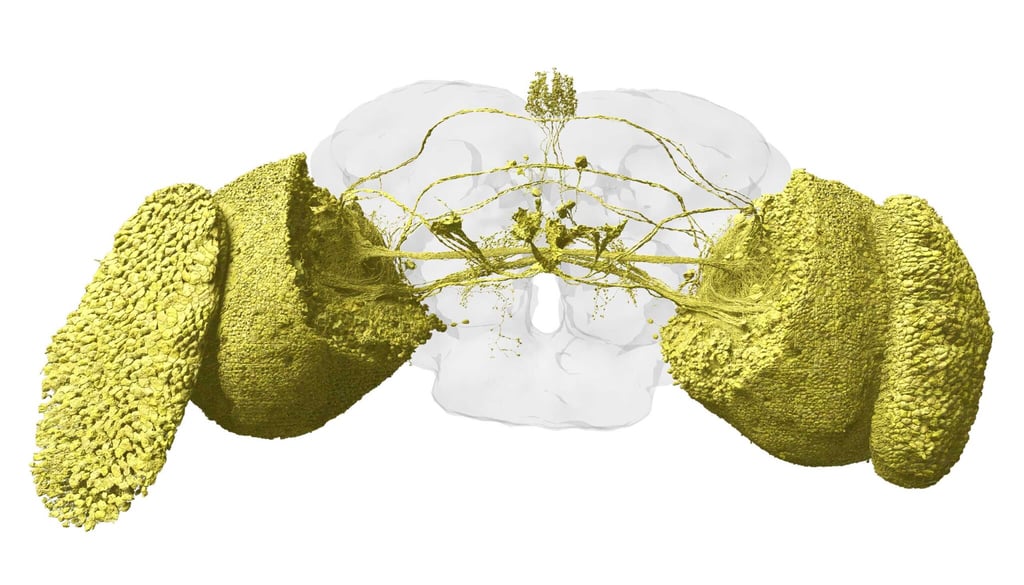
For years, neuroscientists have been painstakingly mapping the connectome, which is a dense forest of trillions of connections between neurons. But a map is not a traveler. Knowing where the neurons are doesn't explain how they create action and life.
Eon Systems has tried to embody the map. They took the adult Drosophila (a fruit fly) connectome of the central brain, consisting of roughly 140,000 neurons and 50 million synaptic connections, and uploaded it into a digital body called NeuroMechFly.
How a digital fly works
In the video, the fly uses invisible taste cues to navigate the environment towards a food source – stylized as slices of banana.
It stops to brush "dust" off its antennae with its front legs, then resumes its trek toward the fruit before finally settling in to eat.
This process works because of four parts that mimic biological reality.
- The fly receives sensory input from the surrounding virtual world, which affects it. If the fly hits a sugar patch, virtual taste receptors fire.
- These signals are piped into the digital brain, where a leaky integrate-and-fire (LIF) model calculates how the neurons should respond based on their physical connections.
- The brain activates descending neurons that are responsible for motor control.
- The body moves, the environment changes, and the loop starts again every 15 milliseconds.
The model is a simplified neuron model, and it has limitations. For example, it cannot capture the full range of neural activity that occurs in real life when a fly feels hunger, is in mating or egg-laying state, or has a recent sensory history.
Despite the creature's realistic grooming and foraging, the team at Eon is quick to temper expectations.
"The current embodied fly is best understood as a research platform," the company stated, acknowledging that their model is a "deliberately low-dimensional" version of the real thing.
This fly doesn't get hungry in the biological sense, nor does it learn from its mistakes. It lacks the hormones, internal states, and plasticity that make a living fly so unpredictable.
“We only implement a small subset of sensory inputs and model only a handful of behaviors,” said the scientists.
“Internal state, plasticity, learning, and hormonal changes are largely missing. Biological flies do not respond to the same sensory input the same way in all contexts.”
Why do scientists use fruit flies for brain research?
Because fruit flies have relatively simple brains and share many genes with humans, scientists have used them for decades to study how neurons work.
For the past couple of decades, scientists have been focusing on mapping the fly’s brain, and AI has become crucial in finally accomplishing it.
The current breakthrough is built on extensive previous research conducted by multiple scientists. One of the studies that laid the foundation was conducted in 2024 by a consortium of scientists who completely mapped the fly brain.
The researchers reconstructed a brain containing about 139,000 neurons and 54.5 million synapses, allowing scientists to trace how signals travel from sensory inputs to outputs that control behavior.
Out of this research, another study emerged, conducted by Philip Shu, who is now a senior scientist at EON Systems. The research focused on simulating the entire fly brain on the computer.
Does this mean we can soon upload human brains?
After this outstanding breakthrough, the startup has the ambition to go further.
“Eon's mission is to produce the world's largest connectome and highest-fidelity brain emulation, targeting a complete digital emulation of a mouse brain and laying the groundwork for eventual human-scale emulation,“ said Alex Wissner-Gross on X.
The lead scientist is also optimistic about the perspectives of brain “uploads.”
“We can imagine a world where we can simulate a mouse brain, or eventually a human brain, and really get fundamental insights into the causes of various mental health disorders and about how the brain works,” Shiu told Berkeley News after his research was published in 2024.
However, not all are convinced by the narrative. Some find plans to map mouse brains in two years unrealistic and a public stunt to generate hype.
Scaling from a fruit fly to a mammal is a logistical mountain of staggering proportions. A mouse brain contains roughly 70 million neurons, but researchers have successfully mapped only 0.2% of it to date.
A single cubic millimeter of tissue required the collective effort of 150 scientists across 22 institutions and nine years of grueling work. This microscopic sliver alone generated 1.6 petabytes of storage. This may not be feasible for a startup in the near future. But let’s see.
It is not the first time ambitious projects have promised digital consciousness but failed to deliver. A well-known example is the Human Brain Project (HBP), launched in 2013. After promising to simulate a human brain within a decade, it instantly attracted $1 billion in funding.
By 2014, the road to digital consciousness hit a wall of skepticism when 750 neuroscientists signed an open letter blasting the project’s rigid top-down structure and questionable scientific assumptions.
When the project finally shuttered in 2023, it still hadn't reached its goal. Not even close.
Unlock more exclusive Cybernews content on YouTube.