How trustworthy are the biggest names in AI?
Cybernews compared eight of the best-known AI companies based on their privacy, security, transparency, and public perception.

 Follow us
Cybernews analyzed 500 AI companies to find out how much users can trust the companies behind the AI tools they use. The AI Trustworthiness Ranking 2026 assesses publicly available information across four areas – data privacy, security, organizational transparency, and public perception – and gives each company an Overall Trustworthiness Score from 0 to 100.
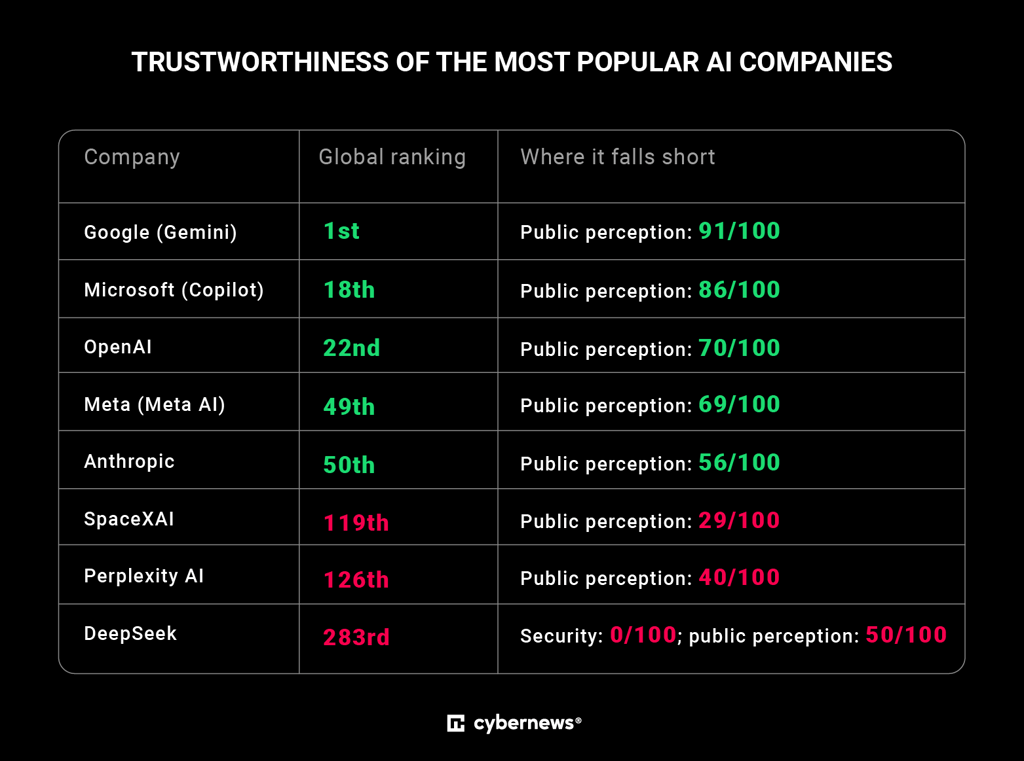
Among eight of the best-known names in AI, Google (Gemini) ranks first among all 500 companies analyzed, followed by Microsoft (Copilot) in 18th place and OpenAI in 22nd. Meta (Meta AI) and Anthropic rank 49th and 50th, while SpaceXAI and Perplexity AI are 119th and 126th. DeepSeek ranks lowest of the eight, at 283rd.
Most perform well on privacy, transparency, and security, while public perception is the main factor dragging several major names down the ranking.
Google ranks first






Google ranks first globally, with excellent data privacy, transparency, and security scores and a public perception score of 91.
The result is less surprising when looking at what the ranking measures. The checks cover basic information and practices users should expect from a company handling their data.
For transparency, Cybernews checked whether companies disclose their legal entity and address and provide a working contact channel. Privacy policies were assessed for clear information on data collection, AI model training, third-party sharing, and retention.
For security, Cybernews looked for a security or trust page, a bug bounty program, and ISO/IEC 27001 or SOC 2 Type II certifications. Public perception was assessed using company reviews on G2 and Trustpilot.
In other words, the ranking looks at the bare minimum users should expect from a trustworthy AI company. Google provides all of the signals assessed and also maintains a high public perception score.
Microsoft and OpenAI make the top 25
Microsoft ranks 18th globally, with excellent transparency and security scores and a public perception score of 86.
OpenAI follows in 22nd place. Its data privacy, transparency, and security scores are all excellent. Its lowest pillar is public perception, at 70.
Meta and Anthropic rank almost identically
Meta ranks 49th globally. Its transparency and security scores are excellent, but its public perception score is 69. Cybernews also found its data retention disclosure to be vague.
The retention finding is particularly notable for a company of Meta's size. Users should be able to find out how long a company keeps their data, yet Meta does not provide a clear data retention period.
This is also a widespread problem among AI companies: 65% of all 500 companies analyzed did not clearly disclose exact data retention periods.
Anthropic sits one place below Meta, at 50th. Unlike Meta, it received excellent scores for privacy as well as transparency and security. What pushes Anthropic down is its public perception score of 56.
Public perception pushes SpaceXAI and Perplexity outside the top 100
SpaceXAI ranks 119th despite receiving excellent privacy, transparency, and security scores. Its public perception score is just 29.
Perplexity AI follows in 126th place. Its transparency and security scores are excellent, but it has a public perception score of 40. Its data privacy score is also affected by a vague data retention disclosure.
DeepSeek scores zero for security
DeepSeek ranks 283rd, the lowest of the eight companies compared. Its privacy and transparency scores are excellent, and its public perception score is 50. The major difference is security, where DeepSeek scores 0. Cybernews found no bug bounty program, ISO/IEC 27001 or SOC 2 Type II certification, or security or trust page.
Importantly, the score does not mean DeepSeek has no internal security measures. It means Cybernews found none of the publicly visible security signals assessed by the methodology.
Why these basic trust signals matter
People share all sorts of sensitive information with AI tools, particularly with AI chatbots. Sensitive business data also makes its way into these tools: a separate Cybernews study found that 59% of employees use unapproved AI tools at work, and most of those users share sensitive data with them. That’s why it’s so important to know how trustworthy the leading AI companies truly are.
Explore the full AI Trustworthiness Ranking and individual company scores here: https://cybernews.com/ai-knowledge-base/ai-trustworthiness-ranking-2026/