59% of employees use unapproved AI tools at work – most of them also share sensitive data with them
Cybernews conducted a survey on employees in the U.S. to figure out how they use AI tools at work. The findings were quite surprising, revealing that the vast majority of respondents used AI tools that were not approved by their employers.


 Follow us
Cybernews conducted a survey on employees in the U.S. to figure out how they use AI tools at work. The findings were quite surprising, revealing that the vast majority of respondents used AI tools that were not approved by their employers.
The study shows that there’s still a lot of miscommunication (or overall lack of communication) between employees and employers when it comes to AI tools. Many companies lack any official policy on the use of AI, and employees admit to sharing sensitive information with AI tools. Since many of these AI tools end up leaking customer data, thousands of businesses may be at risk. Additionally, IBM recently revealed that shadow AI (the use of unapproved AI tools at work) can increase the cost of a data breach by an average of $670K.
Key findings:
- 59% of employees use AI tools that their employer has not approved.
- 75% of employees who use unapproved AI tools shared possibly sensitive information with them.
- Executives and senior managers are most likely to use unapproved AI tools at work.
- 89% of employees understand the risks associated with AI tools.
- 23% of employers don’t have any kind of policy related to AI use at work.
Most employees use unapproved AI tools behind their employers’ backs – and their direct managers are generally OK with it






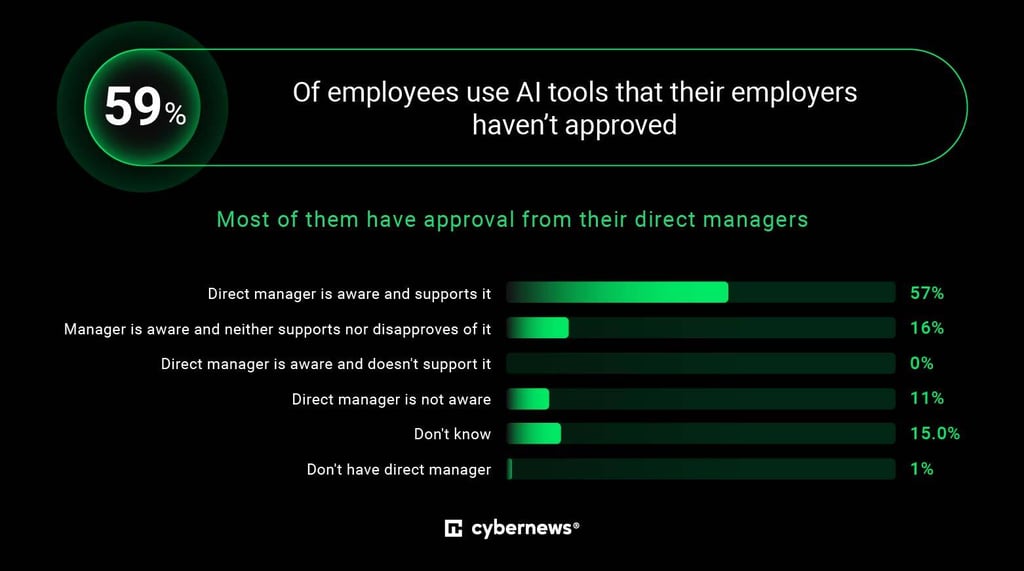
59% of employees admit to using AI tools that haven’t been approved by their employers. More interestingly, out of those using unapproved tools, 57% claim that their direct managers are OK with it and support it, and 16% claim their direct manager doesn’t care. This shows that companies are not putting enough effort into raising awareness on the risks of irresponsible AI use.
“If employees use unapproved AI tools for work, there’s no way to know what kind of information is shared with them. Since tools like ChatGPT feel like you’re chatting with a friend, people forget that this data is actually shared with the company behind the chatbot. As it turns out, many managers quietly give a thumbs-up to using these tools, even if they’re not officially approved. That creates a gray zone where employees feel encouraged to use AI, but companies lose oversight of how and where sensitive information is being shared,” says Mantas Sabeckis, Security Researcher at Cybernews.
75% of employees who use unapproved AI tools at work share possibly sensitive data with them
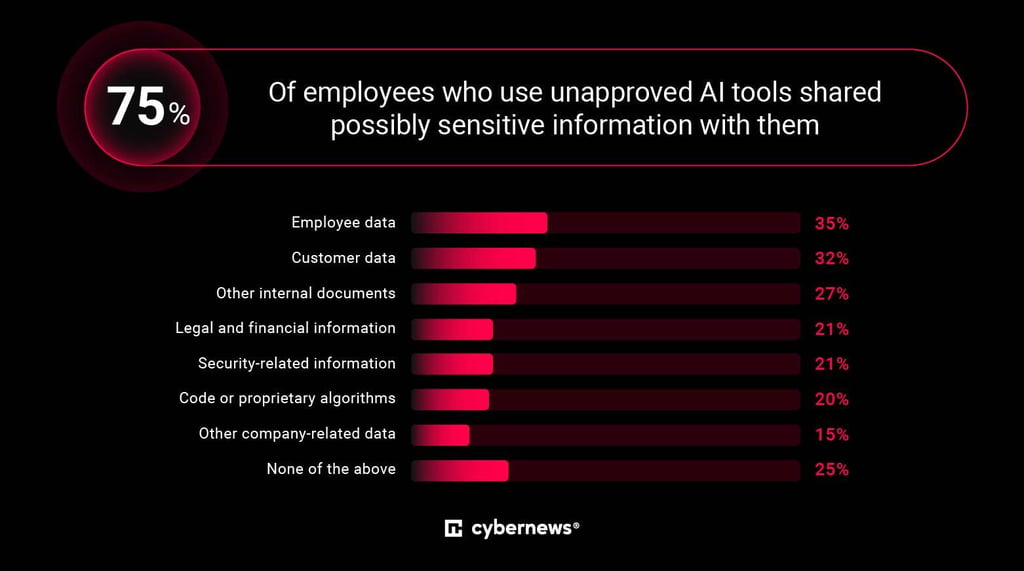
The biggest risk of unapproved AI tool usage at work is that employees will end up sharing sensitive data with them. As it turns out, 75% of employees using unapproved AI tools admit to sharing potentially sensitive information with them. Most commonly, they admitted to sharing employee data, customer data, and internal documents.
Interestingly, the overall share of employees (including both those using and not using unapproved tools) sharing sensitive data with AI tools was 44%. This means that employees using unapproved tools are much more likely to use them irresponsibly.
“When employees paste sensitive data into unapproved AI tools, there’s no guarantee of where that data will end up,” says Žilvinas Girėnas, head of product at nexos.ai, an all-in-one AI platform for enterprises. “It might be stored, used to train someone else’s model, exposed in logs, or even sold to third parties. That means customer details, contracts, or internal documents can quietly leak outside the company without anyone noticing.”
“Once sensitive data enters an unsecured AI tool, you lose control. It can be stored, reused, or exposed in ways you’ll never know about. That’s why companies need secure, approved tools to keep critical information protected and traceable.”
Executives and senior managers are most likely to use unapproved AI tools at work
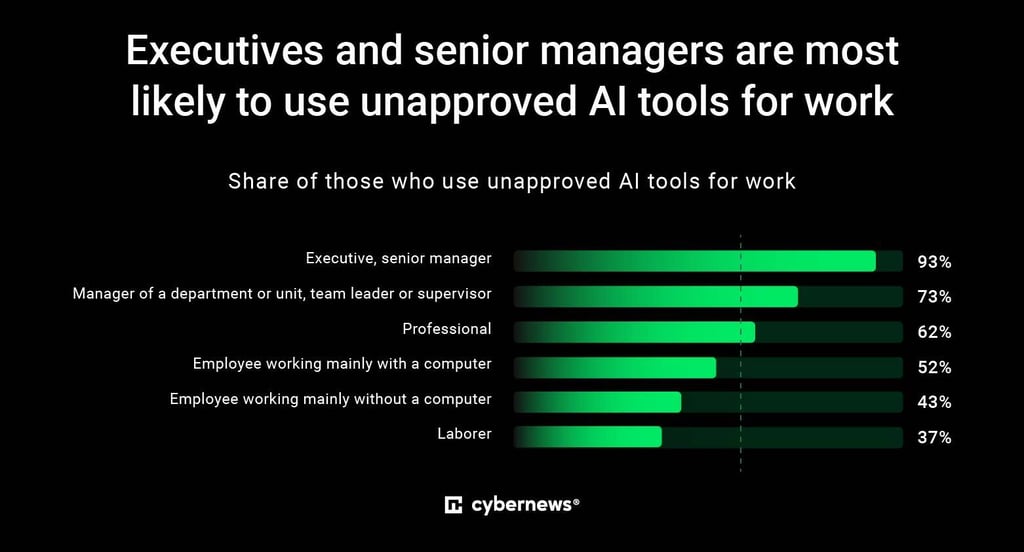
93% of executives and senior managers admitted to using unapproved AI tools at work. Managers, team leaders, and supervisors also used unapproved AI tools surprisingly often. This creates an interesting paradox – those who are supposed to set an example and prioritize company security seem to be the most irresponsible when it comes to AI use at work.
As we already know, most employees using AI tools unapproved by their employers have approval from their direct managers. Again, this shows how important it is to educate all employees on the risks of AI tools, especially those who manage teams.
89% of employees understand the risks associated with AI tools
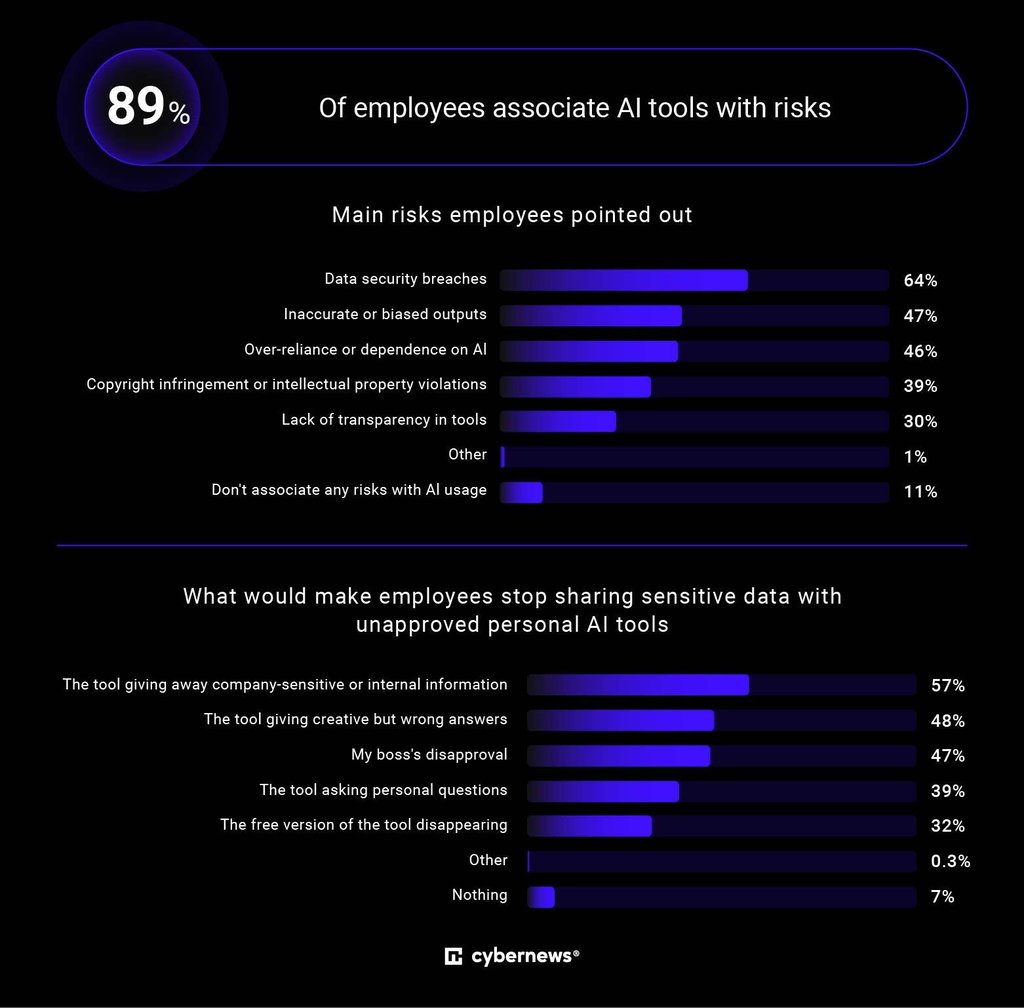
Nearly all survey respondents understand the risks associated with AI tools. Data security breaches were the most common risk that employees pointed out. This makes the study findings even more alarming – it means employees use unapproved AI tools at work and share sensitive information with them, even though they know it may result in a data breach.
57% of those using unapproved AI tools at work claim that they would stop using them in case of a data breach. “While awareness of the risks of irresponsible AI use does exist, employees still need more knowledge. It would be a shame if the only actual way to stop employees from using unapproved AI tools at work were an actual data breach. For many companies, even a single data breach can be impossible to recover from. That's why companies must create a security culture where approved, user-friendly solutions are provided and policies are clearly enforced,” says Mantas Sabeckis, Security Researcher at Cybernews.
23% of employers don’t have any kind of policy related to AI use at work
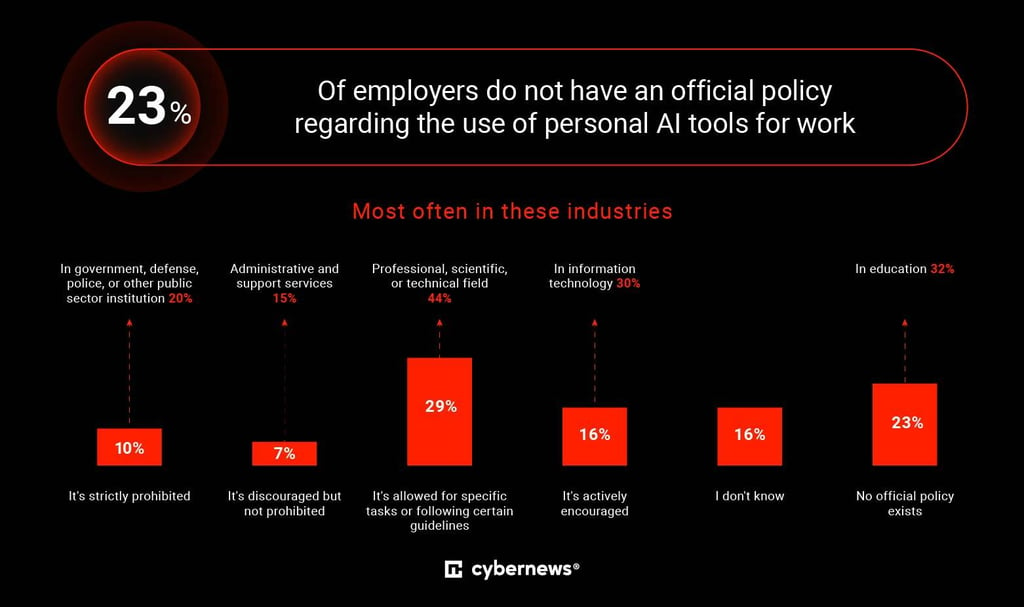
Despite the threats associated with AI tools and their widespread use among employees, nearly a quarter of companies don’t have any kind of official policy regarding the use of personal AI tools at work.
“Shadow AI thrives in silence,” adds Girėnas. “When managers turn a blind eye and there’s no clear policy, employees assume it’s fine to use whatever tool gets the job done. That’s how sensitive data ends up in places it should never be. AI use in the workplace should never live in a gray zone, and leaders need to set clear rules and give employees secure options before the shortcuts turn into breaches.”
Meanwhile, more than half of employers have provided or approved specific AI tools for work.
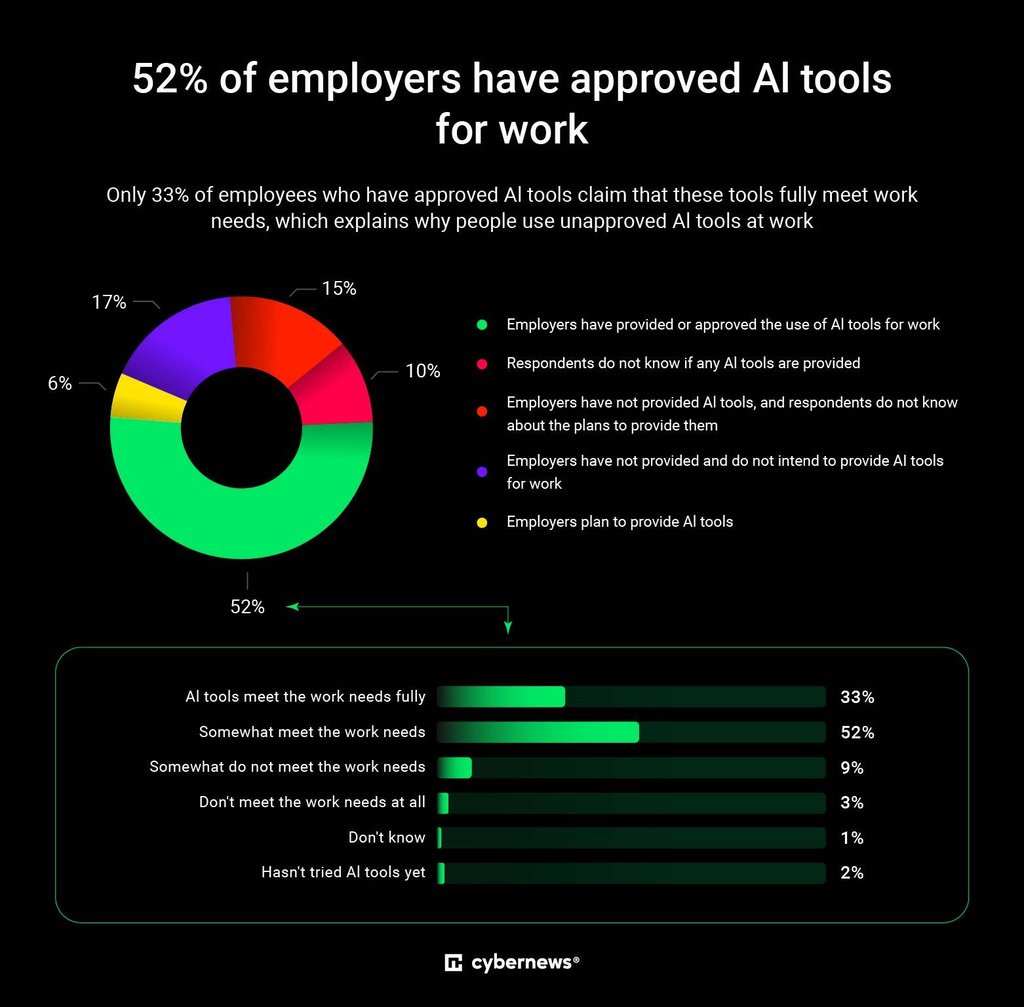
Only a third of employees using tools approved by their companies state that those tools meet their needs. This may be the reason why so many employees resort to unapproved tools – their employers simply do not provide them with the tools required to perform their tasks at maximum efficiency.
“It’s time for companies to stop pretending they can keep up with the market without using AI tools. Those times have passed. Now, if your company isn’t using AI, it’s already behind the competition. Of course, this doesn’t mean employers should blindly approve all tools for the sake of efficiency. But it does mean that companies should look into ways to incorporate AI into their processes securely, efficiently, and responsibly,” says Mantas Sabeckis, Security Researcher at Cybernews.
Bottom line – shadow AI is booming, and companies need to start paying attention
Shadow AI is taking off because employees just want to get their work done faster, and their managers are secretly OK with it. When employees use unapproved AI tools at work, no one really knows where that information ends up. In the moment, it might not seem like a big deal. But over time, it could mean company data, client details, and other sensitive information being leaked to the public. It’s time for businesses and employees to talk openly about AI use, set clear rules, and take control of where their data is going.
Methodology
The survey was conducted between August 13-22, 2025, and targeted employees in the United States aged 18-74. A total of 1,003 respondents participated, drawn from a representative sample of internet users with quotas applied for age, gender, and place of residence to ensure balanced results. The fieldwork was carried out through the Cint research panel.
