German court rules AI music firm illegally trained on copyrighted songs without paying artists
A landmark copyright case.
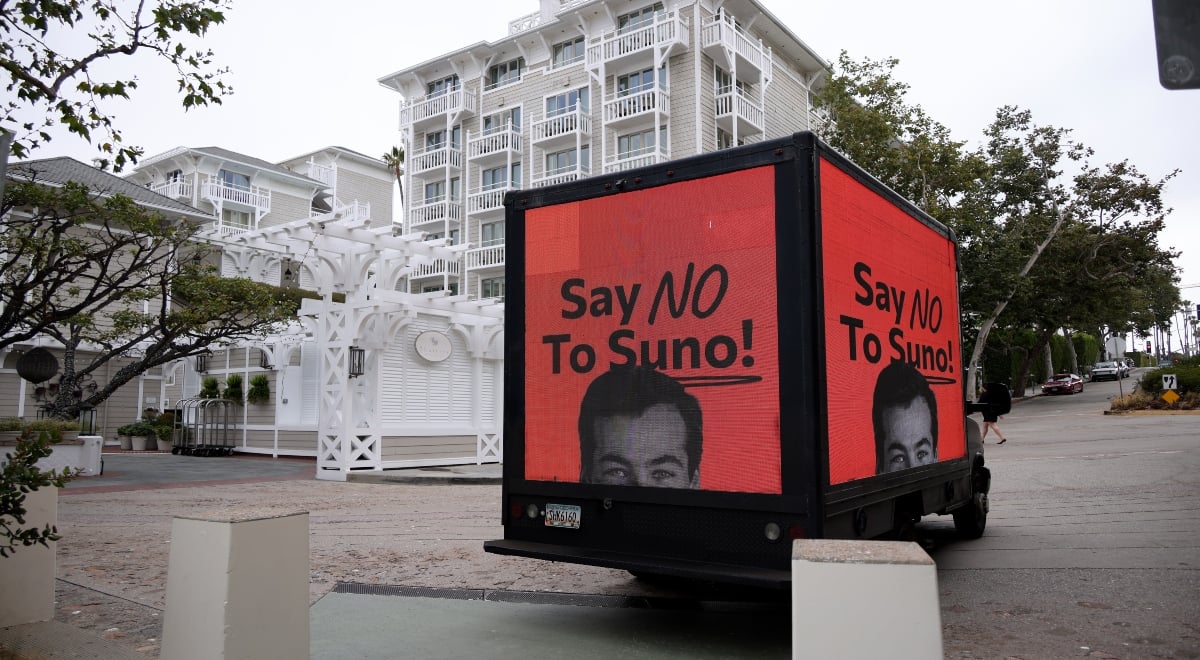
Protest against Suno in California. Photo by Anna Webber/Getty Images for Human Artistry Campaign

 Follow us
- The Munich Regional Court ruled Suno illegally trained its AI on GEMA-represented copyrighted songs.
- GEMA sued Suno after the company admitted using protected songs but refused to pay licensing fees.
- Suno must stop infringing activity, disclose profits, and pay damages to be decided later.
Key Takeaways by nexos.ai, reviewed by Cybernews staff.
The Munich Regional Court ruled that Suno unlawfully trained its AI model with copyright-protected songs from GEMA’s repertoire in the US.
In January 2025, GEMA, a German music organization that represents the rights of more than 100,000 musicians, sued Suno, a US company that can generate complete songs by simply entering text prompts.
GEMA argued that Suno had trained its AI model on copyrighted songs that were represented by the music organization without permission. On top of that, the AI-generated songs were stored and played in Europe during training.
Despite GEMA submitting a request for licensing, Suno didn’t respond. The generative AI music creation platform admitted that its AI had been trained on songs represented by GEMA and other companies in the music industry, but refused to pay licensing fees.






Suno claimed it didn’t have to pay licensing fees, arguing that using copyright-protected music to train AI was fair use.
The Munich Regional Court dismissed Suno’s arguments, thus ruling in favor of GEMA.
According to the court, Suno follows a profit-oriented business model by charging users for its premium version of its AI tool. Therefore, the company should have acquired permission to train its AI.
“Even under the American copyright law in force there, the providers should have acquired a license from GEMA and are not allowed to use the works of its members for free,” the court ruled.
Suno must cease its infringing activities, disclose its profits, and pay damages to be determined later.



Stay updated with our latest stories and follow us on social media
Be the first to discover new stories, ideas, and updates from our team.
“The court made it clear today: AI models based on intellectual property theft are not protected by the legal system. AI providers must acquire licenses and are not allowed to use the works of our members for free,” Tobias Holzmüller, CEO of GEMA, said in a statement.
Suno opposes the court´s ruling and is considering whether to appeal.
“We disagree with today’s ruling, which rests on a fundamental mischaracterization of how Suno’s technology works, how it is used, and how US law applies, and are evaluating all available options, including an appeal,” a company spokesperson told Music Business Worldwide.
Although the Munich Regional Court’s decision only applies in Germany, its ruling can be used in other lawsuits against AI music companies.
Suno has been involved in several major lawsuits from the record industry over the years, accusing the AI music generator platform of training its AI model with copyright-protected material.
Last year, Warner Music Group and Suno reached an agreement, allowing users to create AI-generated music from artists who opted in for the use of their names, images, likenesses, voices, and compositions.