Why travel eSIM is killing roaming: The hidden mobile connectivity revolution
Our in-house expert researchers and journalists conduct independent, unbiased testing of eSIM services, assessing their real-life effectiveness and usability.
By staying current with industry developments and openly sharing our transparent testing methodologies, we ensure readers receive accurate, up-to-date insights so they can make informed choices about eSIM solutions.
Learn more
Imagine you're coming back from a one-week trip to Spain, opening your carrier app, and suddenly seeing a $200 roaming bill, despite mostly using hotel Wi-Fi and checking Google Maps a few times. Over the past few decades, these roaming fees have been considered an inevitable part of travel.
Now, that model is starting to collapse. Recently, the eSIM revolution has been dismantling the traditional roaming system telecom carriers have relied upon since the 1990s. Instead of paying inflated roaming fees through outdated inter-carrier agreements, travelers can now activate affordable local or regional mobile plans digitally, often within minutes. Travel eSIMs are exposing just how inefficient and unprofitable the traditional roaming model has been for telecom carriers for decades. And increasingly, travelers are choosing not to play by those rules anymore.
This article explores why the international roaming model is starting to crack, how eSIM platforms are accelerating that disruption, and why forward-thinking travelers are already abandoning traditional carrier roaming for something far more flexible, transparent, and global.
The roaming racket – how traditional carriers have overcharged travelers for 30 years
Traditional international roaming works through inter-carrier agreements that have remained largely unchanged since the 1990s. When you travel abroad, your home carrier pays a foreign network operator for access to its mobile infrastructure. That wholesale cost is then heavily marked up and passed on to the traveler.
The problem is not just the pricing; it is the lack of transparency around it. For years, travelers often had little visibility into how much data they were actually using or how quickly charges were accumulating. A few Google Maps searches, automatic app updates, or social media uploads could quietly generate hundreds of dollars in fees before the user realizes it. The so-called bill shock became a defining feature of international roaming driven by complex pricing structures, expensive daily passes, and delayed billing notifications that often left travelers unaware of costs until after the trip. It has complex pricing structures, expensive daily passes, and delayed billing notifications.
Eventually, the EU roaming regulations introduced strict roaming caps and later eliminated many roaming charges within the bloc altogether, effectively acknowledging that the traditional system had become exploitative for consumers.
Outside the EU, however, the old roaming model still largely remains in place. And that is exactly where travel eSIMs are starting to disrupt the industry.
What changed – the three forces killing the roaming model
The decline of traditional roaming is no longer just a consumer trend. It is becoming a structural shift in the global telecom industry. For decades, carriers controlled international connectivity through expensive roaming agreements, limited competition, and a lack of consumer alternatives.
That model is now starting to break down. A combination of technological change, growing pricing transparency, and the rise of digital-first connectivity platforms is rapidly weakening the foundations of the traditional roaming business. And unlike previous telecom trends, this shift appears increasingly irreversible. Here are the three major forces accelerating the collapse of the traditional roaming model:
Force 1 – eSIM hardware becomes universal
The removal of physical SIM trays from flagship smartphones has fundamentally changed mobile connectivity economics. When Apple introduced eSIM-only iPhones in the US market in 2022, choosing a mobile carrier stopped being a hardware decision and became a software one. eSIM adoption has also rapidly expanded across flagship Google Pixel and Samsung Galaxy devices, accelerating the shift toward fully digital mobile connectivity.
That shift matters enormously. Once travelers could switch providers digitally within minutes, paying inflated roaming markups for a single home carrier suddenly made less sense. According to GSMA Intelligence and industry forecasts, global eSIM connections are expected to surpass 1.5 billion in the coming years. This signals that eSIM is rapidly moving from an early-adopter feature to a mainstream mobile standard.
Force 2 – wholesale network access at consumer scale
Travel eSIM providers have built a structural advantage that traditional carriers struggle to compete with. Instead of relying on limited roaming partnerships, many eSIM platforms negotiate direct access to wholesale data rates from local Mobile Network Operators (MNOs) worldwide.
The difference is economic as much as technological. Traditional roaming deals were designed to protect carrier margins, while travel eSIM providers competed for large-scale consumer activations and for transparent pricing. That is why travelers often save 75–80% on mobile data costs abroad, not because eSIM data is unusually cheap, but because traditional roaming has remained extraordinarily overpriced for decades.
Force 3 – transparency destroys "bill shock"
Traditional roaming thrives on uncertainty. Travelers rarely knew how much data they were using, how much they were spending, or when their charges were escalating until their bill arrived.
Travel eSIMs have inverted that model entirely. A prepaid 10GB plan priced at $15 comes with a fixed limit and prepaid fixed pricing. Once the data runs out, the connection pauses instead of quietly accumulating hidden per-MB charges. In practical terms, bill shock is almost impossible. More importantly, travelers no longer have to actively fear using mobile data abroad, because for the first time, pricing is fully visible and controlled by the user rather than the carrier.
The numbers don't lie – the scale of the disruption
The economic gap between traditional roaming and travel eSIMs is no longer small enough for carriers to ignore. In many travel scenarios, users cut mobile data costs by 75–80% simply by switching away from traditional roaming plans. Travel eSIM platforms are quickly becoming one of the most popular roaming charge alternatives for international travelers.
Take a typical 7-day trip to Japan as an example. Using traditional roaming rates from major carriers, travelers could easily spend more than $150 on mobile data during the trip. A comparable travel eSIM plan with prepaid high-speed data can cost closer to $15–20.
This is no longer just a niche travel-tech trend. According to GSMA Intelligence and industry forecasts, global eSIM connections are expected to surpass 1.5 billion in the coming years as eSIM support becomes standard in smartphones, tablets, and other connected devices.
Even telecom companies themselves are starting to adapt. Many traditional carriers are now launching their own travel eSIM apps and digital roaming alternatives, a strong sign that the old roaming model is becoming harder to maintain in a market where users expect transparent pricing and instant connectivity.
Who the revolution benefits – and who it doesn't (yet)
The biggest winners of the eSIM revolution are frequent travelers who spent years treating roaming fees as an unavoidable travel tax. Digital nomads, business travelers, and international tourists with modern flagship smartphones can now switch networks in minutes and avoid many of the inflated costs tied to traditional roaming.
But disruption is not yet fully universal. Some travelers still face limitations in remote destinations where local carrier eSIM support remains underdeveloped. Budget Android devices also lag flagship phones in eSIM adoption, leaving some users locked into older physical SIM systems.
Still, these gaps seem to be temporary rather than structural. eSIM support is expanding rapidly across carriers, countries, and devices, far faster than most previous mobile technology shifts.
Yesim – the app at the center of the revolution
If the traditional roaming model is collapsing, travelers are naturally asking the next question in the travel eSIM vs. roaming debate: which platform is actually replacing it? Increasingly, Yesim is positioning itself as one of the strongest travel eSIM platforms for travelers looking to avoid traditional roaming fees altogether. Travelers searching for the best travel eSIM increasingly prioritize transparent pricing, instant activation, and global coverage. Here are the key features that make Yesim stand out in the growing travel eSIM market:
- SwitchLess technology across 800+ operators. While many travel eSIM providers connect users to a single local network, Yesim’s SwitchLess technology automatically selects the strongest available signal from 800+ partner operators worldwide. Instead of manually switching networks or getting stuck with weak coverage, the connection continuously optimizes itself in real time.
- 200+ destinations in a single app. Yesim offers coverage across 200+ destinations, including more countries than most travelers will visit in a lifetime. Everything is managed through a single app, removing the need for local SIM cards, airport kiosks, or separate regional providers.
- Built-in VPN for iOS users. Yesim is one of the few travel eSIM platforms that includes a free integrated VPN on iOS. Travelers get carrier-grade encryption for safer public Wi-Fi use and mobile connectivity in a single app.
- Virtual phone numbers (US, UK, Canada, and more). Yesim offers virtual phone numbers in regions including the US, UK, and Canada. For business travelers and digital nomads managing banking apps, work portals, or 2FA-enabled services abroad, this solves a real connectivity problem most travel eSIM providers still ignore.
- Flexible plans built around different travel styles. The pricing structure adapts to the traveler rather than forcing them into rigid carrier plans. Fixed-data packages work well for family holidays and predictable spending, while pay-as-you-go eSIM plans support long-term and multi-country travel.
- Ycoins loyalty rewards. Every Yesim purchase earns Ycoins cashback rewards that can be used toward future purchases. Traditional roaming only penalizes usage with higher fees; Yesim turns connectivity into something frequent travelers actually benefit from over time.
The roaming revolution is already underway. With Yesim, travelers can download the app, activate an eSIM in under 60 seconds, and take their next trip without worrying about roaming fees again.
How to make the switch – your 3-step roaming escape plan
Switching away from traditional roaming no longer requires carrier stores, physical SIM cards, or complicated setup processes. In practice, the entire transition takes less time than it does to connect to airport Wi-Fi. Here are the steps to take before activating a travel eSIM:
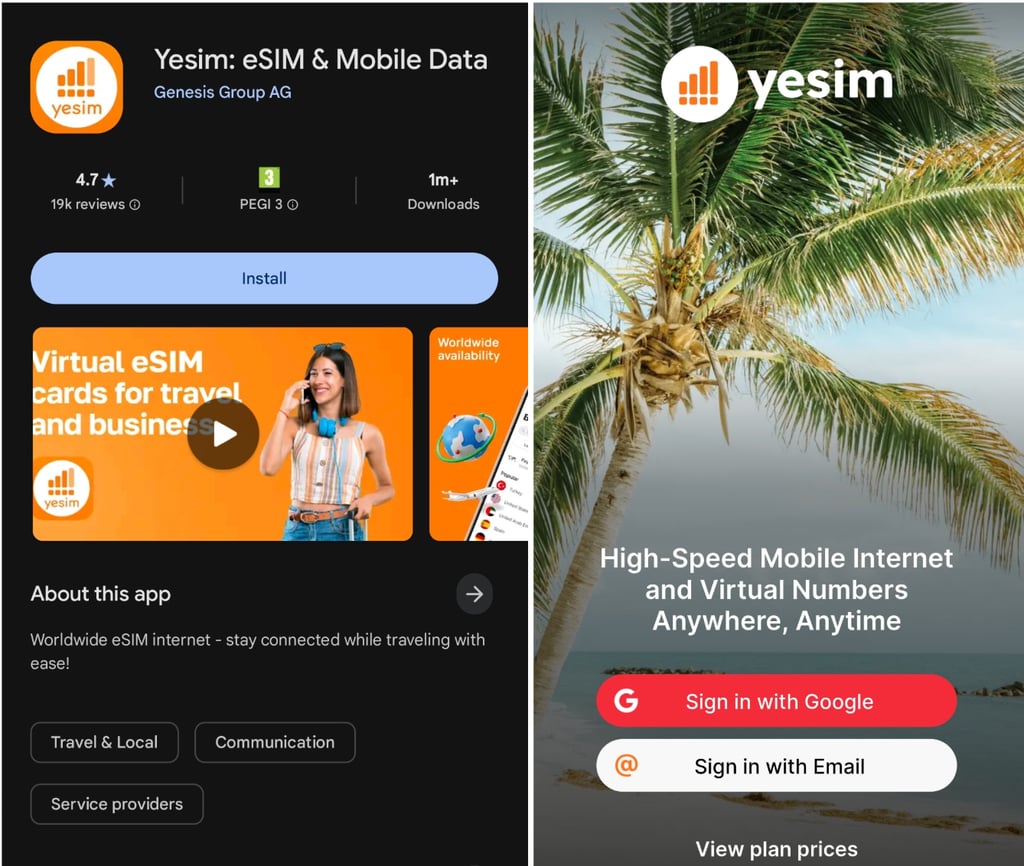
1. Download the Yesim App before your trip
Install the Yesim App on your iPhone or Android while still connected to your home Wi-Fi. Sign up and follow the app prompts to set up and activate your eSIM before departure, helping you avoid connectivity issues and unnecessary stress after landing.
2. Choose your plan type
Select a fixed-data country plan for a single destination or a pay-as-you-go global plan for multi-country travel. The eSIM profile activates digitally through a QR code and typically takes less than 60 seconds to set up.
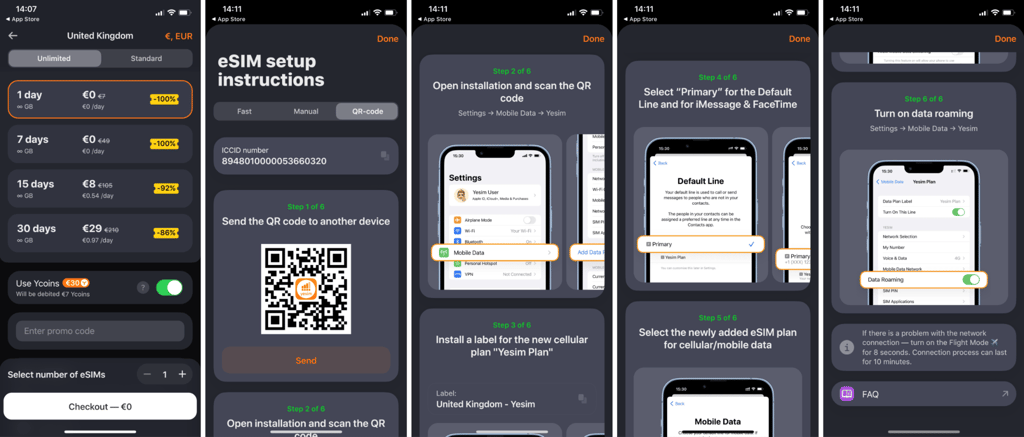
3. Turn on Airplane Mode when you land, then switch to your Yesim eSIM
Turn on Airplane Mode after landing to prevent your home carrier from triggering roaming charges automatically. Then activate your Yesim eSIM and connect to local mobile networks immediately without paying traditional roaming fees.
The future of roaming and why it's already here
The shift from travel eSIM vs. roaming is no longer a prediction for the future; it is already reshaping global mobile connectivity. Within the next few years, international roaming fees in 2026 may soon feel as outdated as paying per minute for long-distance calls. The younger generation may not understand why people once accepted spending hundreds of dollars on mobile data in foreign countries.
The eSIM revolution is accelerating faster than many telecom operators anticipated. Even major carriers are now launching their own travel eSIM apps and roaming-charge alternatives, which is a clear sign that eSIM disrupting telecom is no longer a niche trend but one of the biggest telecom disruption shifts in consumer connectivity.
For travelers, the transition is becoming increasingly obvious. Instead of expensive roaming packages, users now expect instant activation, transparent pricing, and global coverage directly from their phones. The best travel eSIM platforms are not just helping travelers save money; they are fundamentally changing how people stay connected internationally.
And unlike many technology shifts, the roaming revolution is already available today. With Yesim, travelers can kill roaming charges with a single app download and stay connected across 200+ destinations.
FAQ
Why is international roaming so expensive?
International roaming is expensive because mobile carriers add significant markups to fees from foreign partner networks. Traditional roaming relies on inter-carrier wholesale agreements between your home carrier and foreign networks, with additional costs added throughout the process before the final bill reaches the traveler. Most travel eSIM providers bypass this system by accessing local wholesale network rates directly. Travel eSIMs also largely eliminate bill shock through fixed pricing and prepaid data plans.
How much can I save with a travel eSIM vs. roaming?
Travelers can save 75–80% by using a travel eSIM instead of traditional international roaming. In many cases, a 10GB mobile data plan that could cost more than $150 through standard roaming fees is available for under $20 with a travel eSIM provider. Travel eSIMs are now one of the fastest-growing roaming charge alternatives globally.
Is travel eSIM data as fast as regular roaming?
Yes, travel eSIM data can be just as fast as traditional roaming because it uses the same local carrier infrastructure. Travel eSIM providers connect users directly to local mobile networks, often without the additional roaming layers provided by home carriers. Platforms like
Yesim
also use SwitchLess technology to automatically select the strongest available signal across 800+ operators worldwide.
Can I use a travel eSIM and keep my home number active?
Yes, you can use a travel eSIM while keeping your home number active on most dual-SIM compatible devices. This allows you to use your home SIM for calls and texts while using a travel eSIM like Yesim for mobile data abroad. You can also enable Wi-Fi calling on your primary number to avoid traditional roaming call charges.
Is eSIM available in most countries?
Yes, eSIM coverage is now available in most major travel and business destinations worldwide. Travel eSIM support continues to expand rapidly as more carriers and smartphones adopt the technology. Platforms like Yesim already offer coverage across 200+ destinations globally, including most countries travelers visit regularly.