Vivint vs. Xfinity home security: which system is worth your money in 2026?
Being behind major reports like The Mother of All Breaches and RockYou2024, our in-house cybersecurity experts and journalists provide unbiased, real-world testing and in-depth analysis.
We maintain complete transparency by openly sharing our testing methodologies with our audience.
Learn more

Equipping your home with a security system is a good idea to protect yourself and your assets against potential break-ins and other threats. Yet, with so many options on the market, deciding on a particular system can be challenging.
If you’ve already done at least a little bit of research, you likely already know of Vivint and Xfinity, two of the most well-known names in home security. While both offer excellent home protection and a wide range of equipment, these providers cater to different types of users.
To determine which home security system is best, I’ve teamed up with the Cybernews research team to compare these two systems. I dug into every important detail, from installation and equipment to monitoring, features, and pricing, to figure out which one actually gives you more for your money. Below are our findings.
Vivint vs. Xfinity home security overview
| Home security system | Vivint | Xfinity |
| Rating | 4.8/5 ⭐ | 4.5/5 ⭐ |
| Installation type | Professional | Professional and DIY |
| Monitoring options | Professional | Professional and DIY |
| Wired or wireless | Wireless | Wireless |
| Camera options | Outdoor Camera Pro (Gen 2) with Smart Deter, Doorbell Camera Pro, Indoor Camera Pro, and Spotlight Pro | Indoor Camera, Indoor/Outdoor Camera, Video Doorbell |
| Motion sensor | Yes ✅ | Yes ✅ |
| Smart locks | Yes ✅ | Yes ✅ |
| Smoke detector | Yes ✅ | Yes ✅ |
| Mobile app | Yes ✅ | Yes ✅ |
| Price | Packages starting at $599.99 | Packages starting at $360 |
| Subscription cost | Starting at $29.99/month | Starting at $10/month |

Vivint pros and cons
Xfinity pros and cons



Our team combines security industry experts and consumer protection specialists who thoroughly analyze home security systems and services. Our transparent research process includes a systematic evaluation of features, costs, and real-world performance. We maintain independence from manufacturers while staying current with industry developments. Read our full methodology to learn more about our review and testing process.
Our methodology
Before we jump into the comparison, let’s take a moment to see how the team and I evaluated these home security systems. Namely, we focused on creating an honest, data-driven review based on several key aspects. Here are the ones we looked into and how we scored them:
- Features, technology, and pricing (40%). Our evaluation began with a comprehensive analysis of both systems. We pitted Vivint and Xfinity against each other and compared them in terms of equipment, smart features, and costs.
- Customer feedback (30%). To maintain impartiality, we examined hundreds of genuine user reviews on platforms such as Trustpilot, Quora, and Reddit. This gave us plenty of insight into how real users felt about both Vivint and Xfinity.
- Expert analysis (20%). We then examined each provider’s industry certifications, compliance with data privacy laws, and adherence to relevant standards. We even looked into how well these companies adopt the latest technological trends.
- Ease of use (10%). Last but not least, we assessed how easy each system was to use, from initial setup to monitoring and app control. The quality of the provider’s customer support was also a factor here.
Vivint vs Xfinity home security: installation and fees
First and foremost, your choice between Vivint and Xfinity will depend on the type of installation you want.

On the one hand, Vivint requires professional installation. However, that’s not something you’ll need to pay extra for, as it’s included in your smart home package. You also get free equipment replacement for the first year, but the packages start at $599.99, which is on the pricier side.

On the other hand, Xfinity caters to both DIY enthusiasts and those who prefer a white-glove approach. If you opt to install the system yourself, you can expect to pay at least $360 for the equipment. However, professional installation does bump up the price by $100.

Although Vivint’s professional installation comes free of charge, I do appreciate the fact that Xfinity offers both options.
Vivint vs Xfinity home security: features and technology
Compare Xfinity home security vs Vivint in terms of features, and it’s a close call. Both are among the top systems, as both provide reliable wireless equipment, cellular connectivity, and battery backups. However, there are a few differences you should be aware of.

All Xfinity home security systems come with a touchscreen controller, at least three door/window sensors, and one motion sensor. Batteries and cellular system backups are standard across the board. Meanwhile, the Xfinity Home app offers intuitive controls and lets you stay connected to your home even when you’re on the go.

Vivint goes a step further and is widely praised for its modern, state-of-the-art equipment. For example, its proprietary cameras offer wide viewing angles, 4K recording capabilities, and impressive zoom. Vivint’s Doorbell Camera Pro is also equipped with two-way communication and features a Smart Deter option, which can help ward off unwanted visitors.
Pair that with the Vivint smart hub control panel, pet-friendly motion sensor, and a variety of smart home integrations, and you get one seriously robust system.
Vivint’s proprietary pieces, although a bit pricey, offer impressive features. That’s why in the Xfinity home vs Vivint battle, Vivint wins this round.
Vivint vs Xfinity home security: monitoring plans and pricing
Another element that’ll help you decide is the type of monitoring you want, but things are a bit more complicated here than you’d expect.

Xfinity offers both professional and self-monitoring options, with professional monitoring starting at $45/month. There’s no contract required here as long as you purchase the equipment outright. However, opting for self-monitoring doesn’t eliminate all monthly costs. Even if you go the contract-free route, the Xfinity security system costs at least $10/month.
On the other hand, Vivint takes a professional-only approach, with a monthly fee starting at $29.99. But choosing Vivint means access to the brand’s two award-winning, state-of-the-art monitoring centers, located in Provo, Utah, and Eagan, Minnesota, which provides more peace of mind for the price.
Much like Xfinity, Vivint lets you pay on a month-to-month basis if you buy the equipment outright. Here, the basic package starts at $599.99, which is on the pricier side.
The fact that Xfinity imposes a monthly fee even with self-monitoring doesn’t sit right with me. Thus, I’m crowning Vivint as the winner of this round in the Xfinity vs Vivint showdown, as its professional monitoring option is more affordable.
Vivint vs Xfinity home security: smart home features
Monitoring your home with standard sensors and cameras is one thing, but it’s the ability to seamlessly integrate with your smart home devices that differentiates these brands from competitors.
As a subsidiary of Comcast, Xfinity has a long list of partnerships with other smart home brands, including LIFX, Philips Hue smart lights, August Smart Locks, Kwikset, and Chamberlain MyQ. It also works with a TV service called X1, whose voice remote is particularly effective for controlling your security system and any smart products connected to it.
And if you prefer to use your phone instead of a remote, the Xfinity Home app is a breeze to work with. Its clean design and easy-to-navigate interface make setting up integrations and controlling the Xfinity system effortless.

Vivint is also extremely smart-home-friendly, offering voice-command integrations with Google Assistant and Alexa. You can easily arm and disarm your system, lock and unlock main and garage doors, and control temperature and lighting with just your voice.
All of this is available within the intuitive Vivint app, too, which also allows you to set schedules, view camera footage, receive instant alerts, and control the entire system with just a few taps.

Both brands excel in terms of smart home integrations. However, Vivint does voice-command integrations remarkably well and offers impressive flexibility for advanced home automation setups, so it comes out ahead here.
Vivint vs Xfinity home security: customer service
As the whole point of equipping your home with a security system is to prepare for the worst, the responsiveness and quality of the brand’s customer service matter. They’re also crucial if you encounter issues with equipment, monitoring, or any other system-related problems.

Vivint is well-known for its professional customer service. Support is available 24/7 via phone and live chat, with wait times being relatively low. As a result, most Vivint customers are pleased with the company’s customer service and often praise it in the comments.
Unfortunately, users don’t share the same sentiment about Xfinity, and the company isn’t exactly known for the quality of its customer service. As a Comcast subsidiary, most Comcast home security reviews note that the brand’s support is often unresponsive. It also primarily relies on the Xfinity Assistant, which most users find unhelpful.
Xfinity is also widely known for its tendency to make breaking contracts difficult. All in all, there’s a significant number of customer service complaints here, so the provider could undoubtedly benefit from some improvements in this area.
In terms of customer service, Vivint wins the Xfinity home security vs Vivint showdown by a mile. Its customer support team is fast, knowledgeable, and readily available to assist you with any issues or queries you might have.
Vivint vs Xfinity home security: user reviews
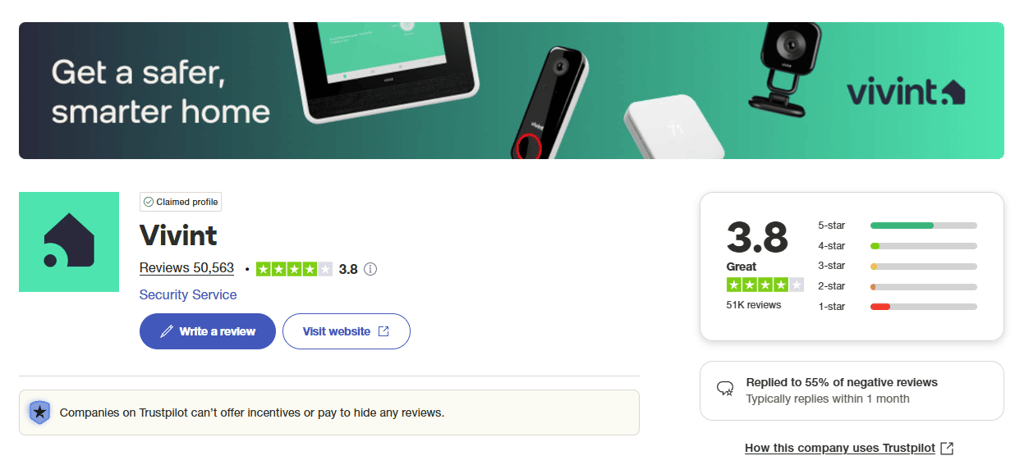
Vivint enjoys an excellent reputation across the board. User feedback on Trustpilot and Reddit is mainly positive, with Vivint products and technicians receiving high praise. A handful of negative comments are also present, and they’re often related to Vivint’s pushy sales representatives.
On the other hand, Xfinity’s rating is significantly lower on these review platforms. However, it’s difficult to conclude whether this is due to Xfinity being a subsidiary of the somewhat notorious Comcast or directly associated with Xfinity’s equipment, monitoring, and pricing. What is known, though, is that the negative feedback is most often related to poor customer service.
While a large majority of Xfinity security reviews were negative, there is, however, a sliver of praise in the comment section. Most of these mention the ability to go contract-free and save money with Xfinity’s security bundles as a significant advantage.
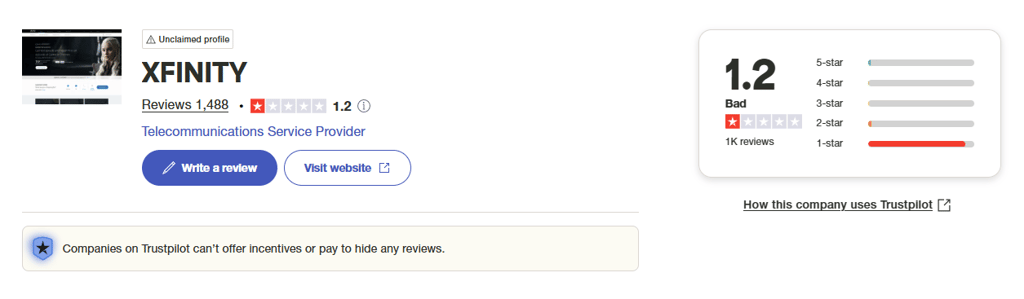
According to most Xfinity home security reviews, users are disappointed with both Comcast as a company and Xfinity as its subsidiary. Even if some customers are satisfied with their Xfinity system and pricing, the sheer volume of negative comments about the company gives Vivint a significant advantage.
Vivint vs Xfinity home security: final verdict
All things considered, Vivint is the better overall choice. Yes, its equipment is on the pricier side. And yes, Vivint only offers professional installation and monitoring. However, it’s also a feature-packed system that includes high-quality cameras, excellent sensors, numerous accessories, environmental monitoring, an intuitive app, and seamless smart home integrations.
Pair that with responsive and professional customer service and overwhelmingly positive user feedback across the board, and it’s immediately clear why it wins the Vivint vs Xfinity face-off.
That said, Xfinity can also be a solid option if you don’t mind its limited service area, Xfinity internet requirements, and low-rated customer service. Take these out of the equation, and Xfinity’s flexibility in terms of installation and monitoring, lower monthly fees for self-monitoring plans, and more affordable systems overall make it an excellent choice for existing Xfinity users.
FAQ
Is Xfinity home security good for renters?
Yes, Xfinity is an excellent option if you don’t own the property you’re protecting. It doesn’t require a contract, so you’re free to cancel the subscription if you move. Vivint is just as good if you buy the equipment outright and go contract-free, but there is a $129 moving fee.
Does Vivint require a long-term contract?
No, Vivint doesn’t necessarily require a contract. For users who purchase the equipment outright, Vivint is available on a month-to-month payment basis. However, if you opt to finance your home security system with Vivint, you will have to sign a 42- or 60-month contract.
Can I integrate Xfinity security with existing smart home devices?
Yes, but to an extent. As a subsidiary of the giant Comcast, Xfinity works with various third-party smart devices, such as Philips Hue, August Smart Locks, and Kwikset. Nonetheless, if you already have a couple of smart home devices, you should still check Xfinity’s compatibility list before committing.
Which system, Xfinity or Vivint, offers the best value overall?
Vivint offers the best value if you're looking for a future-proof security system with more advanced features, better smart home integrations, and broader availability. That said, if you're on a tight budget, Xfinity might be the more affordable option, as long as you keep in mind its limitations in coverage and equipment variety.