IONOS review 2026: $1.00/month hosting that’s actually reliable
Our in-house experts conduct internal independent, hands-on testing and transparent reviews of web hosting providers by using custom-built tools or utilizing industry-recognized tools and methods to ensure impartial and evidence-based assessments.
Using the same criteria for all services, we share our detailed methodologies and practices to help customers make informed hosting decisions.
Learn more
IONOS, formerly known as 1&1, might seem almost too good to be true, with its hosting plans starting at just $1.00/month. I started testing IONOS by subscribing to its shared hosting plan Plus, which is its best-selling option. Using our official web hosting testing method, our research team and I evaluated every key aspect of the service to provide an accurate, hands-on review.
In this IONOS review, I cover performance under real-world conditions, ease of use, security features, support quality, and overall value for money. Hopefully, it will give you a complete picture of what you can expect from this budget-friendly host.
IONOS review 2026: my verdict
Overall, I liked IONOS for its perfect blend of affordable pricing, strong performance, and ease of use. I find it best for beginners, small business owners, and anyone looking for simple and affordable hosting. On the downside, IONOS isn’t the fastest under heavy load, so anyone running high-traffic or resource-intensive sites should avoid it. Its value shines for everyday websites but not for performance-hungry projects.
| ⭐ Rating: | |
| 💵 Price: | From $1.00/month |
| 📑 Uptime guarantee: | 99.99% |
| ⚙️ Hosting types: | Shared, WordPress, Windows, VPS, dedicated |
| 🌎 Server locations: | The US, the UK, Germany, France, and Spain |
| 👨💻 24/7 live support: | Yes |
| 🔥 Coupons: | - |
IONOS pros and cons
Not sure if IONOS is good for you?
Answer 3 quick questions and we'll help you find a hosting provider that matches your needs.


Find web hosting match
Three simple questions. We’ll point you the right pick. No email, no sign up.
What type of website are you building?
What matters most to you?
How experienced are you with web hosting?
Best web hosting pick for you

Hostinger
Launch your site quickly with beginner-friendly tools, strong performance, and easy management. A solid choice for business websites and online stores that need speed without extra complexity.
Best web hosting pick for you

WordPress.com
Build and manage your WordPress site without worrying about much of the technical setup. You get a streamlined platform for publishing, updating, and growing your WordPress site from one place.
Best web hosting pick for you

IONOS
A strong choice if you want hosting at a very low starting price. It gives users plenty of flexibility while still keeping the core setup relatively straightforward.




Our in-house research team and expert writers work hand in hand to regularly test hosting services and provide accurate and fact-checked information. Discover the ins and outs of how we test and evaluate website hosting providers.
IONOS pricing and plans – 4.9/5
IONOS stands out with some of the lowest prices on the hosting market – you get shared hosting from $1.00/month, making it significantly cheaper than other quality providers like Hostinger ($2.24/month) or Bluehost ($1.99/month). On top of that, IONOS also offers a wide range of hosting solutions, including shared, VPS (virtual private server), WordPress, dedicated, and cloud hosting. Here are the main types of hosting offered by IONOS and their price range:
| Plan | Starting price | Best for |
| Shared hosting | From $1.00/month | Basic websites for portfolios, blogs, passion projects, and small businesses |
| VPS hosting | From $2.00/month | More advanced users who want better resources, control, and performance |
| Dedicated hosting | From $41.00/month | High-traffic websites, organizations, online stores, and advanced users |
| eCommerce hosting (WooCommerce) | From $16.00/month | Small online stores using WooCommerce |
| Website builder hosting | From $1.00/month | Beginners building a website without coding skills |
All shared hosting plans, including Essential, Starter, Plus, and Ultimate, come with a free domain for the first year, a free Wildcard SSL certificate, professional email, unmetered bandwidth, one-click installs, and daily backups, and every plan also includes a 30-day money-back guarantee so you can try the service without any risk.
IONOS offers one of the cheapest starting prices on the market. You can get a shared hosting plan for as low as $1.00/month. Considering IONOS’ reliable performance, it’s a great value provider if you’re looking for a basic hosting solution.
IONOS ease of use – 4.5/5
I tested IONOS by managing domains, emails, and websites using its custom control panel. From my personal experience, the interface is intuitive and well organized. Built-in security and performance tools are also easily accessible. While it doesn’t use the traditional cPanel, the learning curve is minimal, even for beginners.
Everyday tasks like setting up email accounts, installing apps, and monitoring site performance are straightforward. Although it’s not as simple as Wix or Squarespace, which have drag-and-drop options, it’s still impressively user-friendly and efficient for a full-featured web host.
IONOS purchase process
Purchasing a plan was straightforward but packed with upsells. I selected the shared hosting plan Plus and went through a step-by-step checkout process. The interface clearly displayed pricing, billing cycles, and included features, which made the initial selection easy.
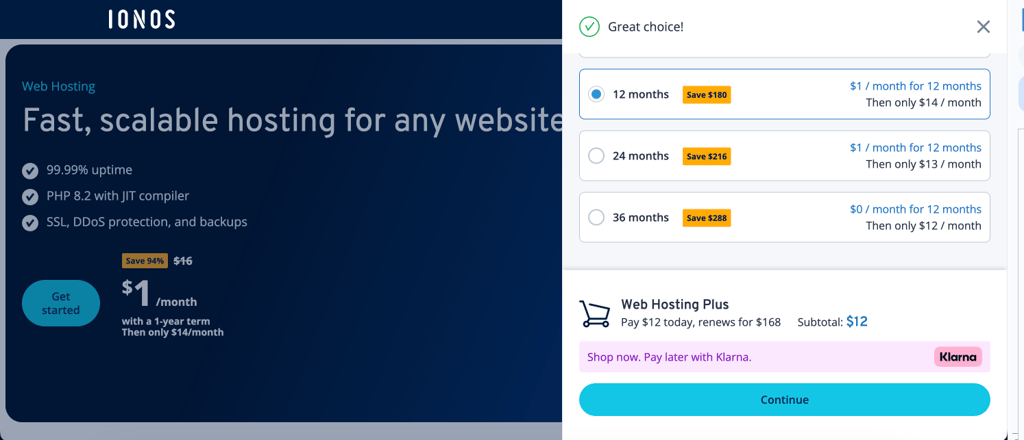
However, I noticed several aggressive upsells along the way, including options for site backups, extra security tools, and premium support, all pre-checked by default. It was easy to uncheck them if you don’t need them, but beginners might accidentally add extras and increase the total cost.
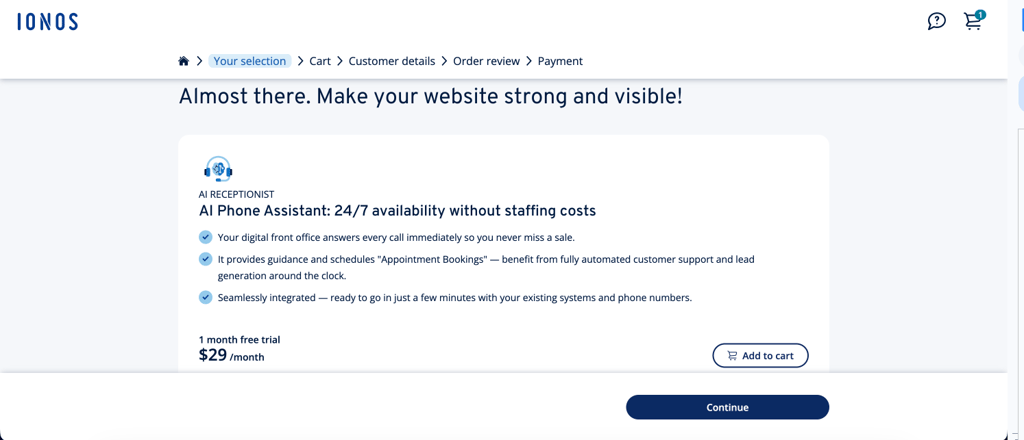
Payment options were standard, including credit card and PayPal, and the confirmation process was quick. In short, the process is simple and transparent, but users should carefully review each step to avoid paying for unnecessary add-ons.
IONOS web hosting setup process
The IONOS hosting setup process is quite simple for new customers and involves just a few steps. However, it can get more complicated if you want to transfer an existing WordPress site. Here’s what the IONOS setup looked like:
- After purchasing my plan, I signed into the IONOS control panel, which has seen noticeable improvements. Most tools are easy to find, and navigating between hosting, domains, and website projects became intuitive after a short adjustment.
-
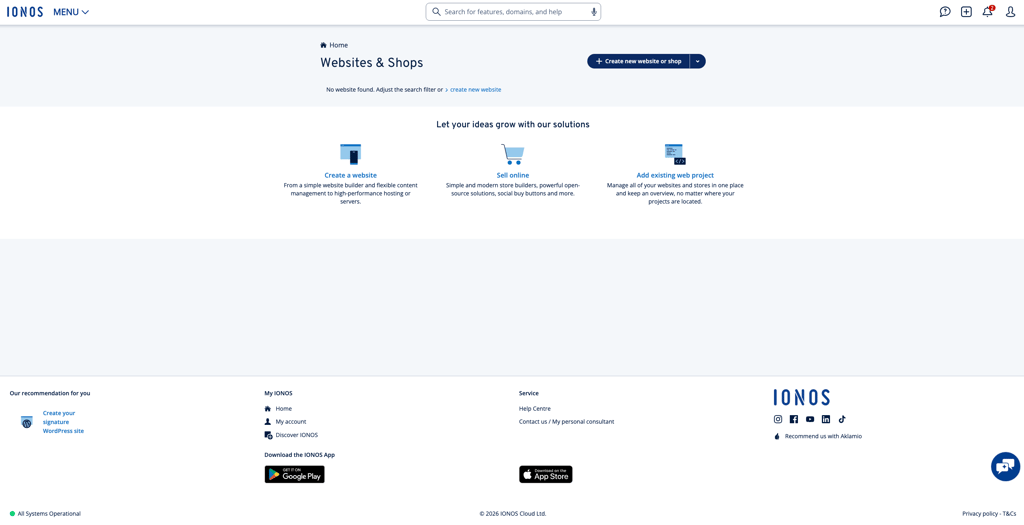
In the Websites & Stores section, I clicked Create new website. I chose WordPress, and the guided installation handled the database setup and basic configurations automatically. You can also upload your own files or link external projects if needed.
-
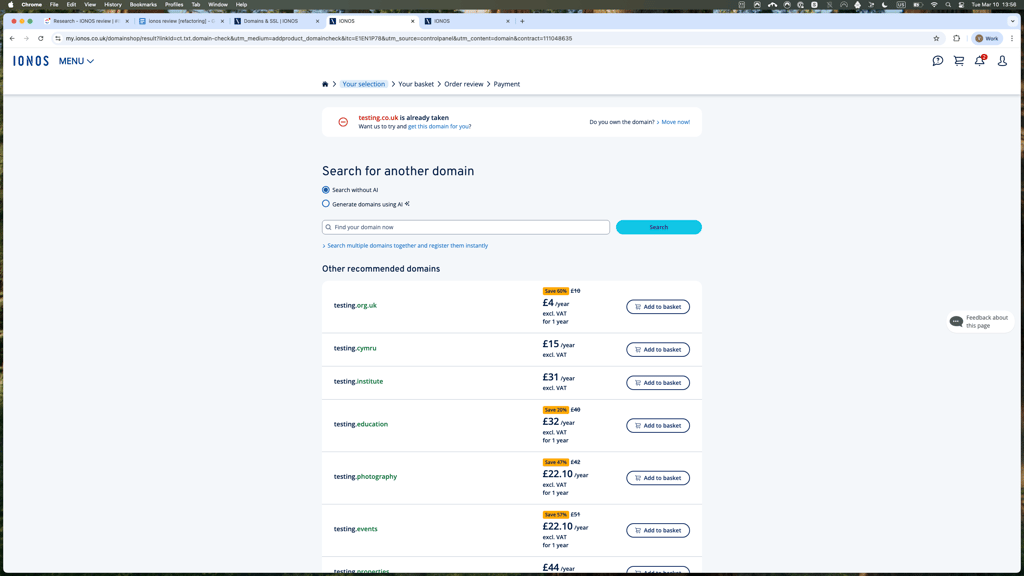
For new domains, IONOS automatically links them to the hosting plan. If you already own a domain, you don’t need to transfer it – simply point its DNS records to IONOS in the Domains & SSL section, and your site is ready to use.
-
IONOS provides a free Wildcard SSL. While it mostly activates automatically, I double-checked the SSL status in the control panel and enabled HTTPS to secure the site fully.
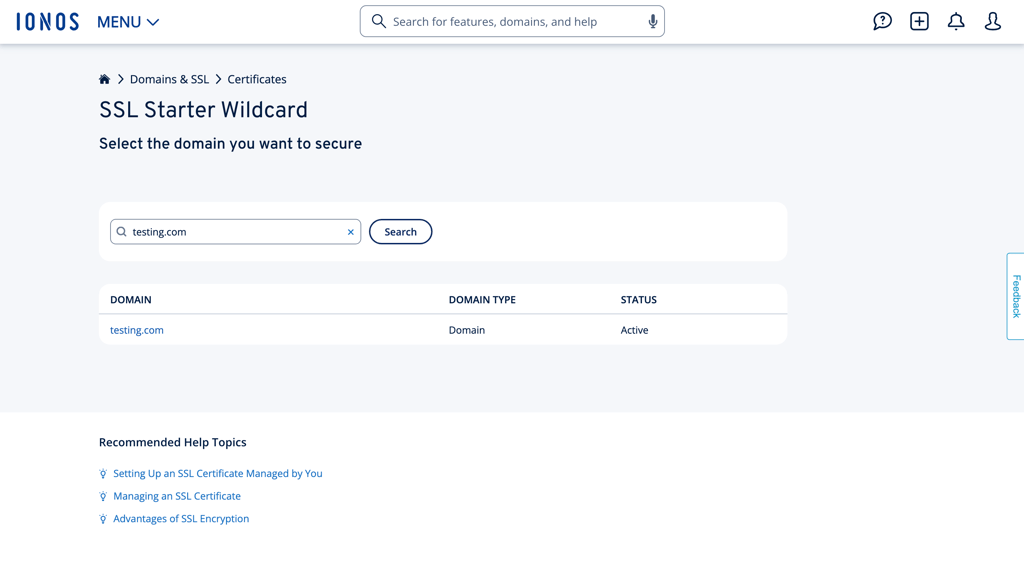
- All IONOS plans include a website builder, so once your domain and hosting are ready, you can start building immediately. We have a separate IONOS builder review if you’d like to take a look.
Overall, the setup process is quick and functional, though some menus feel slightly cluttered compared to more simplified platforms.
Website migration
For website migration, things can still get tricky, especially with WordPress sites, but it’s less complicated than it was back in 2024. IONOS now offers an automated migration tool that simplifies the process significantly. While it’s not entirely hands-off, the tool takes care of most of the heavy lifting, including securely transferring themes, plugins, and databases. Here’s how the migration process usually looks:
- After logging into the control panel, I checked the available migration options. For WordPress sites, IONOS recommends using a migration plugin or manual transfer, since automatic migration tools aren’t always included with basic plans.
- Before starting the migration, I backed up my existing website files and database. This step is important to prevent data loss and ensure you can restore the site if anything goes wrong during the transfer.
-
I connected to the IONOS server using FTP and uploaded my website files to the hosting directory. At the same time, I imported the website’s database through the phpMyAdmin tool available in the control panel.
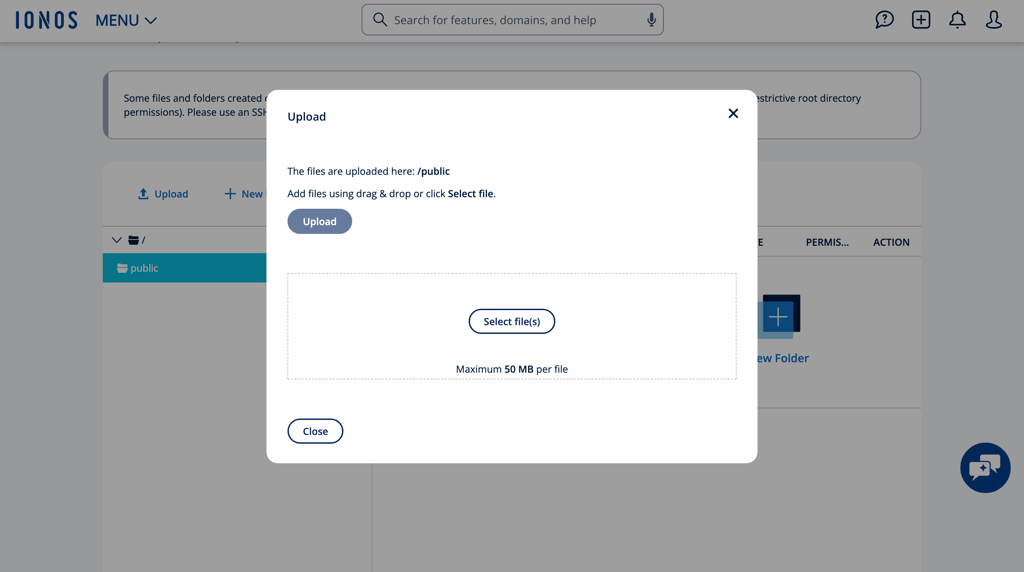
- Once the files and database were in place, I pointed my domain’s DNS records to IONOS. This step links the migrated website to the new hosting environment.
- After the DNS changes propagated, I tested the website to confirm everything loaded correctly.
Overall, the setup was manageable, though if you’re moving a complex site, you might still need to do some manual tweaks or use WordPress plugins. The control panel takes a short adjustment period, but managing hosting, domains, and email quickly felt efficient.
IONOS control panel
When I used the My IONOS control panel, the first thing I noticed is how clean and organized the dashboard is compared to previous iterations. The interface is tile-based, with everything grouped into big, clearly labeled sections that make it reasonably easy to find what I need.
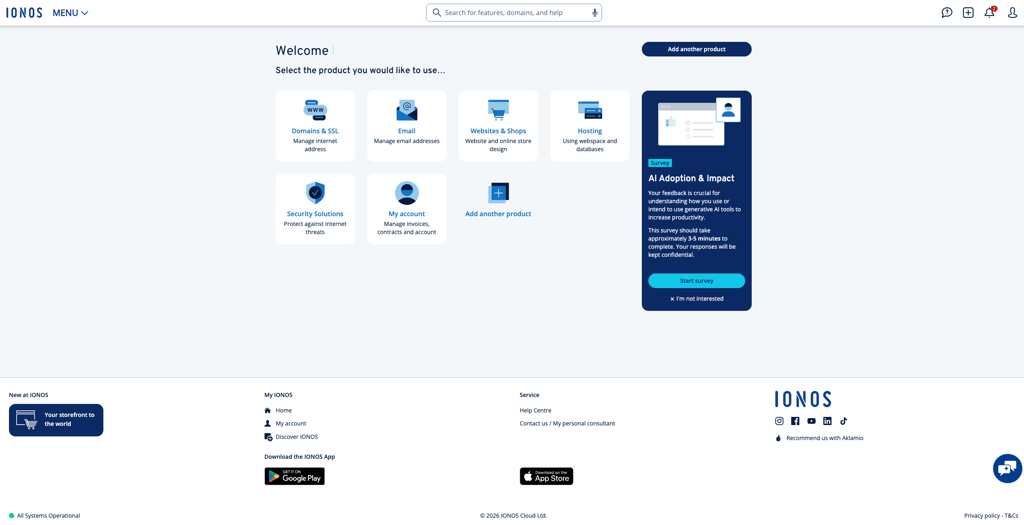
Here’s what I found in the control panel:
- Domains & SSL – where I could manage my internet addresses and security certificates
- Email – for managing all my email addresses linked to my domain
- Websites & Shops – this is where I could handle my websites and online stores
- Servers & Cloud – used for setting up and managing servers
- Online Marketing – tools aimed at winning and retaining customers
- Security Solutions – to protect my website from internet threats
- My account – where I can manage invoices, contracts, and account details
- Add another product – a quick way to buy or subscribe to more services
What I really like is how the large tiles and built-in search bar make navigation quick and intuitive. The Website Health Check tool is also useful – it scans your website for potential issues like missing SSL, security risks, SEO gaps, or performance problems and suggests fixes directly from the dashboard. The Add another product button is also easy to spot whenever you need extra services.
What I didn’t like is that the dashboard still mixes management tools with promotional suggestions, such as recommended upgrades or additional services. While not overly intrusive, these suggestions can slightly distract you from the main management tasks.
To improve the experience, I’d like to see less promotional content and more customization options, such as the ability to pin frequently used actions or create shortcuts for common tasks.
Overall, the IONOS control panel is clean, beginner-friendly, and functional, though a bit more flexibility and fewer promotional elements would make it even better.
IONOS for WordPress websites
My experience with WordPress on IONOS has been pretty standard. The setup is quick, thanks to the one-click installer. WordPress core, themes, plugins, and PHP are updated automatically, which saves time and keeps things running smoothly without requiring constant monitoring.
IONOS also includes daily malware and vulnerability scans, DDoS protection, daily backups, and SSD storage by default. These are the essentials I expect from any host offering WordPress plans, and thankfully, IONOS delivers them well without requiring much effort on my part.
After the initial one-click setup, the AI WordPress Website Builder and the AI Assistant help shape the site by generating layouts, pages, text, and images. Meanwhile, the WordPress Website Cockpit keeps everything organized, displaying updates, backups, and basic security information in one place, making site management simple.

Overall, IONOS gives the core WordPress features I need in 2026. Installation is quick, updates happen automatically, daily scans and backups run in the background, and the tools for building and customizing a site are easy to work with. It can feel limited for larger or more complex projects, but for a typical site or small business website, it covers the essentials without much effort.
IONOS email hosting
IONOS includes its own email service with all hosting plans, providing a simple way to create custom email addresses once a domain is registered with them. Setting up a mailbox is quick, and the control panel makes it easy to manage addresses, passwords, and basic settings.

Storage starts at 2GB/mailbox and can be upgraded if needed. IONOS also offers optional features like an AI Email Assistant for webmail, which helps with writing and organizing messages, though it’s only available as a paid add-on after a short trial.
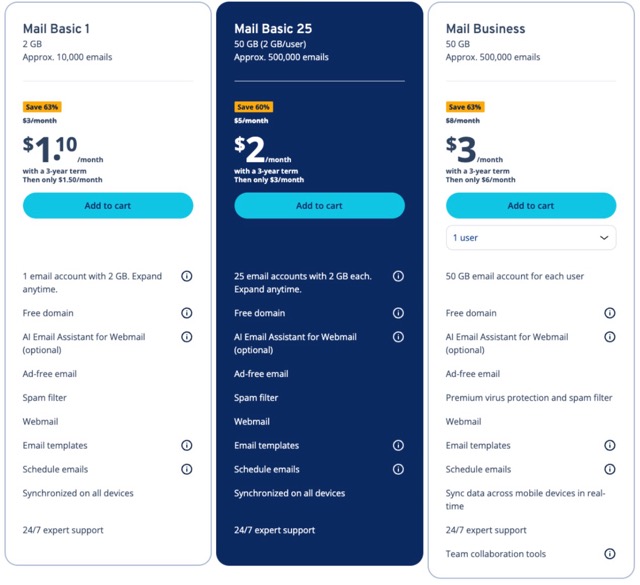
Overall, IONOS’ native email service is reliable for everyday use. It covers the basics well, works without complications, and suits small businesses or personal projects that only require simple branded email addresses, without relying on other providers.
IONOS is easy to use thanks to its intuitive custom control panel, which makes managing domains, emails, and websites straightforward. Both the setup and migration processes are fairly simple, and everyday tasks like installing apps or monitoring performance are easy to handle, even without cPanel.
IONOS performance – 4.4/5
IONOS performance is decent for the price, with strong uptime and generally steady day-to-day reliability. However, its speed has been inconsistent lately, and it struggles under heavier traffic, but it’s still fine for typical small to medium sites. For this review, I asked our research team to run a new round of tests to check uptime, response times, loading speed, and how well it handles traffic spikes.
IONOS server locations
IONOS offers multiple data centers in Europe and the United States. Here are the main locations:
- Frankfurt, Germany
- Berlin, Germany
- Paris, France
- London, UK
- Worcester, UK
- Logroño, Spain
- Las Vegas, Nevada, US
- Newark, New Jersey, US
- Lenexa, Kansas, US
IONOS data centers are spread across major cities in Germany, France, the UK, Spain, and the US. These facilities, both owned and partner-operated, support its cloud and hosting services globally.
IONOS uptime and response time
To evaluate IONOS’ reliability, our in-house research team tested its capabilities over a 2-week monitoring period using tools such as Grafana, webpagetest.org, and the k6 tool developed by Grafana Labs. They measured its uptime and server response time – meaning, how long the site stays up and running and how long it takes to respond to a user request.
For two weeks, the host maintained a stable 100% uptime with 99.9% reachability. That’s even higher than the provider’s uptime guarantee of 99.99%. It performed on par with competitors, such as Hostinger and Bluehost, which also reached an uptime of 100%.
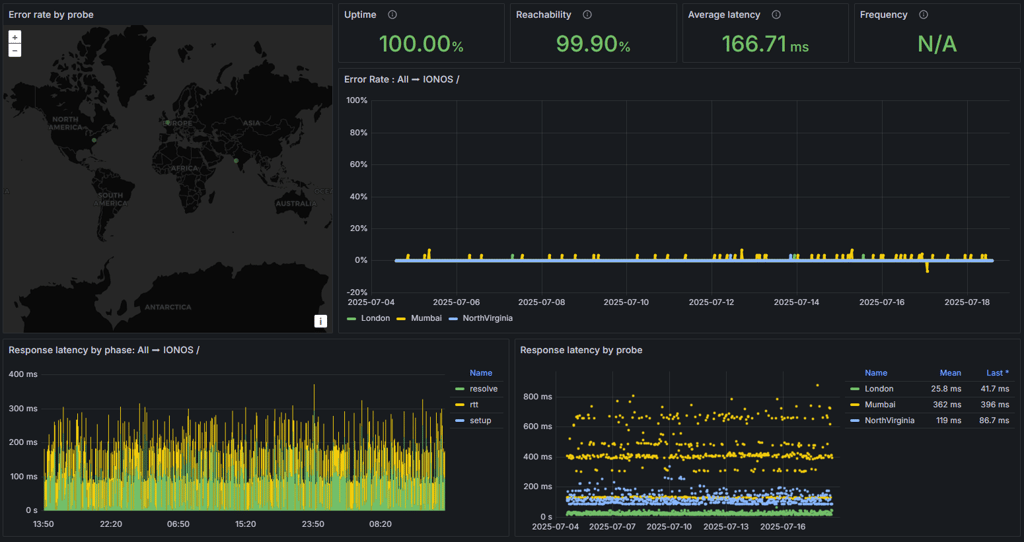
During our previous testing, IONOS had an 85% uptime result, so it has significantly improved. That said, maintaining 100% uptime all the time is virtually impossible, as a few minutes of downtime are inevitable for things like server maintenance in the long run.
As for the server response time, things have unfortunately taken a step backward. In our latest test, IONOS averaged 1749ms, which is a noticeable decline from the previous 181.48ms result. This places IONOS far behind faster providers like Hostinger and Bluehost, both of which consistently stay well under 200ms, and it’s also significantly slower than the general market average of around 600ms.
While the response times were disappointing, the 100% uptime result shows that IONOS can still deliver rock-solid reliability. Your site may not load as quickly as it should, but it will stay online consistently.
IONOS website speed
Next, our researchers tested the provider’s website speed on a fully built WordPress site. It did relatively well in this test with the Largest Contentful Paint (LCP). What you want here is to see an LCP below 2.5s, which is considered incredibly fast and good news for user experience.
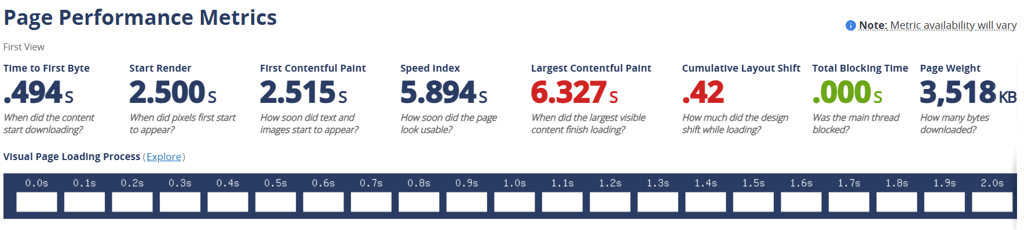
In this latest test, the LCP result from the Virginia, USA server came in at 6.327s, which is well above Google’s recommended 2.5s benchmark and outside the acceptable range of 2.5–4s. This means the page takes noticeably longer to load its main content than it should, especially for visitors in the US.
Compared to the previous 3.352s result, this jump is a significant slowdown. Instead of improving, IONOS’ real-world loading performance, unfortunately, has clearly gotten worse.
IONOS stress testing
Lastly, our researchers tested IONOS’ traffic-handling ability. To do so, they first sent 50 virtual users (VUs) to our test website. Ideally, you want a flat blue line (speed) as the gray line (number of visitors) heads up. Meanwhile, the red line (failure) shouldn’t be there. Regrettably, both the 50VU and 30VU tests led to severe slowdowns, with P95 response times hovering around 5000ms and thousands of HTTP errors.
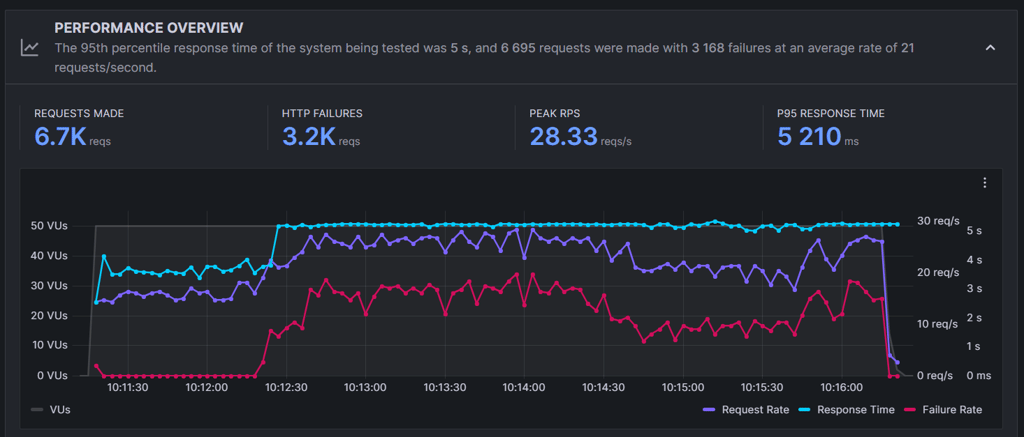
By comparison, Hostinger’s server response time remained low and stable even as the number of users and requests increased. That said, it’s worth noting that 50 VUs would equal 50,000 monthly visitors – a massive load on the server, especially a shared one.
So, we decided to gradually slash the number of VUs until IONOS passed with 20 VUs, which is about 20,000 monthly visitors. It might not sound like a lot, but trust me – that’s still far more than most websites on shared hosting experience.
IONOS previously showed solid speed and stability, performing well enough to hold its own among similarly priced hosts. However, in the most recent tests, its overall responsiveness slipped noticeably compared to earlier results. The one area that remained strong was uptime, which continued to be completely reliable. I’m not entirely sure what caused the change, so we’re planning to run another round of testing in about a month to see if the performance stabilizes.
IONOS delivers excellent uptime and stability, maintaining 100% uptime during our 2-week test and offering multiple server locations across Europe and the US. However, its speed and response times were inconsistent, with slower page loads and noticeable slowdowns under heavy traffic, making it better suited to small-to-medium websites than to high-traffic projects.
IONOS security – 4.8/5
IONOS covers all the security basics for hosting and offers more advanced security solutions. Provided features include SSL Wildcard certificates, daily backups, and DDoS protection. Here’s what you can expect in terms of security:
- SSL certificates. IONOS offers a free SSL Wildcard certificate for all plans to enable an encrypted connection between your site and your visitors. A free Let’s Encrypt SSL certificate is the bare minimum, but getting a Wildcard SSL instead is a pleasant surprise. It protects not only the main domain but also all subdomains.
- Backups. The provider offers automatic daily backups for both webspace and databases. They are automatically stored for up to 6 days, allowing you to recover files easily. For a budget host, weekly backups are more common than daily automated backups, making this a notable advantage for IONOS.
- Distributed Denial of Service (DDoS) protection. DDoS is an attack in which traffic from various compromised systems floods a targeted site to overload it. DDoS attacks often make the targeted site inaccessible, so it’s a good thing that IONOS’ DDoS protection is activated by default.
- Site Scan. A basic version is included to scan for malware. Some of its features include daily malware scanning, reputation monitoring, spam and blocklist monitoring, and a platform scan for WordPress.
- Georedundant infrastructure. IONOS stores your data in two separate data centers, about 60 kilometers apart, to protect against data loss and outages.
- Additional protections. IONOS includes two-factor authentication, domain-level security features like DNSSEC and anti-hijacking via Domain Guard, and email anti-spam. It also offers a firewall, a web application firewall, and malware removal tools to bolster defenses.
Overall, I’m impressed with IONOS' wide-ranging basic and advanced security measures, especially considering its affordability. It’s far more generous than its peers.
IONOS offers strong security for a budget host, including a free Wildcard SSL certificate, daily backups, and built-in DDoS protection across all plans. With additional features like malware scanning, georedundant data centers, DNSSEC, and two-factor authentication, it provides a well-rounded security package that’s more generous than what many similarly priced hosts offer.
IONOS customer support – 4.6/5
| 24/7 live chat | ✅ Yes |
| ✅ Yes | |
| Tickets | ✅ Yes |
| Phone support | ✅ Yes |
| Knowledge base | ✅ Yes |
IONOS offers several support channels to help customers. You can reach them by phone for technical issues, which is available for many countries, including the US, where support is available 24/7.
In addition to phone support, IONOS now allows you to submit support tickets directly through the control panel. Once submitted, you receive an email confirmation with a link to track or update your ticket. Email support is also available.
When testing the phone support, I always found someone available to take my calls, and the agents were helpful and efficient. The 24/7 live chat also connected me to an agent pretty fast.

However, I had to try a few times, as the live chat was sometimes too busy with no agents available. Nevertheless, my overall experience with IONOS 24/7 support was positive.
The IONOS Help Center and knowledge base are extensive, with hundreds of well-organized articles covering domains, technical support, online marketing, and security. Between phone support, ticket submissions, and the knowledge base, IONOS provides multiple ways to get help, though the live chat system could use improvement.
IONOS has multiple support channels, including 24/7 phone and live chat, email, support tickets, and a large knowledge base. In my testing, phone support was consistently responsive and helpful, while live chat sometimes had availability issues, though overall the support experience was positive.
Video review
If you would like to see IONOS in action, a full video walkthrough is included right below.
Final verdict – 4.6/5
From my experience, IONOS is a reliable and affordable choice for beginners, small businesses, and typical WordPress or online store sites. It covers the basics well, like security, email, and automatic backups, with extra features available if needed. Performance has generally been solid, though recent tests showed slower speeds than before, so it can be a bit inconsistent. Overall, it’s a practical option for most everyday websites, even if it’s not the best for very high-traffic or resource-heavy projects.
- Overall rating – 4.6/5
- Pricing and plans – 4.9/5
- Ease of use – 4.5/5
- Performance – 4.4/5
- Security – 4.8/5
- Customer support – 4.6/5

FAQ
Is IONOS good?
Yes, IONOS is a solid choice for beginners and small websites, offering reliable uptime, essential security features, and affordable pricing. While it’s not the fastest host, its low cost and dependable performance make it a strong value pick.
Is IONOS safe?
Yes, IONOS is safe, providing strong security features like daily backups, SSL certificates, and DDoS protection. Its platform follows standard industry practices to keep websites and data secure.
What is IONOS?
IONOS is a well-known European hosting provider focused on providing services to businesses and web projects of various sizes. In addition to web hosting services, it also offers domain registration and cloud computing.
Why is IONOS so cheap?
IONOS is cheap because it offers promotional pricing, streamlined infrastructure, and in-house tools for beginners and small businesses. By limiting third-party software like cPanel, it cuts costs without sacrificing core features. This way, it stays an affordable yet reliable option for basic to mid-level hosting needs.
Can IONOS be trusted?
Yes, IONOS can be trusted. It's a well-established hosting provider with years of experience, strong security features, transparent pricing, and millions of users worldwide. While budget-friendly, it still delivers reliable uptime and responsive customer support, making it a legitimate and dependable choice.
Does IONOS offer a free trial or money-back guarantee?
Yes, like most hosting providers, IONOS offers a standard 30-day money-back guarantee. It lets you test out the services risk-free and get your money back on a no-questions-asked basis.
What are the best alternatives to IONOS?
The best alternatives to IONOS are Hostinger and Bluehost. Hostinger, though pricier, is a great alternative because it offers more features and surpasses IONOS in performance. Similar to IONOS, Bluehost is a cheaper provider, but it offers more WordPress-specific features.