Oxiline Blood Pressure Monitor review: 9S Pro and XS Pro explained
Being behind major reports like The Mother of All Breaches and RockYou2024, our in-house cybersecurity experts and journalists provide unbiased, real-world testing and in-depth analysis.
We maintain complete transparency by openly sharing our testing methodologies with our audience.
Learn more
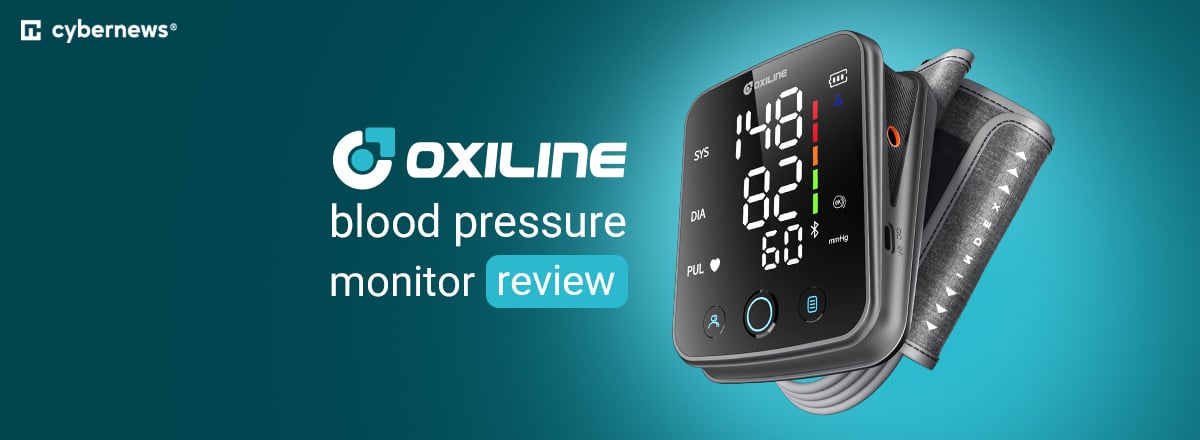
Oxiline Blood Pressure Monitors combine affordability, user-friendly design, and essential health tracking features that meet home monitoring needs. Patients with hypertension can use them for daily readings. Caregivers can use them to monitor elderly family members. Oxiline excels at clear readings, easy setups, and consistent performance.
In this article, I cover the Oxiline Pressure 9S Pro and Oxiline Pressure XS Pro, both of which were designed for home blood pressure tracking. I’ll explain key differences in features, usability, and value, as well as highlight which model fits which user needs.
I and the Cybernews research team reviewed Oxiline's official product specifications, warranty, pricing details, and user feedback to evaluate how these blood pressure monitors perform in everyday use. Keep reading for more information on either home health tool.
Quick overview of Oxiline Blood Pressure Monitors
Check out this overview table for quick information about Oxiline’s Blood Pressure Monitors:
| Features | Oxiline Pressure 9S Pro | Oxiline Pressure XS Pro |
| Overall rating: | ||
| Description: | A dependable upper arm monitor designed for accurate daily readings, featuring a large LCD screen and straightforward controls for routine home use | A more refined monitor with a sharper OLED screen, built for users who want faster readability, improved visibility, and a more modern design |
| Pricing tier: | Mid tier, offering a balance between features and affordability | Upper mid tier, reflecting upgraded display and enhanced usability |
| Compatibility: | Standalone use | Bluetooth 5.0 Low Energy (BLE) for seamless pairing with iOS and Android via Oxiline Health App |
| Display: | 3.5” backlit LCD display | 3.5” crystal OLED display |
| Key features: | Supports multiple user profiles, detects irregular heartbeat patterns, and stores past readings for trend tracking | Uses OLED technology for higher contrast, improves reading visibility in low light, and provides faster visual feedback during frequent measurements |
| Subscription: | None required | None required |
| Ease of use: | Large buttons and simple prompts make it suitable for seniors and first-time users | Higher contrast display and cleaner layout reduce eye strain and make repeated daily checks quicker and easier |
| Best for: | Families, seniors, and users who want dependable daily monitoring at a reasonable price | Users who want premium display clarity, frequent monitoring, and easier reading in all lighting conditions |


Our team of in-house researchers, writers and editors reviews and analyzes health tech products using a research-driven approach. We gather data from multiple sources, fact-check all information, and conduct our research based on peer-reviewed studies, expert opinions, consumer ratings, and regulatory approvals.
You can learn more about how we test health tech products here.
Our methodology
Evaluating home health tools requires strict standards to ensure objective findings and helpful, long-term value. When reviewing Oxiline Blood Pressure Monitors, I used these weighted criteria:
- Transparency of specs and validation (25%). I analyzed manufacturer documentation and validation certifications to determine clarity and completeness.
- Performance consistency (20%). I tested repeated measurements to evaluate stability and consistency.
- Ease of use (20%). I assessed setup, cuff application, and interface simplicity.
- App and connectivity reliability (15%). I tested Bluetooth pairing, data syncing, and app responsiveness.
- Pricing and warranty value (10%). I compared costs and warranty against comparable models.
- User sentiment consistency (10%). I reviewed online user feedback for trends and common experiences.
I gathered information from official product pages, customer reviews, and online forums. This review does not replace clinical trials and instead reflects usability and reported performance for home monitoring purposes.
Understanding Oxiline Blood Pressure Monitors
To understand the key differences between Oxiline Pressure 9S Pro and Oxiline Pressure XS Pro, review the table below:
| Model | Overall rating | Best for | Key specs | Memory | Connectivity | Price |
| Oxiline Pressure 9S Pro | Home users and seniors needing clear, reliable tracking | VIBRA™ T9S Sensor, 3.5” backlit LCD display, standard upper arm cuff (8.6” to 16.5”), USB-C or AAA batteries | 2 users + guest user mode | ❌ No | $99 | |
| Oxiline Pressure XS Pro | Users wanting compact design and essential features | VIBRA™ TXS Sensor, 3.5” crystal OLED display, standard upper arm cuff (8.6” to 16.5”), USB-C or AAA batteries | Unlimited profiles | ✅ Yes, Bluetooth 5.0 Low Energy (BLE) | $119 |
Oxiline Pressure 9S Pro
The Oxiline Pressure 9S Pro has the following features:
- VIBRA™ T9 Sensor designed for reliable readings
- 3.5” color display for easier viewing of results
- Storage for up to 200 readings total, supporting 2 users
- Irregular heartbeat detection
- Cuff fit detection to indicate if the cuff is wrapped correctly or too loose
- “Keep Still” movement indicator to help reduce measurement errors from motion
- WHO blood pressure indicator
Who it’s for: The 9S Pro suits home users who want a feature-rich monitor for regular tracking, especially in multi-user households with seniors.
Oxiline Pressure XS Pro
The Oxiline Pressure XS Pro is equipped with the following:
- Bluetooth connectivity to sync readings to the Oxiline app (available on the App Store and Google Play Store)
- More advanced sensor the Pressure 9S Pro for improved accuracy
- App tracking and management for storing and readings, viewing trends and analytics, and sharing results with your healthcare provider
- Irregular heartbeat detection
- Cuff fit detection
- “Keep Still” movement indication
- WHO blood pressure indicator
Who it’s for: The XS Pro suits tech-oriented users who want advanced accuracy and Bluetooth app tracking, especially those who monitor regularly and share detailed readings with healthcare providers.
How do they work?
Upper-arm blood pressure monitors like Oxiline use an inflatable cuff around the upper arm to temporarily restrict blood flow. The device measures changes in pressure as the cuff deflates, using oscillometric sensors to detect blood flow and pulse waves. These readings are processed to provide systolic, diastolic, and pulse rate values.
Systolic pressure measures the force of blood against artery walls during heartbeats. Diastolic pressure records pressure between beats. Pulse rate indicates the number of heartbeats per minute. Large population data from the HUNT Study show that systolic and diastolic blood pressure, along with derived pressure metrics, are strongly associated with markers of cardiovascular injury and overall heart health.
These monitors are best used for tracking trends over time and supporting discussions with healthcare providers. They help users identify patterns, monitor changes, and maintain records for medical consultations.
Design and ease of use of Oxiline Blood Pressure Monitors
Both Oxiline monitors use a comfortable, adjustable upper arm cuff. When purchasing an XS Pro from the Oxiline website, you can choose between a standard cuff (8.6” to 16.5”) or an XL cuff (8.6" to 18.9"). Alternatively, you can get the XL cuff as an add-on for $9.99.
The 9S Pro uses a simple button layout with clearly labeled controls and large on-screen numbers. The XS Pro improves readability with an OLED display that offers higher contrast and sharper visuals.
Both monitors are lightweight and compact, which makes storage and travel convenient. The XS Pro adds Bluetooth connectivity for pairing with the Oxiline app. The pairing process has easy-to-follow steps, which makes syncing and tracking readings straightforward.
Performance
Oxiline monitors deliver stable readings when users follow proper technique. Consecutive measurements typically show minimal variation, helping users monitor blood pressure trends more consistently over time.
Oxiline claims its sensors and calibration processes meet recognized validation standards. These claims indicate the devices can produce clinically comparable results under controlled conditions. However, real world measurements often vary due to arm position, movement, stress, or improper cuff alignment.
Proper cuff placement and body posture play a critical role in performance. The cuff should sit at heart level and remain snug without excess pressure. Users who stay still and measure at consistent times often see more dependable results.
Who should use Oxiline Blood Pressure Monitor
The following users will enjoy the advantages of Oxiline’s blood pressure monitors:
- People monitoring hypertension trends. Consistent daily blood pressure readings help identify long-term blood pressure patterns and evaluate how lifestyle changes or treatments affect blood pressure, as demonstrated in the ADAMPA randomized clinical trial.
- Individuals tracking BP at home between doctor visits. Regular home measurements help fill gaps between appointments and provide physicians with more complete data for evaluation.
- Multi-user households. Memory storage and user profile support allow multiple family members to track readings on a single device without mixing results.
Note that these devices aren’t intended for users who require clinical testing. They may also be less suitable for individuals who prefer wrist-based monitors, as these models focus on upper-arm measurements.
Using Oxiline Blood Pressure Monitor at home (step-by-step)
To start using your Oxiline Blood Pressure Monitor, follow these steps:
- Sit quietly for five minutes with your back supported and feet flat on the floor.
- Place the cuff on your upper arm, aligning the artery marker and ensuring a snug but comfortable fit.
- Keep your arm at heart level, resting on a flat surface, and remain still without talking.
- Press the start button to begin the measurement; wait for the cuff to inflate and the reading to appear.
- Record the reading manually or sync it to the Oxiline app for tracking and trend analysis.
- Repeat the measurement after one to two minutes if advised by your healthcare provider to confirm consistency.
For the most reliable results, measure at the same time each day and maintain identical posture. Consistency in timing and arm position reduces variability and ensures readings reflect true blood pressure trends over time.
Tips for ensuring accurate and reliable readings
For more reliable readings, follow these tips and best practices:
- Measure at the same time daily. Consistent timing helps track true blood pressure trends and reduces natural daily fluctuations.
- Avoid caffeine or exercise before reading. Temporary increases in heart rate or blood pressure can skew results if measurements are taken too soon afterward.
- Sit upright with feet flat. Proper posture supports stable circulation and prevents inaccurate readings caused by slouching or dangling legs.
- Use the correct cuff size. A cuff that is too tight or too loose can produce misleading measurements, especially for larger or smaller arms.
- Take multiple readings and average. Recording two or three measurements and calculating the average gives a more reliable representation of blood pressure.
Maintaining consistent timing, posture, and technique ensures that each reading is comparable, making it easier to monitor trends and detect meaningful changes over time.
Oxiline Blood Pressure Monitor costs and availability
The Oxiline Pressure 9S Pro costs $99, while the XS Pro costs $169 (or $179 if you want an XL cuff instead of a standard cuff). Both come with a lifetime warranty, 30-day money-back guarantee, and free shipping.
Each order comes with four AAA batteries, a user manual, and a standard cuff. The XS Pro also comes with a carrying bag. The XL cuff can be bought as an add-on for $99.
What do users think about Oxiline?
Users generally praise Oxiline blood pressure monitors for their clear, easy-to-read displays and helpful features like multi-user memory and trend tracking. Many report that daily home measurements feel straightforward, and the LED and OLED screens make reading results simple for seniors and first-time users.
Some users mention occasional concerns about device accuracy, especially when readings differ from other monitors. App connectivity can also be inconsistent, with syncing errors reported on both iOS and Android. A few users also note slow or unresponsive customer service when resolving issues.
On Reddit and other forums, users highlight the importance of proper cuff placement. Many recommend Oxiline for home use but advise checking app performance and verifying readings against other devices to ensure confidence in results.
Conclusion
Oxiline blood pressure monitors fit home users who want a reliable, easy-to-use device for daily tracking. They work well for individuals monitoring hypertension, multi-user households, seniors needing large displays, and users who want app integration.
Compared with established brands like Omron, Oxiline delivers similar features at a lower price. However, it may show slightly more variability in real-world readings and occasional app issues.
Before buying a new blood pressure monitor, make sure you consider these factors:
- Confirm cuff size and ensure it fits comfortably, paying attention to arm circumference and proper placement guidance.
- Verify the return policy, including the allowed return window, eligibility after opening, and any return shipping requirements.
- Decide if Bluetooth syncing matters and review how the app tracks readings, displays trends, and shares data with healthcare providers.
- Compare warranty coverage, including duration, what is included, and the process for repairs or replacements.
For more information, check out these articles:
Oxiline Pulse Oximeter review: accuracy, features, and real-world reliability
Oxiline Scale X Pro vs Withings: which smart scale is better?
FAQ
Is Oxiline clinically validated like Omron blood pressure monitors?
No. Oxiline monitors claim internal validation and testing to meet home-use standards, but they do not hold the same widely recognized clinical certifications as Omron.
How accurate are Oxiline home blood pressure monitors?
Oxiline devices report consistent readings in controlled settings, but actual results can vary due to cuff placement, posture, and body position. Trend tracking over time is more reliable than single measurements.
What is the difference between Oxiline 9S Pro and XS Pro?
The XS Pro offers a sharper OLED display, Bluetooth syncing, and advanced sensor technology, while the 9S Pro provides a standard LCD, basic memory storage, and simpler app-free operation.
Can Oxiline monitors sync with Apple Health or Google Fit?
Yes, the XS Pro supports Bluetooth pairing to the Oxiline app, which can integrate data with Apple Health or Google Fit for tracking trends, sharing results, and monitoring over time.
How often should I calibrate a home blood pressure monitor?
Manufacturers recommend checking calibration every one to two years, or sooner if readings seem inconsistent. Proper technique, cuff placement, and periodic validation help maintain measurement reliability.
-
Systolic Blood Pressure, Diastolic Blood Pressure and Pulse Pressure and the Risk of Subclinical Myocardial Injury
The HUNT Study
-
Long-Term Effect of Home Blood Pressure Self-Monitoring Plus Medication Self-Titration for Patients With Hypertension
A Secondary Analysis of the ADAMPA Randomized Clinical Trial