How we test identity theft protection products

Cybercriminals are becoming more sophisticated, increasing the risk of people’s personal information being exposed or misused. Identity theft protection services help spot these threats early by monitoring credit activity, personal identifiers, financial accounts, and data found in public records and online sources for signs of any suspicious activity.
However, while all identity theft protection products share the same goal – help detect and respond to identity theft – they don’t work the same. Therefore, we evaluate these services using a consistent, evidence-based methodology that focuses on the features users rely on most, from monitoring coverage and alert quality to recovery support, security, ease of use, and overall value. This page explains how we test identity theft protection products and how we determine our ratings.
Why our testing methodology matters
To monitor and identify potential risks, identity theft protection services collect some of your most sensitive personal data. This usually includes your Social Security number, address, phone number, email address, and financial account information. Because of this, it's important to understand how providers handle your data. We evaluate not only how well each service detects and responds to identity threats but also how it protects the personal information you entrust to it.
Many identity theft protection providers tend to advertise similar features, including dark web monitoring, credit monitoring, identity alerts, and insurance coverage. However, while these features look the same on paper, in reality, their quality, reliability, privacy practices, and overall value can differ. Using a consistent testing methodology helps us evaluate every product fairly and separate genuine protection from marketing claims.
What identity theft protection products can and can’t do
The primary purpose of identity theft protection is to spot potential misuse of personal information, so that you can take action as soon as suspicious activity occurs. Most services offer a combination of features, including monitoring, alerts, recovery assistance, and identity theft insurance. So, if anything happens, you don’t need to think or search for what to do next.
Monitoring features help track changes across areas like credit reports, personal information, and public records. If there’s any suspicious activity, alerts notify users, so they can reach out to identity restoration specialists to guide them through the process of restoring their identity. Some products also include insurance policies that might cover eligible expenses related to identity theft recovery.
However, it’s important to understand that these services can’t guarantee that identity theft will never happen. They’re developed to identify and manage risks – not eliminate them entirely. They also can’t prevent all forms of fraud, remove stolen information from every online source, or undo damage that’s already been done. To help you understand identity theft protection better, I concluded its capabilities and limits in a table:
| Can help with | Can’t guarantee |
| Monitoring credit activity and changes to credit reports | Complete prevention of identity theft or fraud |
| Alerting users to certain suspicious activity or exposed personal information | That all stolen personal data will be detected |
| Providing guidance and support during identity recovery | Removal of stolen data from the dark web or other online sources |
| Covering eligible recovery-related costs through identity theft insurance | That financial losses will always be fully reimbursed |
Our main testing categories
For a fair and consistent comparison, we evaluate each identity theft protection service across several core categories that have the greatest impact on users. While individual products might offer unique benefits, our methodology focuses on how effectively each service detects potential threats, supports recovery, protects user data, and ensures an overall user-friendly experience:
| Category | What we evaluate |
| Monitoring coverage | The range and depth of monitoring features, including credit monitoring, identity monitoring, dark web monitoring, financial account monitoring, public records monitoring, and child identity protection (where available) |
| Alert quality | How fast alerts are delivered, how clearly they explain potential risks, what information they give about the incident, and whether they include recommendations for the next steps |
| Insurance coverage | The amount of identity theft insurance, including stolen funds reimbursement, scam reimbursement, coverage for eligible recovery expenses, and protections such as 401(k) or investment account coverage (where offered) |
| Fraud alerts and risk detection | Additional fraud detection features, including home title monitoring, payday loan tracking, and three-bureau credit monitoring |
| Digital privacy and security | Built-in security and privacy tools, such as VPN services, antivirus protection, data broker removal, and password managers |
| Identity restoration | The responsiveness and quality of recovery support, including dedicated case managers, lost wallet assistance, legal assistance, and guidance through the identity recovery process |
| Ease of use | The overall user experience, starting from account setup, identity verification, adding information for monitoring, to dashboard clarity, navigation, and how easily users can understand alerts and recommendations |
| Pricing and value | The cost of the service compared with the features provided, including monthly and annual pricing, renewal costs, free trials, promotional offers, refund policies, and overall value for different user needs |
How we test monitoring coverage
Monitoring is the foundation of most identity theft protection services, so this is what we evaluate first. We don’t just check whether a product offers monitoring features – we assess the breadth of its coverage, the types of information it can track, and how useful those features are for spotting potential identity theft. Finally, we prioritize services that monitor a wider range of personal data and provide more comprehensive coverage.
Credit monitoring
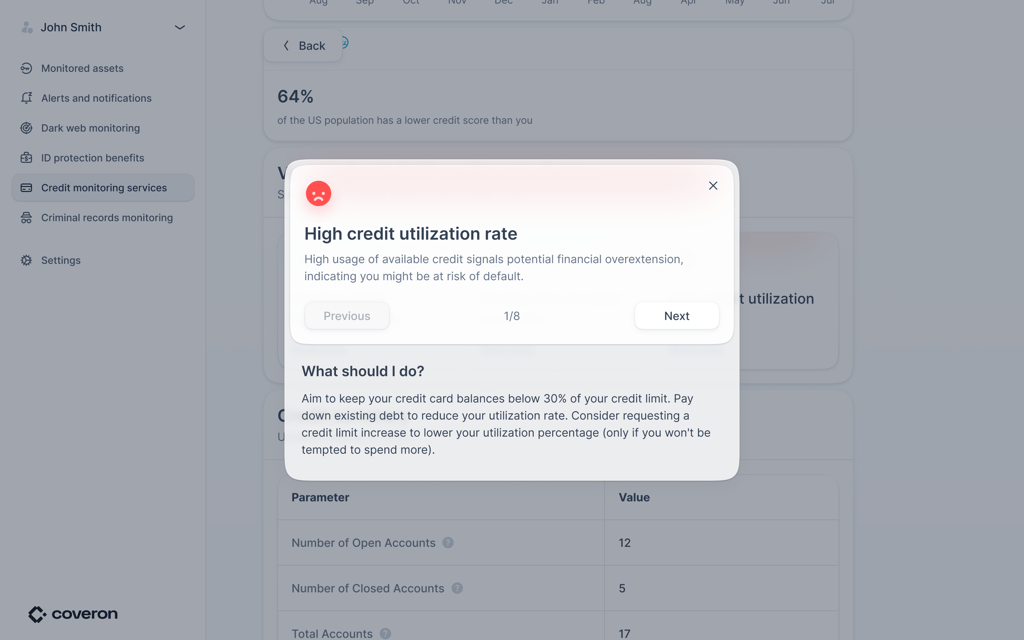
Credit monitoring detects changes to users’ credit reports that could indicate fraudulent activity, such as new credit inquiries, newly opened accounts, or other unauthorized changes.
During testing, we look at how many credit bureaus the service monitors, the type of credit events that trigger alerts, access to credit reports and credit scores, and the frequency of credit report and score updates. We also evaluate additional credit-related tools, such as credit locks or credit freezes, where available.
Identity monitoring
Identity monitoring regularly scans various data sources – from public records and credit applications to dark web sources – to find misuse of users’ personally identifiable information (PII). During testing, we assess the range of data the service monitors and the comprehensiveness of its monitoring.
Our evaluation typically includes monitoring Social Security numbers, names and addresses, phone numbers and email addresses, driver’s license and passport numbers, bank accounts and payment cards, child identities, as well as public records and change-of-address requests.
Dark web monitoring
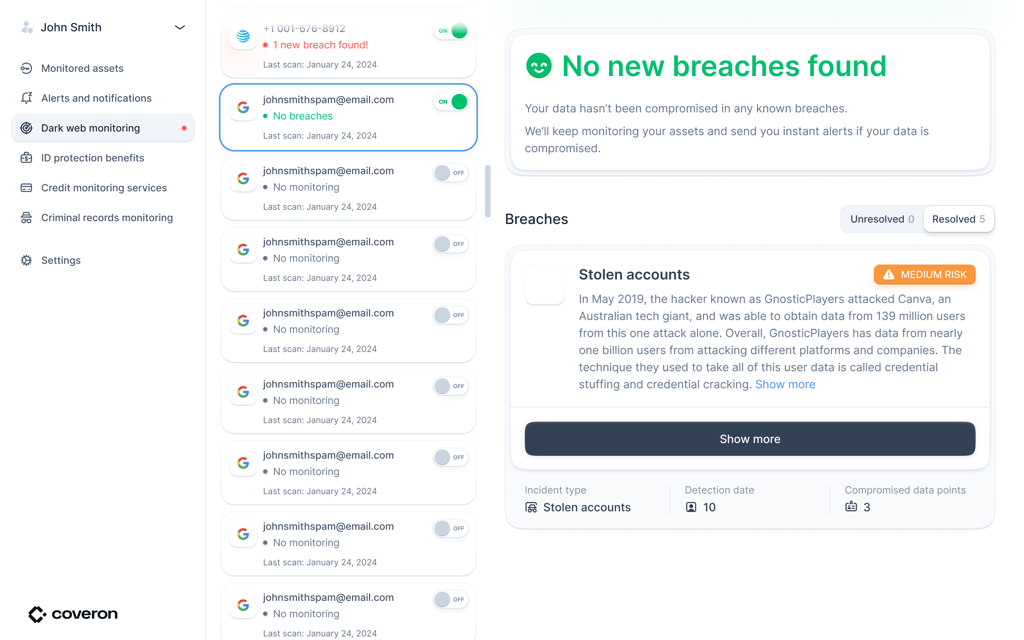
Dark web monitoring checks whether users’ personal data appears in known data breaches or marketplaces that sell compromised data. As providers monitor different amounts and types of information, we compare both the scope of monitoring and the value of the results.
We evaluate the types of personal information that can be monitored (like email addresses, passwords, Social Security numbers, and bank accounts) and the number of data points users can add for monitoring. We also look at whether users can monitor family members' or children’s information. Finally, we assess how clearly potential exposures are presented and whether alerts include enough context to help users understand potential risks and recommended next steps.
How we test alerts
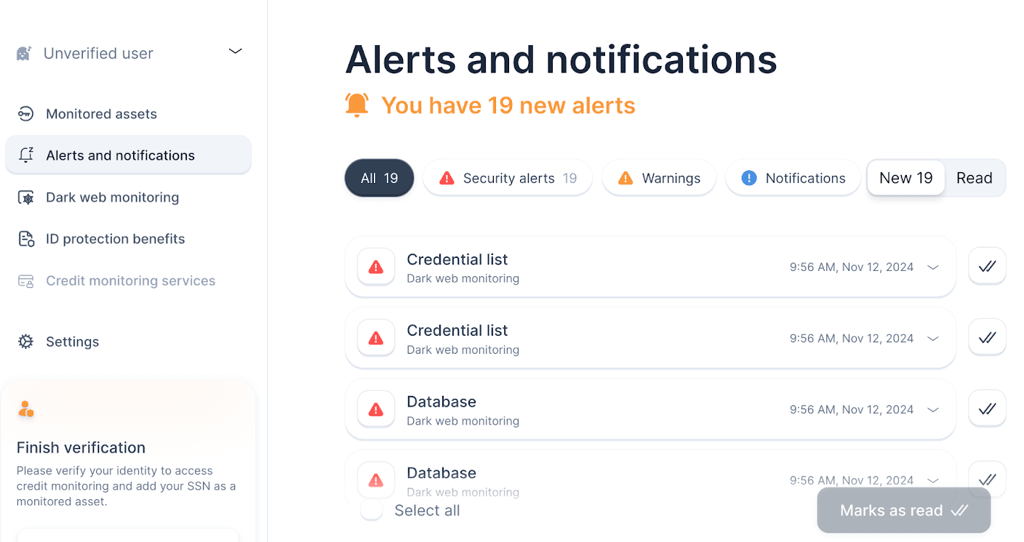
If compromised data is found, alerts notify users about what happened and what steps they should take next. In situations like these, users must act as swiftly as possible, so it’s not enough for a service to simply send notifications. During testing, we review how quickly alerts are delivered, how much context they give, and whether they help understand the magnitude of a risk.
Overall, our evaluation includes alert speed, alert clarity (whether the alert clearly explains what happened), severity and risk explanation (whether the alert helps users distinguish between high-risk incidents and lower-priority notifications), and affected data. We also check the recommended actions, delivery methods (the channels the service uses to alert you), and alert management (how easy it is to review, organize, and revisit previous alerts within the dashboard or mobile app).
Services that deliver timely, informative, and actionable alerts score higher than those that provide limited information or leave users to interpret potential risks on their own.
How we test recovery support
Apart from monitoring and alerting, identity theft protection services also help users recover in case their identities are compromised. In our testing, we evaluate how accessible, comprehensive, and practical these recovery services are when responding to an identity theft incident.
First, we assess whether users receive a dedicated restoration specialist or a case manager, and how clearly they guide users through the recovery process. Personalized assistance is always a huge bonus. Then, we look at support availability (whether the help is available 24/7) and support channels (whether it’s available via phone, live chat, and email). Additional recovery resources, like educational materials or fraud resolution checklists, can also help when responding to identity theft.
In short, services with knowledgeable specialists, multiple support channels, and all-around recovery assistance score higher than services that offer limited guidance or rely primarily on self-service resources.
How we evaluate identity theft insurance
Recovering from identity theft can be costly, as the process might involve financial losses and expenses to restore a person’s identity and accounts. Because of this, many providers offer identity theft insurance to help cover some recovery costs.
That said, the advertised coverage amount doesn’t always reflect the actual level of protection. So, in our testing, we evaluate what is covered in identity theft insurance (whether the policy reimburses stolen funds, scam losses, legal fees, and recovery-related expenses), any limitations that might apply (restrictions, waiting periods, exclusions, or claim requirements), and how useful the policy actually is.
We favor services that offer broad, clearly explained insurance coverage with fewer limitations and meaningful financial support during the identity recovery process.
How we test privacy and account security
To monitor for compromised data, identity theft protection services require sharing sensitive personal information. Therefore, privacy and account security are another part of our evaluation. We assess how well providers protect user accounts and personal data, as well as the security controls they offer to reduce the risk of unauthorized access.
When testing services, we review whether they support multi-factor authentication (MFA) or two-factor authentication (2FA), how they handle password requirements, and whether they provide login alerts or notifications about account changes. We also pay attention to the clarity of their privacy practices, including how they explain the collection, use, storage, and protection of personal information.
Additionally, we consider available account management controls, such as the ability to review account activity, manage security settings, and control personal information.
All in all, services with stronger security measures, transparent privacy practices, and practical tools for protecting user accounts are more favored in our evaluations.
How we test ease of use
To evaluate ease of use, we conduct hands-on testing of each identity theft protection service, going through the entire user experience from account creation to everyday use. This helps us understand how well the service is suited for beginners and whether there’s a steep learning curve.
We review the signup flow, identity verification process, and how easy it is to add personal information for monitoring. We also look at the dashboard layout, navigation, alert readability, and how easy it is to manage account settings. In short, we prioritize services with straightforward setup processes, intuitive interfaces, and clear guidance.
How we evaluate pricing and value
Pricing is only a part of a product’s overall value. In our evaluations, we compare monthly and annual pricing, renewal rates, free trials, promotional discounts, and refund policies. We also weigh whether the included features justify the price. The best services offer comprehensive protection with transparent pricing and strong overall value.
How we score and rank identity theft protection products
To ensure a fair comparison, each identity theft protection product we test receives a final rating. We calculate it by testing the product across core categories and applying weighted values to reflect the importance of each category. This approach allows us to compare products consistently while ensuring that features with the greatest impact on users carry more weight. Here’s our standard scoring model:
| Category | Weight |
| Monitoring coverage | 20% |
| Identity restoration | 20% |
| Fraud alerts | 15% |
| Insurance coverage | 15% |
| Pricing and value | 15% |
| Ease of use | 10% |
| Privacy and security | 5% |
In some reviews, we adjust these weights to match the topic. For example, family-focused reviews might place more emphasis on child identity monitoring, while budget-focused reviews might give more weight to pricing and value.
What we don't test
Note that we evaluate these products using ethical and responsible testing methods. To keep our reviews safe, fair, and consistent, we don’t engage in illegal or deceptive activities. This means we don’t:
- Commit fraud or impersonate another person
- Apply for credit using fake or stolen identities
- Buy or access stolen personal data
- Intentionally expose personal information to trigger alerts
- Attempt to bypass or compromise a provider's security
We evaluate the features, usability, and recovery support provided by each service, using hands-on testing and publicly available information.
Our researchers



Our in-house research team and expert writers constantly collaborate to evaluate identity theft protection services. Every product is assessed using a strict testing methodology that combines hands-on testing with thorough feature analysis.
Our researchers regularly review identity theft protection services to reflect product updates, new features, and changes in pricing or policies. They evaluate key areas such as monitoring coverage, alert quality, identity restoration, insurance, privacy and account security, ease of use, and overall value. These findings are then used by our writers to produce accurate, evidence-based reviews.
We regularly update our content to keep our recommendations accurate and relevant. If you spot an error or inconsistency, please let us know through our contact page.