OmniWatch identity theft protection review: can it really keep your data safe in 2026?
Our in-house experts test identity theft protection services themselves, using real-world scenarios and established testing methods. We look at how well each service monitors personal information, how quickly and clearly it sends alerts, what recovery support it offers, and how it handles customer data.
We assess every provider using the same criteria and explain our testing process clearly, so readers can compare services and make a more informed choice.
Learn more
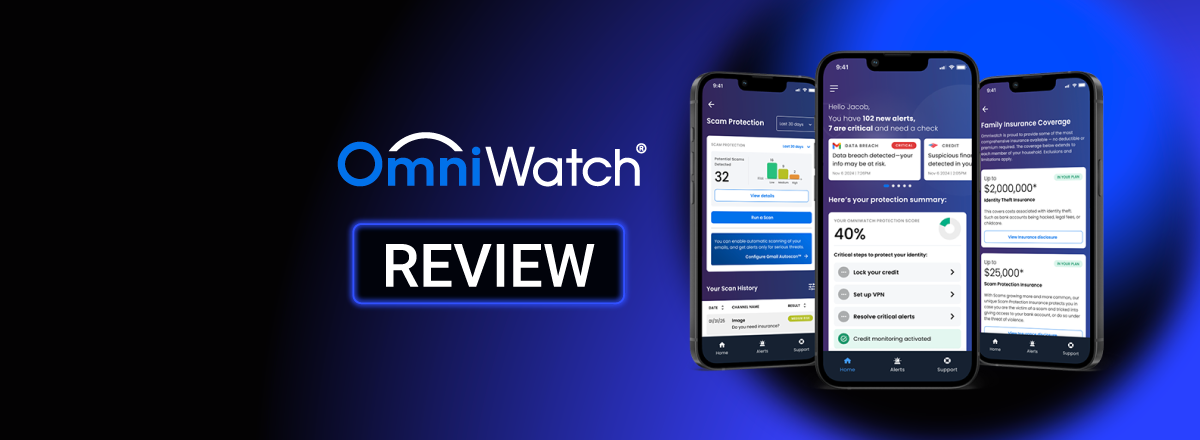
OmniWatch is a US-exclusive identity theft protection service. Currently, it offers the biggest identity theft insurance policy of up to $4 million per adult. Since it was launched in 2023, it is still light on features, missing a few I consider important for safety.
On the other hand, it packs additional benefits like a VPN, malware protection, and AI-powered scam detection. It's a very promising newcomer.
In this OmniWatch identity theft protection review, I'll detail its features, benefits, and setbacks, pricing, and compare OmniWatch to other identity theft protection services. Cybernews researchers verified and enriched my findings for a holistic review.
Overview of OmniWatch identity theft protection
Before we get started, let’s see what OmniWatch is all about. This overview table of the brand’s identity theft protection service will get you up to speed quickly:
| Overall rating | 4.8/5 ⭐ |
| Price | From $7.99/month |
| Free trial | ❌ No |
| Free version | ❌ No |
| Money-back guarantee | 30-days for annual, 14-days for monthly plans |
| Supported platform | Web-based interface on all platforms, iOS and Android apps |
| Number of devices covered | Up to 3 (antivirus only) |
| Number of people covered | Up to 2 |
| Credit monitoring | ✅ Yes |
| Credit reports | ✅ Yes (3 bureaus) |
| Credit score | ✅ Yes |
| Dark web monitoring | ✅ Yes |
| Social media monitoring | ❌ No |
| Identity monitoring | ✅ Yes |
| Identity theft insurance | ✅ Yes (up to $4 million per adult) |
| Identity restoration services | ✅ Yes |
| Additional features | VPN, antivirus |
Pros and cons of OmniWatch identity theft protection
Now that we’ve defined what OmniWatch offers, it would also be a good idea to go over what it excels at. And we can’t do that without mentioning a few areas where it could use improvements, as well:




Our in-house experts test identity theft protection services using real-world scenarios and consistent criteria. We assess monitoring, alerts, recovery support, and data handling to help readers compare providers confidently. Learn more about our testing process.
OmniWatch identity theft protection: key features
Despite being one of the most affordable ID theft protection providers currently on the market, OmniWatch genuinely offers a lot for your dollar. Here’s what you’ll find across the board:
Credit monitoring
Every OmniWatch tier includes TransUnion credit monitoring. However, the Elite and Family plans take it a step further by also including Equifax and Experian, thereby covering all 3 major credit bureaus. With real-time alerts for all things SSN, credit, and data, OmniWatch ensures you find out about incidents as soon as they happen.
Dark web monitoring
OmniWatch doesn’t just do the World Wide Web; it watches over that dark part of the internet, as well. And since this is where stolen identities are most often bought and sold, it does a bang-up job at looking out for your personally identifiable information (PII).
It also offers 24/7 identity monitoring. OmniWatch keeps a constant watch on dark web forums, leak databases, and various other places on the internet where your PII can turn up.
Social security number tracking
Besides monitoring credit and breaches involving your login credentials, OmniWatch also keeps track of your Social Security Number (SSN). It’s worth noting that the provider doesn’t store this info; it only passes it to TransUnion to confirm your identity.
Data breach alerts
The first few hours are crucial in the event of an ID theft. Fortunately, OmniWatch excels in this department by providing real-time alerts on data exposure. This can help you limit the damage cybercriminals can cause with your PII.
Easy-to-use dashboard
OmniWatch’s web-based interface is simple yet comprehensive. You’ll have no issue navigating it and understanding what each section offers. Registering for the service also takes only a couple of minutes, as I'll show the step-by-step process shortly.
Identity restoration services
If your identity does get stolen under the watchful eye of OmniWatch, the provider will help you deal with the situation. Its white-glove restoration service agents are at your disposal 24/7. Whether you’re dealing with a lost wallet or identity theft, OmniWatch’s US-based identity theft restoration agents will help you deal with it.
Regarding traditional customer support, you can talk to their live agents online on weekdays from 7 AM to 4 PM. You can also call them weekdays from 6 AM to 9 PM or send them an email, so there are enough options to choose from.
Family protection plan
If you’d also like to protect your significant other, OmniWatch’s Family tier has all the bells and whistles you’ll need. It extends all the Elite plan benefits for two adults, increasing the insurance policy up to $8 million for two people. Regarding kids, it monitors the child's SSN and alerts if your child's personal details are misused.
Reimbursement options
Last but certainly not least, OmniWatch offers industry-leading $4 million in identity theft insurance per person, while covering up to $100,000 in scam-related losses, including ransomware. So, you can rest assured you’ll be reimbursed in case of any incidents.
Does OmniWatch identity theft protection keep your data safe?
Put simply, yes, OmniWatch takes proper care of any and all personal information that you give it. While the team and I didn’t test the service ourselves, OmniWatch publicly disclosed that it takes sufficient security measures. That’s just one of the indications that you can trust it.
The provider also uses reliable industry-standard AES-256 encryption for both data in transit and at rest. This makes it virtually impossible for bad players to get a hold of your PII, at least not by brute force. Furthermore, OmniWatch only uses your SSN for identity verification with TransUnion without storing it on its own servers.
As for the data it does store, OmniWatch is SOC 2- and SOC 3-certified. So, rest assured that the way it keeps and processes your PII complies with the latest cybersecurity standards. It’s also PCI DSS-compliant, which ensures payment information stays private.
Does OmniWatch undergo third-party security audits or vulnerability testing?
Yes, OmniWatch is SOC 2 (Systems and Organization Controls 2) and SOC 3 compliant. These are trustworthy attestations built around five key criteria: security, confidentiality, privacy, availability, and processing integrity. You will see major companies like Google, Amazon, and PayPal all undergoing SOC 2 compliance to prove data security practices.
Don't be alarmed if you can't find much information on the OmniWatch SOC 2 attestation online. Because this document holds sensitive cybersecurity information, it is usually available upon user request through OmniWatch communication channels.
However, OmniWatch sometimes displays a SOC 2 compliance badge with its branding. In its privacy policy, you can find that it uses encryption and other data security measures. All of that leads me to agree that OmniWatch is indeed a secure service that has been audited, including vulnerability reports.
Are attestations verified publicly?
No, typically, SOC 2 attestation documents are not shared through public channels. As mentioned previously, they contain highly sensitive business data, which cannot be shared risk-free.
However, verified users can ask for this document. It is usually done via internal customer support channels and requires signing a Non-Disclosure Agreement. For this reason, companies release public SOC 3 reports that do not disclose sensitive information. Unfortunately, we could not find it in the case of Omniwatch.
OmniWatch identity theft protection: plans and pricing
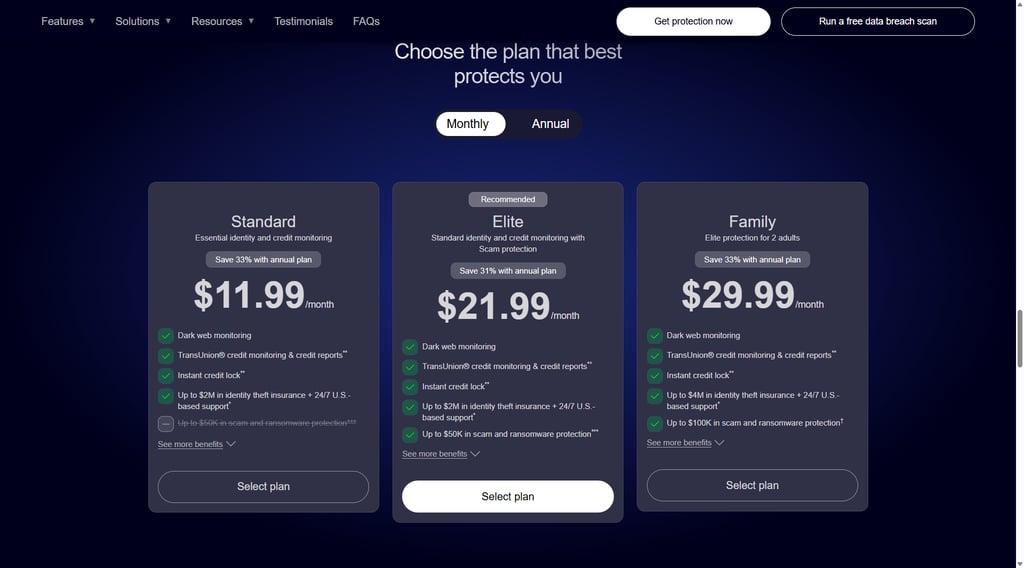
When it comes to pricing, OmniWatch offers 3 distinct plans to choose from:
| Plan | Monthly subscription | Yearly subscription |
| Standard | $11.99 | $95.88 ($7.99/month) |
| Elite | $21.99 | $179.88 ($14.99/month) |
| Family | $29.99 | $239.88 ($19.99/month) |
The provider’s entry-level plan (Standard) offers essential ID and credit monitoring, dark web surveillance, instant credit lock, automatic email scanning, AI-powered scam detection for texts and emails, VPN, antivirus protection, 24/7 support, and coverage of up to $2 million in the event of any incidents.
However, it’s also limited to TransUnion credit monitoring and reports only. Luckily, that’s where the Elite plan comes in, building on the previous tier with 3-bureau credit monitoring, home title monitoring, payday loan alerts, up to $4 million insurance, and up to $100,000 in scam and ransomware protection.
Finally, there’s the Family tier, which doubles what you get with the Elite plan. As such, it essentially offers Elite-level protection for 2 adults.
It’s worth noting that there’s no free plan, and you can’t test-drive any of the paid tiers, either, which is a disadvantage, especially considering that most competing ID theft protection providers offer a free trial. That said, they’re all more expensive than OmniWatch, even if it's just by $0.50/month.
OmniWatch: user reviews
On paper, OmniWatch appears to be an almost perfect toolkit for ID theft protection. But what its users think is just as important, if not more. That’s why I also dug into OmniWatch reviews across Reddit, Quora, Trustpilot, ConsumerAffairs, and other relevant platforms.
Let’s start with the bad news first. OmniWatch has been hit with a few one-star reviews. In fact, 7% of Trustpilot users have rated it this way, with the complaints boiling down to chargeback issues upon cancellation. That said, OmniWatch is still in its infancy, so the number of comments is still really low.
On the flip side, you’ll also come across more than a few OmniWatch reviews from users who’ve noted that the service’s industry-leading $4 million insurance helps them feel safer and more protected. Many also praise its easy-to-use dashboard and responsive support.
Overall, OmniWatch enjoys a decent reputation across the board.
User experience and interface
I found registering for OmniWatch super straightforward. All it takes is a click here, a tap there, and OmniWatch will turn on its watchful eye to safeguard your PII:
-
Pick a plan. Visit the official OmniWatch website and select from the Standard, Elite, or Family tiers.
-
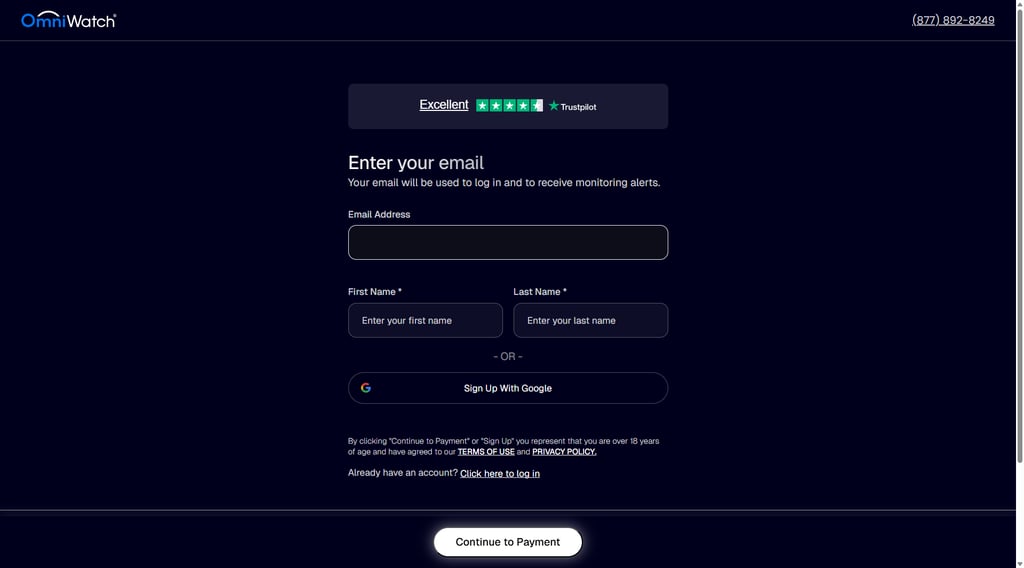
Create an account. Add your email address and name. Then, tap the Continue to Payment button.
-
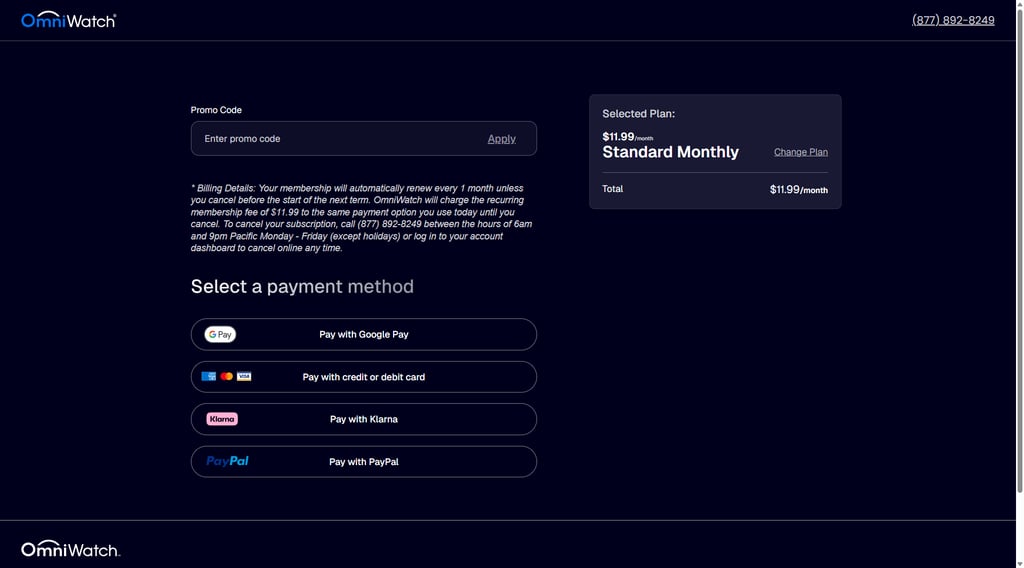
Add billing info. I liked that there's a variety of payment methods, so choose your preferred one, including Klarna and PayPal.
- Verify your identity. Once you’ve got the subscription handled, you’ll have to verify your identity through TransUnion, one of the 3 major credit bureaus.
-
Set up OmniWatch. With everything cleared, you can go on over to OmniWatch’s dashboard and set up your preferences in terms of notifications and monitoring.

Alternatives to OmniWatch
While OmniWatch is undoubtedly an excellent ID protection service, there are a few alternatives that may better suit your needs. That said, let’s see how OmniWatch stacks up against these competitors in terms of cost, strengths, weaknesses, and protection levels:
| Service | OmniWatch | Aura | Coveron | Norton LifeLock |
| Price | From $7.99/month | From $12/month | From $4.74/month | From $12.49/month |
| Pros | – Excellent price for value ID protection service | – 3-bureau credit monitoring across all plans | – Modest price | – Includes top-rated antivirus |
| Cons | – Limited Standard plan | – On the pricier side | – No social media monitoring | – Steep renewal price increase |
| Key features | – 24/7 identity, SSN, credit, and dark web monitoring | – Protection for up to 10 devices per person | – Cyber extortion protection of up to $50,000 | – Device-wide cybersecurity tools, AI-powered scam detection |
| Best for | Budget-conscious users | Families | Personal scam protection | General online safety |
OmniWatch vs Aura
The thing that catches my eye first is that the OmniWatch first-year Family is significantly more affordable than Aura. It has fewer features, but compensates with better pricing. That's a common strategy for newer services entering established markets. Also, OmniWatch has been adding new features since its release, so I'm waiting to see what else it develops in 2026.
| Plans (annual) | OmniWatch (first year monthly) | OmniWatch (after first year) | Aura monthly |
| Individual (Elite) | $14.99 | $21.99 | $12.00 |
| Family | $19.99 | $29.99 | $32.00 |
Overall, Aura takes the upper hand. It monitors all three credit bureaus since the start and offers a personal data removal tool, which OmniWatch lacks so far.
OmniWatch vs Coveron
Coveron was released a year after OmniWatch, so both are new services. Both offer scam protection reimbursement, in addition to identity theft insurance. However, Coveron comes with one the best VPNs, available with the Full Protection Plan. It covers 10 simultaneous connections. OmniWatch offers a VPN with its Standard plan, but it only covers 2 devices at a comparable price.
| Plans (annual) | OmniWatch (first year monthly) | OmniWatch (after first year) | Coveron (first year monthly) | Coveron (after first year) |
| Standard/Scam Protection | $7.99/month | $11.99/month | $5.69/month | $12.49/month |
| Elite/Identity Theft Protection | $14.99/month | $21.99/month | $6.64/month | $18.49/month |
| Full Protection | - | - | $10.44/month | $30.49/month |
| Full Couple Protection | - | - | $18.04/month | $16.14/month |
| Family/Full Family Protection | $19.99/month | $29.99/month | $28.49/month | $25.64/month |
As you can see, Coveron is significantly more affordable. Keep in mind that it also gives two-year plans, which offer better discounts. OmniWatch offers only monthly and yearly plans so far.
OmniWatch vs Norton LifeLock
The biggest OmniWatch vs Norton LifeLock difference is that the latter has a very wide range of features. It also has a variety of plans, so let's compare the cheapest one and the Family plans of these two services.
| Plans (annual) | OmniWatch (first year monthly) | OmniWatch (after first year) | LifeLock by Norton (first year monthly) | LifeLock by Norton (after first year) |
| Standard/Core | $7.99 | $11.99 | $10.42 | $12.49 |
| Family | $19.99 | $29.99 | $30.00 | $47.99 |
OmniWatch is more affordable, as Norton has steeper price increases after the first year. OmniWatch is also easier to use, but go over each plan before subscribing to see the full list of benefits. These two identity theft protection services are significantly different.
Final verdict: is OmniWatch worth the price?
After thoroughly researching the tool with the Cybernews crew for this OmniWatch identity theft protection review, I can confidently say that it’s well worth it for most. In fact, I’d go as far as to recommend its Elite and Family plans for individuals and couples, respectively.
It’s easy to set up and use, offers strong protection features, and provides real-time alerts in case of credit score changes or data breaches, all at a very affordable price.
That said, it’s not all rainbows and sunshine here. For starters, its entry-level Standard tier lacks 3-bureau credit monitoring. You also won’t find social media, financial activity, auto title, or address change tracking whatsoever.
If those are the features that would provide you with greater peace of mind, then a competing service like Aura might better suit your needs. It ticks almost all of the boxes mentioned above, albeit at nearly double the monthly subscription cost of OmniWatch.
FAQ
How does OmniWatch identity theft protection work?
Once you provide it with the necessary information, OmniWatch starts scanning the dark web and monitoring your credit reports for signs of financial fraud. It keeps at it 24/7, instantly alerting you to any instances of your PII popping up where it shouldn’t or changes to your credit score.
Does OmniWatch offer credit score tracking?
Yes, OmniWatch keeps track of your credit health, providing monthly VantageScore credit scores and instant alerts in the event of any changes. You’ll also be able to lock your credit to stop bad actors from opening lines of credit in your name.
Is OmniWatch suitable for families?
If we’re talking identity theft protection for you and your partner, then yes, OmniWatch is an excellent choice. That said, if you’d like to protect more than 2 adults or you want dedicated child ID theft protection features, Aura’s Family plan may be a better fit for you.
What happens if my identity is stolen while using OmniWatch?
If you fall victim to identity theft as an OmniWatch user, the provider’s white-glove identity restoration agents can help. OmniWatch also offers up to $4 million in ID theft insurance, so you’ll also be reimbursed for damages that may have occurred.
How does OmniWatch compare to Aura or Coveron in terms of features?
OmniWatch leads the way in terms of insurance coverage and affordability. On the other hand, Coveron excels at handling online cybersecurity, especially when you pair it with its own VPN. Meanwhile, Aura offers the most comprehensive all-in-one security solution. As such, it’s ideal for families, albeit at a higher price.