Guardio vs McAfee: which one’s best for you?
Our in-house experts test identity theft protection services themselves, using real-world scenarios and established testing methods. We look at how well each service monitors personal information, how quickly and clearly it sends alerts, what recovery support it offers, and how it handles customer data.
We assess every provider using the same criteria and explain our testing process clearly, so readers can compare services and make a more informed choice.
Learn more
Identity theft, online scams, and data leaks are common risks of using the internet for shopping, banking, social media, and everyday browsing. And while avoiding suspicious links and downloads is still important, modern scams are becoming increasingly convincing, making it much harder to spot threats before your personal information is compromised.
When I looked into ways to reduce my exposure online, two identity theft protection services kept coming up in my research: Guardio and McAfee. Both are established names in online security, but they approach identity protection quite differently. Guardio places greater emphasis on preventing scams and credential theft before they happen, while McAfee takes a more traditional approach focused on identity monitoring, data cleanup, and recovery.
In this Guardio vs McAfee comparison, I examined their identity protection features, pricing, and overall effectiveness to see how the two services stack up. Keep reading to find out which one offers better protection for your needs.




Our in-house experts test identity theft protection services using real-world scenarios and consistent criteria. We assess monitoring, alerts, recovery support, and data handling to help readers compare providers confidently. Learn more about our testing process.
Guardio vs McAfee overview
Before digging deeper, I compiled a quick overview table comparing the core features of Guardio vs McAfee:
| Guardio ITP | McAfee Identity Theft Protection | |
| ⭐ Rating: | ||
| 🥇 Overall rank: | #6 out of #20 | #15 out of #20 |
| 💵 Price: | From $9.99/month | From $2.24/month |
| ✂️ Free version: | Yes, basic free plan | No |
| 🖥️ Platforms: | Windows, macOS, Linux, iOS, Android | Windows, macOS, iOS, Android |
| 💰 Credit monitoring: | No | Yes (1 or 3 bureaus depending on plan) |
| 🔒 Insurance: | Yes, select eligible plans/users | Yes, up to $2M (Ultimate) |
| 🔥 Coupons: | Guardio Identity Protection coupon 53% OFF | - |

About Guardio
Guardio is a browser-focused service designed to protect users from scams, phishing, malware, and identity theft while you are online. It mainly works via browser extensions for Chrome, Edge, and Opera, but it also offers dedicated apps for Android and iOS to protect your mobile devices.
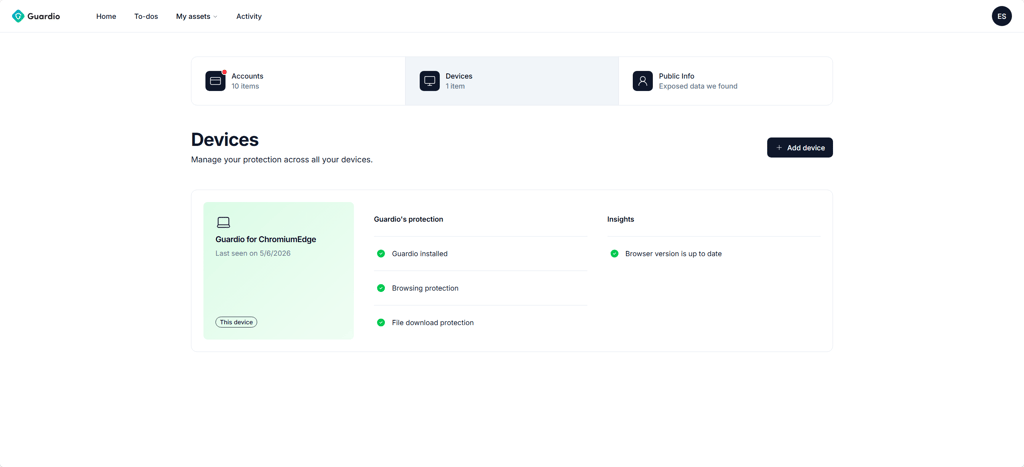
Guardio works by identifying and blocking real-time threats such as malicious websites, phishing pages, dangerous browser extensions, and unsafe downloads. It also offers email protection, detecting suspicious or malicious messages even if they slip through regular spam filters. On mobile devices, Guardio additionally monitors scams delivered via text messages and other similar channels.
Overall, it is not conventional antivirus software as it focuses primarily on online threats rather than performing full system malware scans.
Guardio also offers eligible users up to $1 million in identity theft insurance and access to identity restoration services. However, the insurance is provided by third-party partners and may differ based on the user's plan, eligibility, and location.
About McAfee
McAfee is best known for its well-rounded cybersecurity suite, combining a trusted antivirus with identity theft protection. Unlike Guardio’s browser-first approach, McAfee installs directly on Windows, macOS, Android, and iOS devices, which allows it to protect both online activity and the device itself.
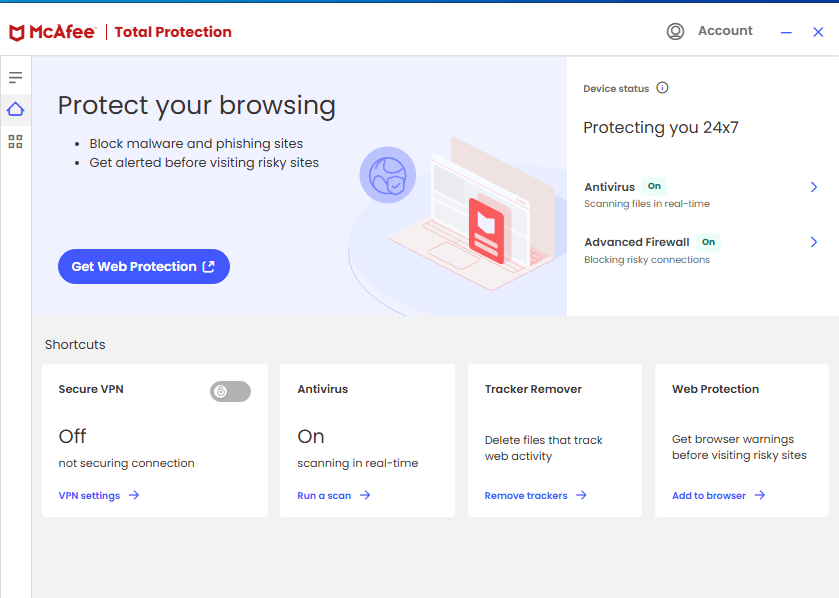
McAfee is, first and foremost, antivirus software focused on scanning devices for viruses and other threats.
As for identity theft protection, McAfee takes a more traditional, yet somewhat broader, approach. It monitors personal information for exposure in data breaches and on the dark web and alerts users when compromised data is discovered. Depending on the plan, McAfee can also provide credit and financial account monitoring, Personal Data Cleanup to remove information from data-broker sites, Online Account Cleanup, and tools for managing social media privacy.
Higher-tier plans add identity restoration assistance and up to $2 million in identity theft insurance for eligible users. However, many of McAfee’s advanced features are limited by plan and location, with some of the most comprehensive financial and credit protections available primarily in the US.
Guardio vs McAfee: features comparison
Guardio and McAfee are both well-established names in the cybersecurity field. However, their approach to identity theft protection is definitely different. Below, I compiled a full-on comparison of key Guardio and McAfee features and how they actually work in real-world scenarios:
| Feature category | Guardio | McAfee |
| Browser/web protection and malicious site blocking |
|
|
| Identity monitoring and dark web alerts |
|
|
| Scam and phishing prevention |
|
|
| Personal data removal/data brokers |
|
|
| Credit and financial monitoring |
|
|
| Identity theft insurance and recovery |
|
|
| Privacy and online footprint protection |
|
|
| Device and malware protection |
|
|
| Platforms and scope of protection |
|
|
| Unique/standout features |
|
|
The comparison above may not provide a straightforward answer to which is better – Guardio or McAfee - as they take vastly different approaches to identity theft protection. But to sum it up, Guardio may be better if you need a lightweight security tool for on-the-go online protection, while McAfee is a broader, more traditional approach to cybersecurity.
Guardio vs McAfee: pros and cons
Both Guardio and McAfee offer genuinely useful and effective identity theft protection tools. That said, both also have some drawbacks:
Guardio vs McAfee: plans and pricing
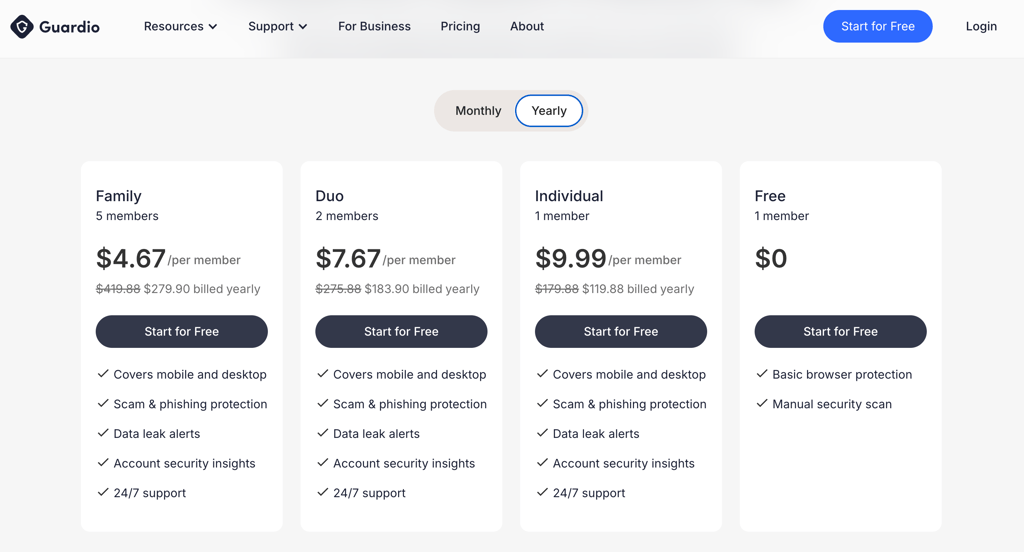
Guardio offers three paid plans – Individual, Duo, and Family, plus a Free plan. All paid plans come with a 3-day money-back guarantee, which is short but useful for testing the service before committing. The plans are also divided into Monthly and Yearly subscriptions, with the Yearly option always the more affordable option in the long run.
Guardio Individual Monthly plan costs $14.99, Duo Monthly is $11.50 per member (two allowed), and Family Monthly is $7.00 per member (five allowed). The Free plan is available without a subscription, but compared to the paid plans, it offers only basic protection.
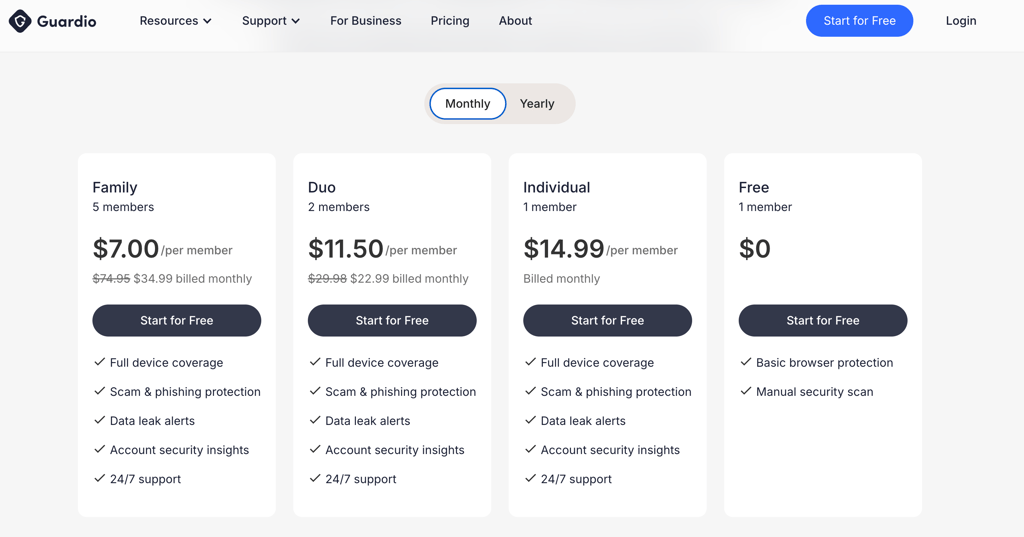
Meanwhile, Guardio Yearly plans offer better monthly pricing, but you will have to pay the full amount upfront. So, Guardio Individual Yearly costs $9.99/month and $119.88/year, Duo Yearly is priced at $7.67 per member per month and $183.90/year, and the Family Yearly is $4.67 per member per month and $279.90/year.
McAfee offers a completely different pricing model, with three annual individual plans that include identity theft protection tools. The plans are McAfee+ Premium Individual for $49.99/first year (renewal price $149.99/year), McAfee+ Advanced Individual for $89.99/first year (renewal price $199.99/year), and McAfee+ Ultimate Individual for $199.99/first year (renewal price $279.99/year).
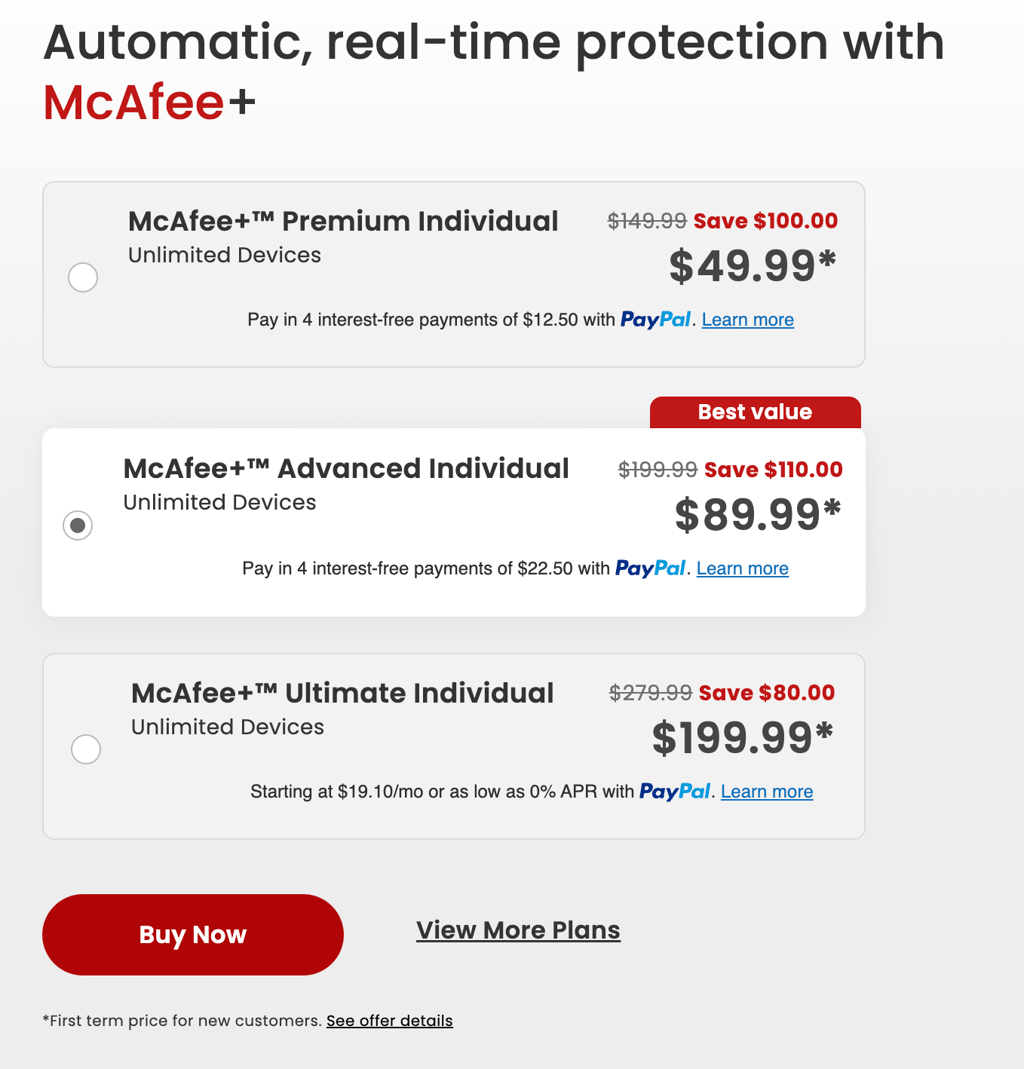
All of these McAfee+ plans include identity theft protection tools, but each tier builds on the previous. So, if you want essential scam protection, identity theft insurance, and loan transaction monitoring, you should pick the McAfee+ Ultimate Individual. If you only need essential scam protection and insurance, McAfee+ Advanced should do. If you only need the essentials, McAfee+ Premium covers them but does not offer insurance.
Comparing Guardio and McAfee prices is not simple, as Guardio is somewhat stronger in identity theft protection. Still, unlike McAfee, it is not a fully fledged antivirus with device protection and online data security. But comparing them based on price alone, McAfee is the cheaper option.

Guardio vs McAfee: which one should you choose?
Guardio would be my top choice for everyday protection. It works where you’re most likely to encounter threats – while browsing, opening emails, following links, or checking messages. It detects phishing attempts, blocks malicious websites and downloads, and monitors your personal information for leaks. It won't scan your entire device like an antivirus, but that's not really what Guardio is built for. Its strength is catching scams and other online threats before you fall for them.
McAfee makes more sense if you want one subscription to cover almost everything. You get a full antivirus alongside dark web monitoring, scam detection, and identity protection. More expensive plans offer considerably more, adding features such as personal data removal, credit and financial monitoring, identity recovery assistance, and up to $2 million in identity theft coverage. Just keep in mind that many of these extras depend on your plan and where you live.
You could use Guardio and McAfee together, and there is some logic to it: Guardio would handle much of the browser-level scam prevention. At the same time, McAfee would protect the device itself and provide broader identity monitoring. However, most people don't need both. There's enough overlap that I'd rather choose based on what I actually need – Guardio for focused online threat prevention or McAfee for a much wider security package.
How we tested these softwares
To prepare this Guardio vs McAfee comparison, the Cybernews research team and I evaluated both services using a structured testing methodology based on real-world security scenarios. We rated four main areas, weighting each according to its importance for protecting users and their personal information online:
- Security tests (35%). After installing each service, we conducted simulated phishing and malware attacks to assess how effectively each tool identified, blocked, and responded to potential threats.
- Identity theft prevention (30%). We created fictional personal information and deliberately exposed it on dark web forums. We then monitored how quickly and accurately each service detected the exposed data and alerted us.
- Ease of use (20%). We evaluated the installation process and tested the available browser, web, and mobile interfaces. We focused on overall usability, navigation, and how easily important security features could be accessed and managed.
- Pricing and value (15%). We compared each service's pricing and features with those of competing identity protection solutions. We also considered the scope of protection, everyday usability, available plans, customer support, and overall value for money.
Guardio vs McAfee: key takeaways
Guardio and McAfee solve somewhat different cybersecurity problems, each with a unique take on identity theft protection. I preferred Guardio for everyday scam prevention, particularly because it catches threats where you're most likely to encounter them – on websites, in emails, through links, and in messages. McAfee is harder to beat on sheer feature count, though, especially if you want antivirus, credit monitoring, and identity recovery under one subscription.
Neither is a clear winner for everyone. I'd recommend Guardio for focused threat prevention and McAfee if you need one service to cover as much of overall security as possible.
Other reviews you may be interested in:
Cloaked vs Guardio: which security & privacy tool should you choose?
Aura vs Complete ID: features, pricing, and privacy compared
Home Title Lock vs LifeLock: which one protects you better?
OmniWatch vs Aura: which identity theft protection tool is right for you?
FAQ
Can Guardio replace my antivirus?
No, Guardio can not replace your antivirus. The software primarily focuses on protecting your data and identity online, and does not offer full system scans and device protection.
Does McAfee include identity theft insurance?
Yes, McAfee includes identity theft insurance. Depending on your selected plan and location, you may be eligible for up to $2 million in insurance compensation if your identity is stolen while using McAfee.
Is Guardio legitimate?
Yes, Guardio is a legitimate identity theft protection software with 8 years of experience in the field. It focuses on browser-based data protection and leak prevention, using secure, trusted practices.