Cloaked vs Guardio: which security & privacy tool should you choose?
Our in-house experts test identity theft protection services themselves, using real-world scenarios and established testing methods. We look at how well each service monitors personal information, how quickly and clearly it sends alerts, what recovery support it offers, and how it handles customer data.
We assess every provider using the same criteria and explain our testing process clearly, so readers can compare services and make a more informed choice.
Learn more
The internet offers endless convenience, but it also comes with growing risks. A single careless click or download can expose you to threats like phishing scams, data breaches, spam calls, or even identity theft. As these risks become more common, many people are turning to digital protection tools to safeguard their personal information and stay secure online.
Two services that often come up in this space are Cloaked and Guardio. While both aim to improve your online safety, they take noticeably different approaches. Guardio focuses on real-time browsing protection, helping block threats as you navigate the web. Cloaked, on the other hand, prioritizes privacy by giving you greater control over how your personal data is shared.
To help you understand how they compare, I worked with the Cybernews research team to examine both tools closely. Drawing on verified user feedback and provider information, this guide breaks down their key differences and strengths so you can decide which solution best fits your online security needs.
Guardio vs Cloaked overview
Before I compare Cloaked vs Guardio in detail, here’s a quick overview table showing how both tools measure up. This will give you a snapshot of their features and strengths.
| Guardio ITP | Cloaked | |
| ⭐ Rating: | ||
| 🥇 Overall rank: | #6 out of #20 | #9 out of #20 |
| 💵 Price: | From $5.07/month | From $9.99/month |
| ✂️ Free version: | Yes, basic free plan | Yes, 14-day free trial |
| 🖥️ Platforms: | Windows, macOS, Linux, iOS, Android | macOS, iOS, Android, web/browser |
| 💰 Credit monitoring: | No | No |
| 🔒 Insurance: | Yes, select eligible plans/users | Yes, up to $1M (paid subscription only) |
| 🔥 Coupons: | Guardio Identity Protection coupon 35% OFF | Cloaked coupon 50% OFF |

About Guardio
Guardio is a browser-based cybersecurity tool designed to protect users from online threats that may arise during everyday browsing. It primarily works as an extension for Chromium-based browsers (Chrome, Edge, Opera) but it also has dedicated mobile apps for Android and iOS.
Guardio provides real-time online protection by blocking malicious websites, phishing attempts, and other threats, as well as detecting unsafe downloads. On mobile, this protection extends to SMS and email, where the apps identify fraudulent links and phishing keywords to keep users safe.
While Guardio helps prevent malware and other malicious attacks, it is not a full-fledged antivirus and does not perform system-wide scans or remove threats. However, it goes beyond basic browser security by offering up to $1M in identity theft insurance. Additionally, Guardio provides identity monitoring (email addresses and phone numbers) by scanning the web and dark web, helping users detect potential data leaks.
About Cloaked
Cloaked is a cybersecurity tool that focuses on user data privacy. It reduces the amount of sensitive user information available online, making it harder for cybercriminals, marketers, and data brokers to access. This helps users lower their risk of encountering threats such as phishing attacks, identity theft, and targeted scams.
To achieve this level of privacy, Cloaked uses multiple layers of protection. It generates unique temporary aliases for emails, phone numbers, and other credentials whenever users’ personal details are requested online, keeping real information hidden. The platform also monitors the web and dark web for compromised data and helps remove exposed information to keep users’ data secure.
Cloaked goes further by offering an encrypted password manager, up to $1M in identity theft insurance, and the ability to block spam calls and robocalls. It’s available as both a browser extension and as mobile apps for Android and iOS.
Guardio vs Cloaked: features comparison
Guardio and Cloaked are both excellent online security tools. However, as mentioned earlier, they work in different ways and cater to different aspects of digital protection. In this section of my Guardio vs Cloaked review, I’ll break down their key features side by side so you can easily determine which one best fits your privacy and security needs.
| Feature category | Guardio | Cloaked |
| Browser/web protection and malicious site blocking |
|
|
| Identity and data broker monitoring/dark web alerts |
|
|
| Spam calls/phone alias/email alias |
|
|
| Scope of protection (devices/browsers vs overall digital identity) |
|
|
From the comparison shown above, it’s clear that the question of ‘Guardio vs Cloaked which is better’ doesn’t have a straight answer. The best choice depends on the security features you value most.
Essentially, Guardio is ideal for frequent web users who visit many websites, download files, and want their devices to stay protected from malware. On the other hand, if your main concern is identity privacy, reducing spam, and protecting personal information, Cloaked is the better choice.
Guardio vs Cloaked: pros and cons
Both Cloaked and Guardio offer unique benefits, but each has a few trade-offs to keep in mind. They include:
Guardio vs Cloaked: plans & pricing
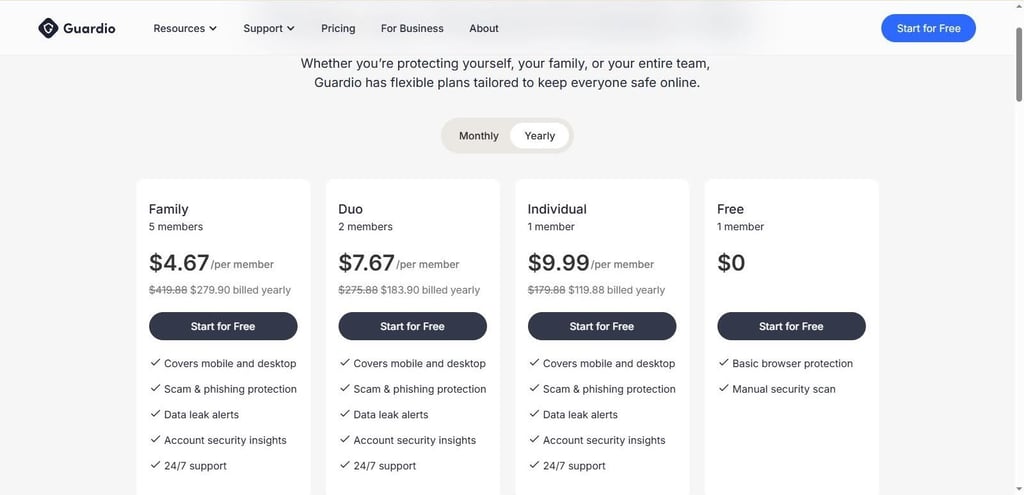
Guardio has a clear pricing model, offering Individual, Duo, and Family plans with either monthly or yearly billing. It’s also worth noting that each plan includes a 3-day money-back guarantee, allowing users to test the features before committing. Additionally, Guardio offers a free plan that provides basic browsing protection and manual security scans.
The Individual plan costs $14.99 per month or $119.88 per year and offers more advanced real-time browser protection than the free plan.
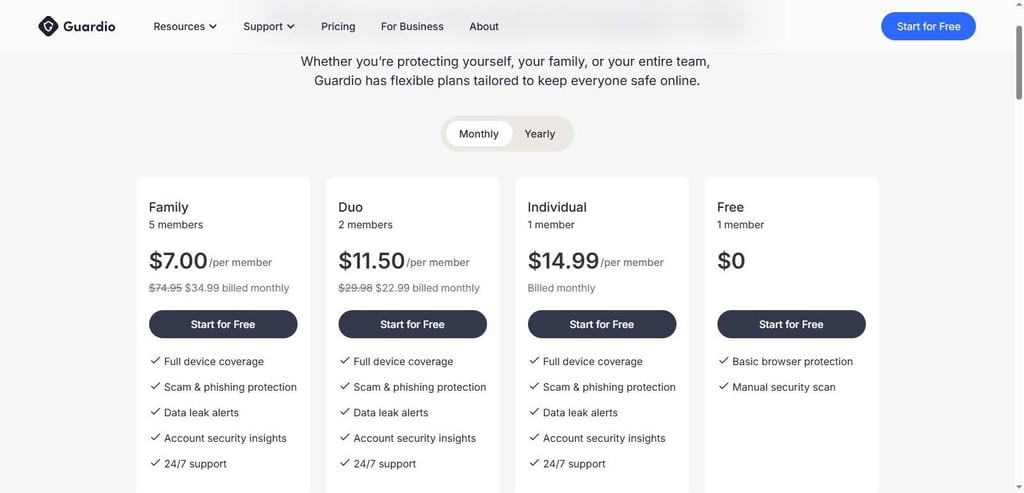
The Duo plan costs $11.50 per user per month, or $183.90 per year for two users. In comparison, the Family plan costs $7 per user per month, or $279.90 per year for five users. Both plans include all the features available in the Individual plan.
If you look closely, you’ll see that Guardio rewards long-term subscriptions and larger user plans with significant savings. I find the 1-year Family plan to be the best value, offering full features for just $4.67 per user per month for five members.
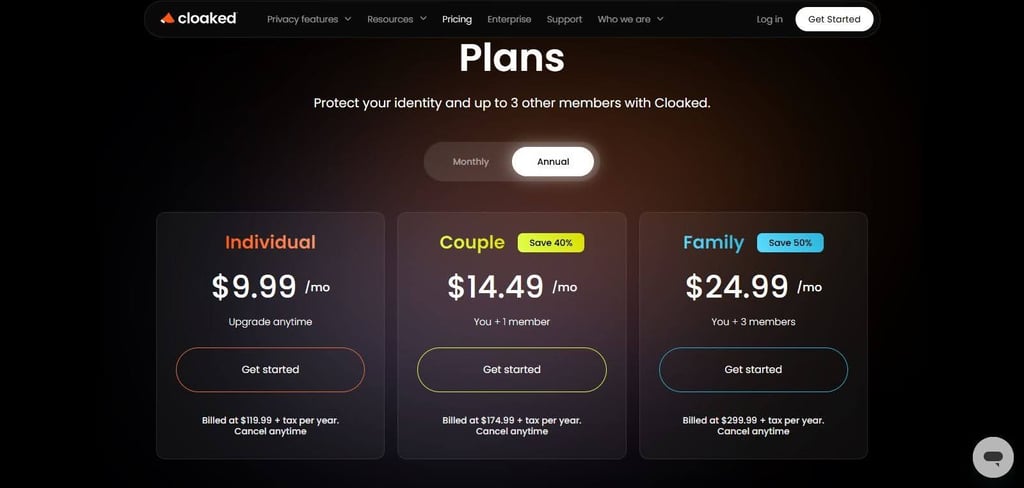
Cloaked uses a similar pricing model, offering Individual, Couple, and Family plans billed either monthly or yearly. It doesn’t have a free version, but each paid plan includes a 14-day free trial.
The Individual plan costs $12.49 monthly or $119.99 yearly and includes data removal, monitoring, and a password manager.
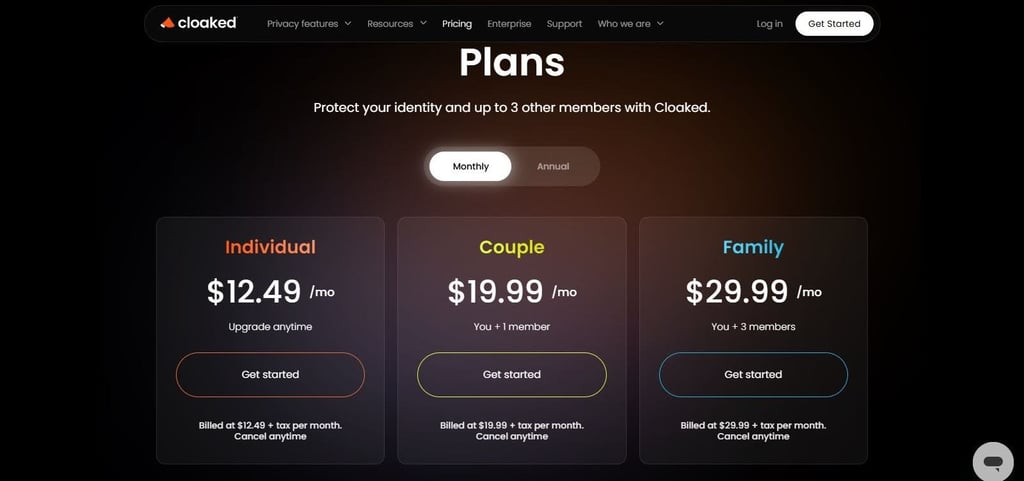
For users who want to share one subscription, the Couple plan offers solid value at $19.99 monthly or $174.99 yearly. It supports two users with full access to every feature, making it cheaper than paying for two Individual plans. The Family plan builds on this by covering up to four users at $29.99 monthly or $299.99 yearly.
When comparing Guardio vs Cloaked, it’s clear that both tools serve different purposes, so it isn’t straightforward to compare their pricing directly. Ultimately, the better choice depends on your personal preferences.
If your main goal is staying safe while browsing, Guardio gets the job done at a price that’s reasonable for its niche. If you prioritize protecting personal information and reducing spam, Cloaked offers stronger privacy, though its pricing is generally considered high for its niche. Overall, Guardio provides better value with its family plan, where the cost per user drops significantly.
Cloaked vs Guardio: which one should you choose?
Guardio is a great choice if you spend a lot of time online and want active protection against malware and other online threats. It offers real-time alerts, phishing protection, and Dark Web monitoring. The extension also blocks harmful websites and unsafe downloads.
If privacy and control over your personal information matter most, Cloaked provides the tools you need. It removes your data from brokers, reduces spam, and hides contact details with secure aliases. The platform also includes an encrypted password manager, giving you stronger control over how your information is shared and protected.
For balanced protection, you can use both tools together. If that isn’t suitable, you can combine one with other tools instead. For example, pairing Guardio with an alias service helps protect your browsing and identity. Using Cloaked alongside a basic antivirus keeps your data private while guarding against malware.
Remember, neither of these tools replaces a full antivirus, which is essential for protecting your devices. You should also practice good online habits: use strong passwords, keep software updated, and stay alert while browsing.
How we tested these softwares (methodology)
To provide a comprehensive Cloaked vs Guardio review, the Cybernews research team and I used a rigorous testing methodology. Each tool was evaluated through a series of real-world tests to see how it performs. Our analysis focused on four key components, each weighted according to its importance in keeping your digital life safe. They are:
- Reviewing security tests (35%). After installing each tool, we ran a simulated phishing and malware attack. We then observed how each tool detected, blocked, and responded to the threat.
- Reviewing identity theft prevention (30%). We created fake personal data and deliberately posted it on dark‑web forums. Then we measured how quickly and accurately each service detected and reported it.
- Ease of use (15%). We checked the installation of the extensions and looked at the web and mobile apps, focusing on how easy and intuitive they are to use. We also reviewed how simple it is to access key features.
- Pricing and value (20%). We compared the features and costs of the tools, along with similar competitor offerings, to see if they provide strong protection at a fair price. We also looked at coverage, ease of use, daily experience, service options, and 24/7 support to determine the best overall value.
Guardio vs Cloaked: key takeaways
Both Guardio and Cloaked are great security tools, but they address different sides of online safety. On one hand, Guardio keeps your browsing safe with real-time alerts and phishing protection. Meanwhile, Cloaked gives you the tools to manage your personal data, phone numbers, and overall online identity.
If you’re trying to figure out which one fits better, think about what matters most to you. You can use their money-back policies, assess your main online risks, and choose accordingly. So, this Cloaked vs Guardio review makes it clear that both are valuable, but your decision should match your main online concern.
Other reviews you might be interested in:
LifeLock vs IdentityForce: which identity theft protection service is better?
Aura vs Complete ID: features, pricing, and privacy compared
Home Title Lock vs LifeLock: which one protects you better?
OmniWatch vs Aura: which identity theft protection tool is right for you?
FAQs
Can Cloaked replace my antivirus?
No, Cloaked isn’t meant to replace antivirus software. It focuses on privacy protection, identity control, and reducing spam, not on blocking or removing malware. For full system security, it’s best to use Cloaked alongside a trusted antivirus program.
Does Guardio include identity theft insurance?
Yes, Guardio’s premium plan includes identity theft insurance worth up to $1 million. This coverage helps you recover costs if your personal details are stolen or misused, adding an extra layer of financial and identity protection.
Will Cloaked aliases work on all websites?
No, not always. Some websites detect and block temporary or masked emails and phone numbers. However, Cloaked aliases work smoothly with most major platforms, helping you protect your real contact details from spam and unwanted data collection.
Is the app Cloaked legitimate?
Yes, Cloaked is a legitimate privacy and identity protection app. It’s backed by real security practices, transparent policies, and proven results in helping users mask personal data, manage aliases, and control what information gets shared online.