LifeLock vs IdentityForce: which identity theft protection service is better?
Our in-house experts test identity theft protection services themselves, using real-world scenarios and established testing methods. We look at how well each service monitors personal information, how quickly and clearly it sends alerts, what recovery support it offers, and how it handles customer data.
We assess every provider using the same criteria and explain our testing process clearly, so readers can compare services and make a more informed choice.
Learn more
2026 is a turning year when numerous cybersecurity products update their services according to contemporary AI benefits and challenges. The changes affect two well-known identity theft protection services, LifeLock and IdentityForce, which I will compare in this article.
LifeLock (owned by Gen Digital) now offers improved credit monitoring. Meanwhile, IdentityForce (owned by TransUnion) made fewer changes to personalize identity theft recovery plans and breach risk assessment.
Both services offer dark web monitoring, fraud detection, alerts, and good insurance policies. But there are significant differences that place LifeLock a few steps ahead, which I will review shortly.
I, together with the Cybernews research team, reviewed official product disclosures, pricing pages, feature lists, and consistent user feedback to compare LifeLock and IdentityForce across security, monitoring depth, and overall value. In this LifeLock vs IdentityForce comparison, I will cover their features, credit monitoring, security posture, pricing, user sentiment, and provide a final verdict.

LifeLock vs IdentityForce overview
| Norton Identity Theft Protection | Identity Force | |
| ⭐ Rating: | ||
| 🥇 Overall rank: | #3 out of #20 | #10 out of #20 |
| 💵 Price: | From $10.42/month | From $19.90/month |
| ✂️ Free version: | Yes, 30-day free trial | Yes, 30-day free trial |
| 🖥️ Platforms: | Web, iOS, Android | Web, iOS, Android |
| 💰 Credit monitoring: | Yes (up to 3 bureaus) | Yes (3-bureau on UltraSecure+Credit) |
| 🔒 Insurance: | Yes, up to $3M (Total plan) | Yes, up to $2M (family) |
| 🔥 Coupons: | Norton LifeLock coupon 16% OFF! | Identity Force now starting at $19.90/month |
About LifeLock
LifeLock was released in 2005 and merged with Avast to form Gen Digital, one of the current leaders of the cybersecurity industry. LifeLock was included in Norton's portfolio, which also packs top-notch antivirus, available to consumers through Norton 360 with LifeLock bundle.
It is also available as a standalone service. Its Core, Advanced, and Total plans are tailored to different individual needs, and now all plans include automatic data removal from data brokers' sites. LifeLock now monitors Equifax and TransUnion on the starter plan, and three credit bureau monitoring starts from the second-tier.
It also offers one of the best insurance policies I've seen. Now it includes a $10,000 scam reimbursement, alongside up to $3 million identity theft insurance on the top-tier Total plan.
Visit my LifeLock review for more details.
About IdentityForce
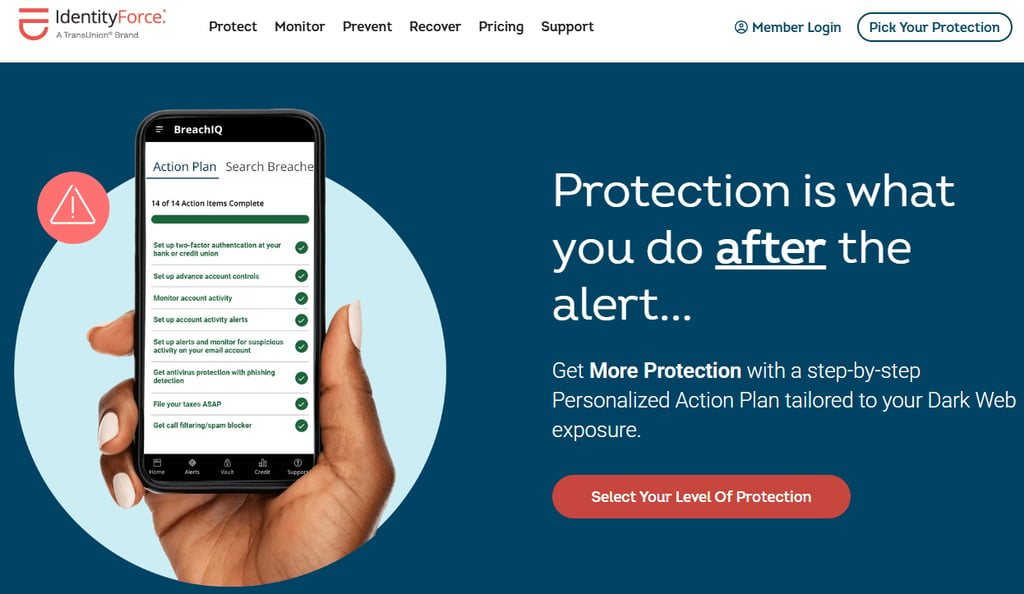
IdentityForce, also launched in 2005, was acquired by TransUnion in 2021. It benefits from in-depth TransUnion reports and offers personalized identity theft recovery plans, including dedicated specialists and a personal online safety assessment score.
It also offers UltraSecure Individual and UltraSecure Family plans. The latter adds child credit activity monitoring for up to 10 children, among other benefits. Both plans can be upgraded to +Credit Individual or +Credit Family tiers that add more in-depth credit monitoring and reports, and increase insurance to up to $2 million per adult.
IdentityForce cost is quite pricey, but it packs additional cybersecurity benefits like online PC protection and a VPN for mobile. I like that it assigns a risk score for each personal data leak on the dark web, outlining really important ones.
Our IdentityForce review has more information.
IdentityForce vs Lifelock: features compared
Both identity theft protection services are feature-rich. With Cybernews researchers, we created a side-by-side comparison table to see which offers more value.
| Feature | LifeLock | IdentityForce |
| Starting price | $10.42/month | $16.66/month |
| Credit bureau monitoring | Three credit bureaus (two on starter plan) | Three credit bureaus (none on starter plan) |
| Dark web monitoring |
|
|
| SSN monitoring |
|
|
| Social media monitoring |
|
|
| Home title monitoring |
|
|
| 401K/investment accounts alerts |
|
|
| Bank account alerts |
|
|
| Family plan availability |
|
|
| Identity restoration specialists |
|
|
| Personal data removal |
|
|
| Auto-renewal price increase |
|
|
| Insurance coverage | Up to $3 million per adult | Up to $2 million per adult |
| Additional insurance | Up to $10K scam reimbursement | None |
| Cybersecurity bundle | Only with Norton 360 bundle (VPN, antivirus, password manager, parental controls) | All plans include a VPN for mobile, anti-key logger, anti-phishing protection, and a password manager |
Both services have similarly good personal data leak and identity theft scam monitoring. However, LifeLock now offers a personal data removal from the broker sites tool, which typically costs a separate subscription. But to get its top-rated antivirus, you must get it through the Norton 360 bundle.
IdentityForce includes additional cybersecurity benefits on all plans, which are essentially safe browsing tools. Norton, on the other hand, is a leading cybersecurity brand, and independent testers like AV-Comparatives have verified its antivirus.
Although LifeLock is more affordable, it also has a steep auto-renewal price increase after the first year. You may end up paying up to $30.41/month for Norton 360 with LifeLock. Still, that is just a bit lower than IdentityForce for a wider range of benefits, making LifeLock the winner.
LifeLock vs IdentityForce: main differences
IdentityForce vs LifeLock offer different cybersecurity benefits, credit bureau monitoring options, insurance coverage caps, and pricing models.
Firstly, you can get LifeLock with the Norton 360 bundle that offers more tools, like antivirus and parental controls. IdentityForce includes its online safety benefits on all plans, but they are significantly more limited.
LifeLock now offers two credit bureau monitoring on its starting Core plan, and monitors three credit bureaus on all other plans. IdentityForce does not monitor credit bureaus on most affordable plans, and monitors three of them with the +Credit plan upgrade.
LifeLock also offers a bigger up to $3 million identity theft insurance policy, compared to IdentityForce's $2 million. Lastly, it is more affordable during the first year, but the LifeLock cost per month increases afterwards. Meanwhile, IdentityForce prices stay the same, and they promise refunds if the prices go up.
Lifelock vs IdentityForce: credit monitoring
Credit monitoring is paramount for identity theft protection, so let's review it more closely. I don't like that not all IdentityForce plans include credit bureau monitoring. If you don't subscribe to the +Credit plan upgrades, it won't monitor a single one.
Meanwhile, LifeLock 2026 update added two credit bureaus (TransUnion and Equifax) monitoring on the Core plan. Upper tiers monitor all three, so it's a good improvement from what was previously its setback.
But if you're primarily using TransUnion, IdentityForce has strong advantages. It offers a credit score simulator that outlines how different scams and financial choices affect your credit score. It also offers quarterly three-bureau credit reports, compared to LifeLock's annual. Both services use the VantageScore 3.0 model.
Keep in mind that credit monitoring does not prevent identity theft, but only alerts of possible scams. However, even with more limited cybersecurity benefits, IdentityForce wins the credit monitoring comparison, but only on more expensive plans.

Compatibility and customer support
Both LifeLock and Norton can be used on multiple devices. They work perfectly on Windows PCs, MacBooks, iOS, and Android smartphones. But keep in mind, neither can be installed on Amazon devices like Kindle, and newer Huawei models.
I found that LifeLock has a more intuitive app design and dashboard. Scanning for viruses on the Norton 360 dashboard is quick, just like connecting to a VPN, and switching to the identity theft protection dashboard takes only a few clicks.
IdentityForce is more complex, but that's not necessarily a bad thing. It provides more details, like the ID safety score and its affecting factors. For beginners, it might be slightly overwhelming, but I found it highly relevant for overall online identity safety.
Regarding customer support, I had two very pleasurable chats with LifeLock's agents.
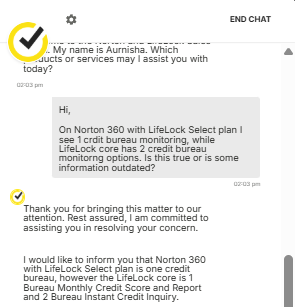
Meanwhile, IdentityForce doesn't have a live chat option, but provides a US phone number and an email to contact them.
| LifeLock | IdentityForce | |
| 24/7 customer support |
|
|
| Dedicated restoration specialist |
|
|
| Live chat |
|
|
| App rating GooglePlay/Apple App Store | 4.4/4.8 | 2.5/3 |
Which identity theft protection service is more secure?
IdentityForce and LifeLock are secure. Both use AES-256 encryption, which is the current data protection gold standard. TransUnion's ownership proves that IdentityForce is legit, as it benefits from PCI DSS and ISO 27002 data security standards. Norton, being one of the major cybersecurity brands, is continuously scrutinized by cybersecurity testers to rate its safety.
Both offer account protection tools like multi-factor authentication and biometric login verification. However, in 2023, hackers targeted LifeLock with credential stuffing attacks, forcing Norton into strengthening its user account protection.
If you require robust protection across your devices, I recommend opting for Norton 360 with LifeLock bundle. However, if you don't require an antivirus, then IdentityForce lets you focus on better credit reports and financial safety.
It's also worth noting that LifeLock now offers personal data cleanup on all plans, which IdentityForce lacks. The tool is similar to Incogni, but we have yet to test its full capabilities. In this category, both have benefits with a different focus, so it's a draw.
Overall pricing and plans comparison
Before wrapping up, let's review each tool's pricing differences, starting with a comparison table.
| Plan tier | LifeLock Core | IdentityForce Ultrasecure Individual |
| Cheapest monthly price | $10.42 | $16.66 |
| Renewal monthly price | $12.49 | $16.66 |
| Includes credit monitoring | Yes | No |
| Additional cybersecurity benefits | Yes | Yes |
| Insurance | Up to $1.05 million | Up to $1 million |
Firstly, LifeLock is more affordable during the first year. But even after the renewal price increase, it still costs below IdentityForce. IdentityForce also does not monitor a single credit bureau on its most affordable plan, but both monitor all three on upper-tier plans.
Both services offer family plans that protect. However, the most affordable LifeLock Core plan has minimal additional cybersecurity benefits and only includes its data removal tool. Although IdentityForce offers its cybersecurity suite in all plans, Norton 360 with LifeLock stands out due to its bundled ecosystem options, combining identity protection with antivirus, VPN, password manager, and scam detection tools, making it stronger for users who want all-in-one coverage.
Our methodology
This comparison is heavily research-based. Here are the evaluation criteria that the Cybernews team and I used:
- Monitoring coverage depth (25%). I verified how well the chosen service identifies various scams, including identity theft fraud and beyond.
- Credit monitoring strength (20%). I researched how well it monitors credit bureaus, an essential financial scam protection tool.
- Security ecosystem integration (15%). I also considered a wider cybersecurity ecosystem and chose software compatibility across various devices.
- Pricing transparency (15%). To determine the actual price-value ratio, I scrutinized all existing payment plans, looked for hidden fees, and renewal pricing policies.
- Customer support quality (15%). I double checked what customer support options are available and whether they receive positive or negative feedback.
- User sentiment consistency (10%). Lastly, I reviewed first-hand user opinions, app ratings, most common praises and problems for real-world use sentiment.
Final verdict: which identity protection service wins?
Although LifeLock wins 4 out of 6 categories, it's a closer call than it may seem. It all boils down to a broader range of features for a more affordable price, but only when buying LifeLock with the Norton 360 bundle.
IdentityForce can also be your priority choice if you're primarily a TransUnion user. Its top-tier plan offers better credit bureau monitoring, but IdentityForce doesn't monitor any bureaus on its most affordable plans. Also, even after the second-year price increase, LifeLock is still slightly more affordable.
When choosing between the two, I recommend evaluating credit-bureau monitoring first. If you need more frequent credit reports and a better credit score assessment, IdentityForce is a better choice. However, LifeLock is a better identity theft protection service overall, and its robust brand positions additional cybersecurity benefits very strongly.
FAQ
Is LifeLock better than IdentityForce for credit monitoring?
LifeLock has better credit monitoring only on its Core plan, compared to IdentityForce's most affordable subscription. However, IdentityForce offers better credit monitoring on the top-tier plans, which include credit score simulations.
Does IdentityForce offer three-bureau credit monitoring?
Yes, IdentityForce monitors all three credit bureaus, but only on its +Credit add-on to individual and family plans.
Which service has better identity theft insurance coverage?
LifeLock has better identity theft insurance coverage, offering up to 3$ million per adult and up to $10K online scam reimbursement.
Can I bundle LifeLock with Norton antivirus?
Yes, in fact, Norton 360 with LifeLock plans offer an excellent price-value ratio and combine identity theft protection with device-wide cybersecurity.
Are identity theft protection services worth the cost?
Yes, according to the FTC report, US consumers lost over $47 billion to identity theft and related scams. Paying for identity theft protection significantly lowers the chances of losing more money to online scams.