UK police expand live facial recognition surveillance to London Underground
“To see a play, you must now pay with your privacy.”
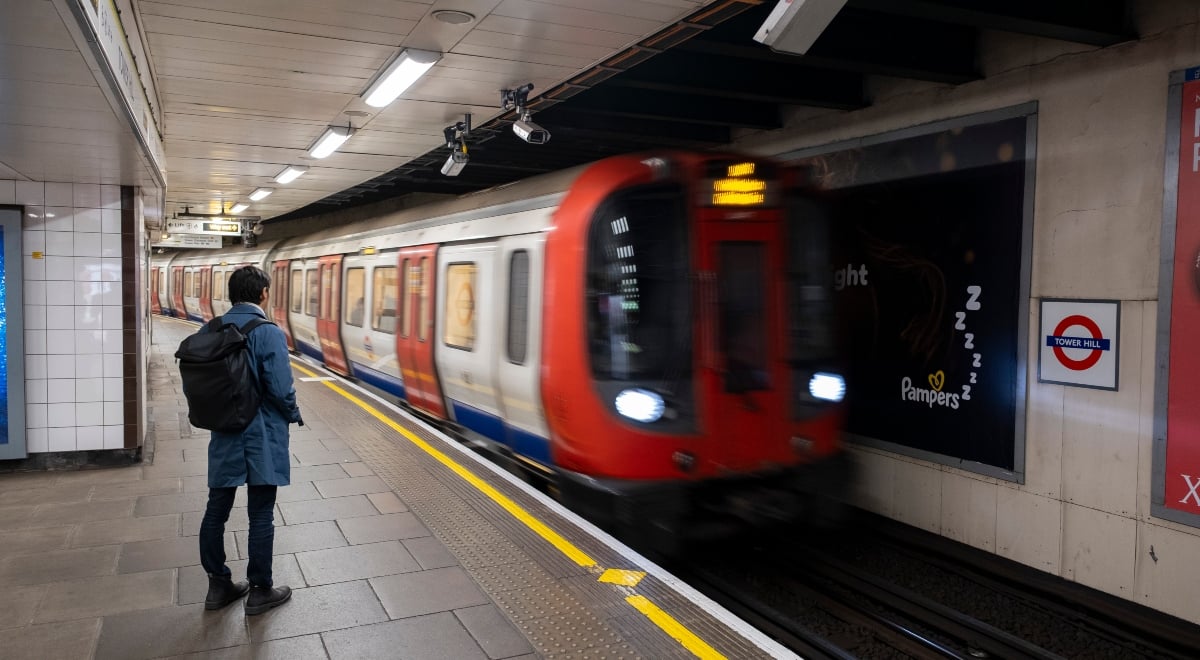
London Underground train. Photo by Mike Kemp/In Pictures via Getty Images.

 Follow us
- British Transport Police extended live facial recognition trials to London Underground stations, starting with London Victoria.
- The pilot, running since February 2026, now alternates between Underground and Network Rail stations until November.
- Privacy group Big Brother Watch calls the expansion a "digital police lineup" that scans innocent commuters without consent.
- Related facial recognition tech helped nearly double solved shoplifting cases and boosted arrests by almost 50% in London.
Key Takeaways by nexos.ai, reviewed by Cybernews staff.
On Tuesday, the British Transport Police (BTP) extended a trial to test the use of live facial recognition at railways and Underground stations in London.
The pilot of live facial recognition began in February 2026 at selected key transport hubs in London, such as London Bridge, Waterloo Rail, Liverpool Street, and King’s Cross.
On Tuesday, the pilot was extended to include selected Transport for London Underground stations, including the London Victoria Underground station.
From now on, the live facial recognition system will alternate between the London Underground and Network Rail stations throughout the trial, which has recently been extended to November of this year.




“This marks an important new stage in our trial of live facial recognition technology,” BTP’s Chief Superintendent Chris Casey says in a statement.
“Expanding deployments into London Underground stations will help us assess the technology in a different transport environment while continuing to refine how it is used across the railway network,” he continues.
To all privacy skeptics, Casey promises that protecting the public, preventing crime, and bringing offenders to justice will remain the focus of the live facial recognition pilot, while at the same time ensuring that the technology is used lawfully, proportionately, and transparently.



Stay updated with our latest stories and follow us on social media
Be the first to discover new stories, ideas, and updates from our team.
Privacy advocacy group Big Brother Watch is expressing its concerns regarding the use of live facial recognition technology.
“Expanding the use of live facial recognition to static cameras is an alarming escalation of an intrusive technology which has already scanned the faces of millions of innocent Londoners,” civil rights expert Silkie Carlo says.
“Forcing people to enter a digital police lineup in the capital’s busiest and most popular destinations is an affront to the idea that you should not have to identify yourself to the police if you have done nothing wrong. To see a play, you must now pay with your privacy.”
The conversation on this topic is live. Join in the discussion.
In January 2026, the Metropolitan Police began testing a new crime-reporting technology that has proven highly effective.
The number of shoplifting offenses that were solved nearly doubled last year. Furthermore, police officers almost made 50% more arrests. Around 80% of suspects were identified through facial recognition software and crime databases.
Sadiq Khan, the Mayor of London, called the new crime reporting technology “a real game changer.”