First a robot outran human half-marathoners, now one has outplayed a ping-pong pro
Ace – that’s the name of an autonomous robot ping-pong player. This week, it played a historic match against a top-level human player and won. What may seem like a milestone in robot sports could presage an array of other applications for similarly adept robots.

Sony's Ace robot returns a shot against player Yamato Kawamata. Sony AI/Handout/REUTERS

 Follow us
Ace – that’s the name of an autonomous robot ping-pong player. This week, it played a historic match against a top-level human player and won. What may seem like a milestone in robot sports could presage an array of other applications for similarly adept robots.
Ace isn’t the first robot to pick up a pink-pong racket. There have been various ping-pong-playing robots since 1983, but until now they were unable to rival highly skilled human competitors.
History was made this week when Ace became the first robot to attain expert-level performance in a competitive physical sport, the maker of the robot, Sony, says.
Mayuka Taira, a professional table tennis player who lost a match to Ace last December, said in comments provided by Sony AI that the robot's strengths "are that it is very hard to predict, and it shows no emotion."
"Because you can't read its reactions, it's impossible to sense what kind of shots it dislikes or struggles with, and that makes it even more difficult to play against," Taira said.
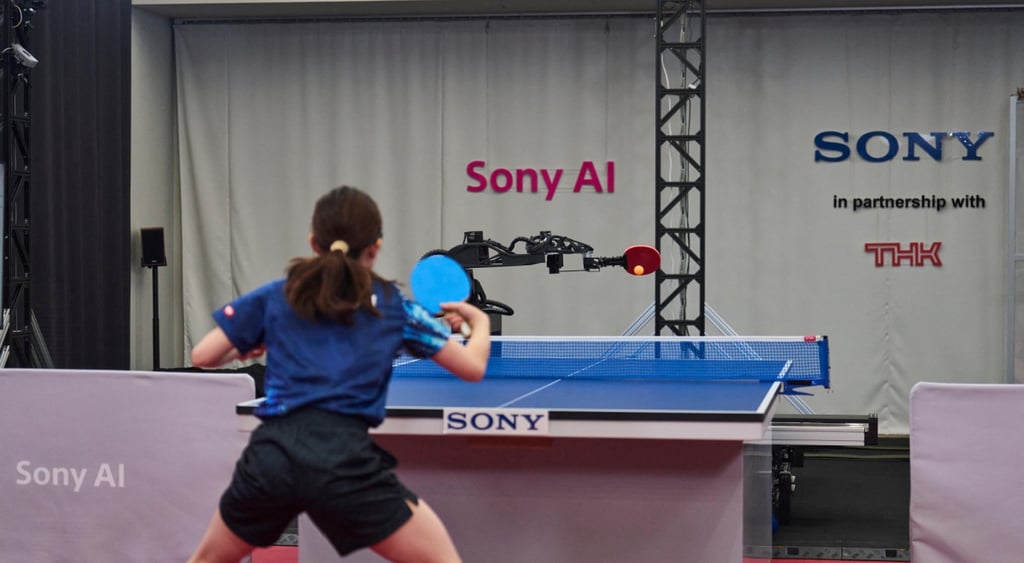
And it did it fair and square, Ace won against a human elite-level and professional players in matches following the rules of the International Table Tennis Federation, the sport's governing body, and officiated by licensed umpires.
In matches detailed in the study, Ace in April 2025 won three out of five versus elite players and lost two matches against professional players, the top skill level in the sport. Sony AI said that since then, Ace has beaten professional players in December 2025 and again last month.
"Unlike computer games, where prior AI systems surpass human experts, physical and real-time sports such as table tennis remain a major open challenge due to their requirements for fast, precise and adversarial interactions near obstacles and at the edge of human reaction time," said Peter Dürr, director of Sony AI Zurich and leader for Sony AI's project Ace.
How did Ace do it and how many joints does it have?
AI systems already have excelled in digital domains in strategy games such as chess and Go and at complex video games.
While video games take place in simulated environments, table tennis requires rapid decision-making, precise physical execution, and continuous adaptation to an unpredictable opponent, Dürr said. The ball moves at high speeds with complex spins and trajectories, pushing humans and robots to operate at the limits of sensing, prediction, and motor control, he added.
Ace's architecture integrates nine synchronized cameras and three vision systems to track a spinning ball with exceptional accuracy and speedy processing time.
"This is fast enough to capture motion that would be a blur to the human eye," Dürr said.
The researchers developed a custom robot platform featuring eight joints. This was the minimum number necessary to execute competitive shots: three for the racket's position, two for its orientation, and three for the shot's speed and strength.
The project's goal was not only to compete at table tennis but to develop insights into how robots can perceive, plan, and act with human-like speed and precision in dynamic environments, Dürr added. According to him, similar techniques could be applied to other areas requiring fast, real-time control and human interaction - such as manufacturing, service robotics, entertainment, and safety-critical physical domains.
Companies worldwide are making advances with robots. On Sunday, for instance, robots outran human runners in a half-marathon race in Beijing.
Robots beat human runners in a half-marathon
A few unnamed Chinese humanoid robots have outrun the fastest human half-marathon runner.
In a race of more than a 100 robots, several beat professional human athletes by over 10 minutes. That’s a dramatic leap from last year's race where most robots failed to finish at all.

Cybernews has reported that the fastest robot, developed by smartphone maker Honor, completed the 21-kilometer course in 50 minutes and 26 seconds, faster than the current human world record. Honor's teams swept all three podium spots, with each robot navigating autonomously rather than by remote control.
According to Reuters, the stark improvement from 2025's inaugural race highlights China's rapid advances in robotics. Nearly half of this year's 100+ robot entrants ran autonomously, fitted with leg designs mimicking elite athletes and liquid cooling technology borrowed from smartphone engineering.
Robots win half-marathons and ping-pong: what’s in it for the industry?
While economically viable applications of humanoid robots mostly remain in a trial phase, the half-marathon's showcasing of these machines' physical prowess highlights their potential to reshape everything from dangerous jobs to battlefield combat, according to Reuters.
"Running faster may not seem meaningful at first, but it enables technology transfer, for example, into structural reliability and cooling, and eventually industrial applications," Du Xiaodi, an Honor engineer on the winning team, told Reuters.






Similarly, the project's goal was not only to compete at table tennis but to develop insights into how robots can perceive, plan, and act with human-like speed and precision in dynamic environments, according to Dürr.
However, Chinese robotics firms are still struggling to develop the AI software that would enable humanoids to match the efficiency of human factory workers.
Experts said the skills on display during the half-marathon, while entertaining, do not translate to the widespread commercialisation of humanoid robots in industrial settings, where manual dexterity, real-world perception, and capabilities beyond small-scale, repetitive tasks are crucial, Reuters reports.
Unlock more exclusive Cybernews content on YouTube.