The number of seniors losing life savings to impersonation fraudsters has quadrupled
The rate at which scammers are draining retirees’ life savings is escalating at an alarming rate. Cybercrooks made off with $700 million last year alone, with most of the losses affecting victims who parted with $100K or more, according to the Federal Trade Commission (FTC).


 Follow us
The rate at which scammers are draining retirees’ life savings is escalating at an alarming rate. Cybercrooks made off with $700 million last year alone, with most of the losses affecting victims who parted with $100K or more, according to the Federal Trade Commission (FTC).
The FTC has seen a more than fourfold increase in reports from older adults who lost $10,000 or more to scammers pretending to be from known and trusted government agencies or companies.
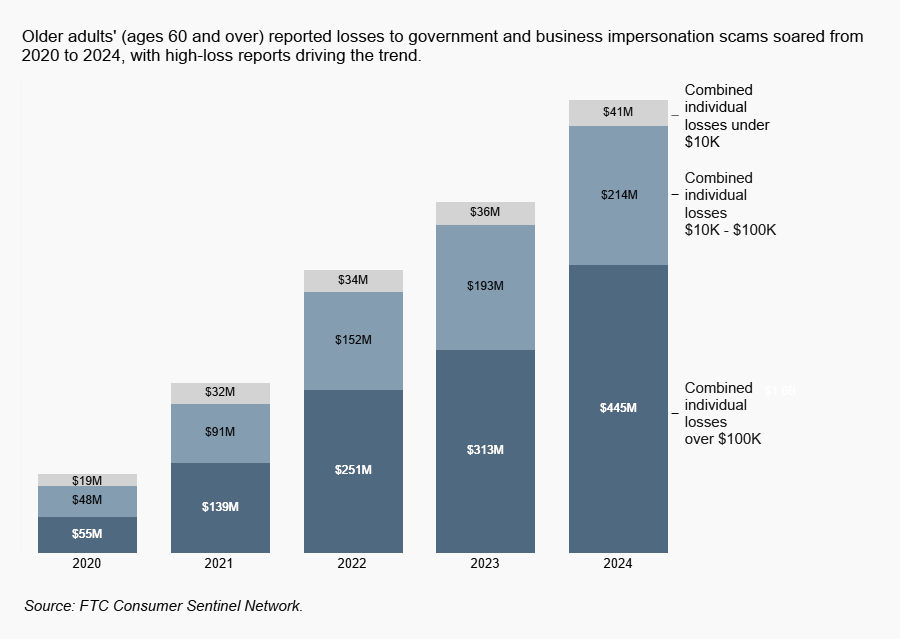
Last year, adults over 60 filed 8,269 reports of losing more than $10,000 to business or government impostors. For comparison, the figure stood at 1,790 reports in 2020, a 4.6-fold increase.
The lost sums grow at even larger rates. In 2020, impostors stole $122 million, and last year, the scam losses reached $700 million.
The worst situation was for those losing more than $100,000 – losses from impersonation scams increased from $55 million in 2020 to $445 million in 2024, an eightfold increase.






Cybercriminals emptied bank accounts and even cleared 401(k) retirement accounts.
“In an ironic twist, recent scams use fake security alerts and other false alarms to prey on older adults’ vigilance about protecting their money and identity to steal from them,” the FTC said in a report.
While younger adults fall for scams too, the FTC said that older adults are “much more likely” to file reports about losing large sums.
In most cases last year, the scams started as phishing. In 41% of reports, phone calls were the initial contact method, 15% of victims indicated the scam started with an online ad or pop-up, and 13% said it started with an email.
Online ads and pop-up security alerts impersonating Microsoft or Apple and containing a number to call were the most frequently mentioned.
What’s surprising is that 33% of elderly victims said they made the transfer to criminals in cryptocurrency. A fifth of victims made a bank transfer, 16% paid in cash.
“Most reports that identified cryptocurrency as the payment method mentioned bitcoin ATMs in the report narrative,” FTC said.
In about 5% of reports with losses of $10,000, and in more than a fifth of the largest losses, gold was used as a payment method or mentioned in a complaint.
What do scammers say?
FTC highlights three typical fake stories that scammers use to get attention.
- Someone is using your accounts: scammers pretend to be from a bank, flagging so-called suspicious activity, or pretending to be an Amazon employee with a message about an unauthorized purchase.
- Your information is being used to commit crimes: fraudsters impersonate government officers or agents, warning that the victim’s Social Security number is linked to a crime like drug smuggling, money laundering, or even child pornography.
- There’s a security problem with your computer. Fake on-screen security alerts often look like they come from Apple or Microsoft and include a number to call. Scammers then say that online accounts have been hacked.
The FTC itself is often impersonated by scammers, who even use the actual names of real staff.
“These scammers say the only way out of the fake crisis is to follow their instructions – which will include sending money to the scammers,” FTC explains.
“There may be layers of complexity to the story, but it’s all a lie aimed at draining your accounts.”
Scammers will assure victims that their instructions will keep money safe, secure their identity, clear their names, help catch criminals, and more.
Most scams still depend on a phone call, which amplifies fear and urgency, making it harder for victims to think clearly and check things out.




How to protect your money?
“Don’t move money to ‘protect it,’” FTC recommends.
“Never transfer or send money to anyone, no matter who they say they are, in response to an unexpected call or message. Even if they say it’s to “protect it.”
The watchdog recommends blocking unwanted calls. This can be achieved by downloading a call-blocking app or using the phone's built-in features.
If you still get a call from someone claiming to be from a government agency or business, hang up and verify: check the official website, look up a phone number there, and contact the company or agency directly for more information. Do not trust phone numbers provided in security pop-ups, emails, text messages, or other unsolicited communications.