Off-grid messaging on the rise as alternative to internet shutdowns and surveillance
Mass surveillance gave rise to encrypted, increasingly decentralized messaging apps. Now, extreme internet shutdowns in Iran are driving demand for even more robust tools: messengers that function entirely offline. People are experimenting with Briar, Bitchat, and other mesh-based apps that rely on Bluetooth and WiFi to stay connected.
Image by Cybernews.

 Follow us
Mass surveillance gave rise to encrypted, increasingly decentralized messaging apps. Now, extreme internet shutdowns in Iran are driving demand for even more robust tools: messengers that function entirely offline. People are experimenting with Briar, Bitchat, and other mesh-based apps that rely on Bluetooth and WiFi to stay connected.
What would you do if the network suddenly goes dark?
Bitchat, a peer-to-peer encrypted messaging app developed by Jack Dorsey, co-founder of Twitter, has recently surpassed one million users on the Google Play Store.
People seem to like it a lot for what it does – creating a Bluetooth mesh that connects people under the same roof or across a neighborhood without requiring any accounts or phone numbers. The app holds a 4.4-star rating and is quickly approaching 2 million users, according to AppBrain statistics.
Bitchat has fans both among campers in remote areas and people in Uganda, who turned to it when the internet was shut down during elections. However, it still has to reach a critical mass of users needed to support long-range messaging.











Briar, another secure messaging app with offline capabilities, has steadily grown to 2.6 million downloads. It’s currently only available on Android.
This app incorporates Bluetooth and WiFi, and can even use memory cards to keep information flowing when the internet is down. It became one of the lifelines in Iran, where 92 million citizens were completely cut off from all internet services, and even calls and text messaging.
These apps do not require an internet connection or servers and work anywhere people use them, including events, protests, travel, or during emergencies.
Bridgefy is yet another mesh network, claiming 12.5 million users. This app was actively used during the 2020 protests in Hong Kong.
Even some phone manufacturers are implementing similar features directly in their phones.
Techno Mobile, a smartphone manufacturer mainly focused on developing markets, has introduced the “FreeLink” feature, enabling calls without any connectivity between two devices supporting the tech.
“No signal? No problem,” the company advertised half a year ago.
“You can call without internet and a SIM card within 500 meters.”
The newest Techno Spark devices already have the updated FreeLink 2.0, which extends the call range to up to 1.5 kilometers in open, unobstructed areas.
“In situations where there is no network coverage or the network is weak, such as outdoor adventures, mountain hiking, concerts, underground parking lots, and other occasions with poor network, direct communication between Bluetooth devices can achieve two-way voice calls, sending and receiving text and voice messages,” the company explains the feature on its website.
Curious what others think about this story? Contribute your thoughts to the debate below.
Freelink also uses Bluetooth for short-range calls. Some reports indicate the use of peer-to-peer communication to route calls or SMS through other devices acting as relays.
Activists during Hong Kong's pro-democracy protests in 2020 turned to apps like Bridgefy, which is powered by the same technology. Bridgefy was also downloaded over 1 million times in Myanmar in 2021 after the country's military seized power.
How does it work?
Device-to-device (peer-to-peer, P2P) messengers do not rely on centralized servers. Instead, they synchronize messages directly between the users’ devices. All data, including messages, is stored only on users’ devices, with no copies or backups in the cloud.
This technology is completely decentralized, and communications are protected by end-to-end encryption. Unlike WhatsApp or other large encrypted messaging platforms, P2P messengers do not have a single point of failure, like a server that can be taken down by authorities.
The Briar app, currently the best implementation of combined radios, was originally targeted at activists, journalists, and other sensitive use cases where privacy is critical.
While it has internet access, it uses the TOR network to hide the user’s identity and prevent any eavesdroppers. If internet access is monitored or severed, users can switch to Bluetooth or WiFi, limiting the adversary’s ability to observe or control the communications.
“Briar’s end-to-end encryption prevents keyword filtering, and because of its decentralized design, there are no servers to block,” the app’s website explains.
“The adversary can’t break standard cryptographic primitives.”

The app also supports takedown-immune forums, with every subscriber keeping a copy of the contents, so there’s no single point where a post can be deleted. The developers had expressed plans to go beyond messaging and add additional applications.
The app also uses a screen lock to protect users’ data, requiring them to enter a PIN, pattern, or password to unlock it. Contacts are added via secure links or in-person QR codes, rather than phone numbers or email addresses.
Designed to bypass surveillance, censorship, and network shutdowns, these systems also have many cons.
Due to limited data rates, many users complain that they are unable to transfer media or that image quality is poor. There is no account recovery, and losing the device or the password means lost access to the data. Users also notice increased battery usage, which is expected because of the increased use of phone radios to transmit data.
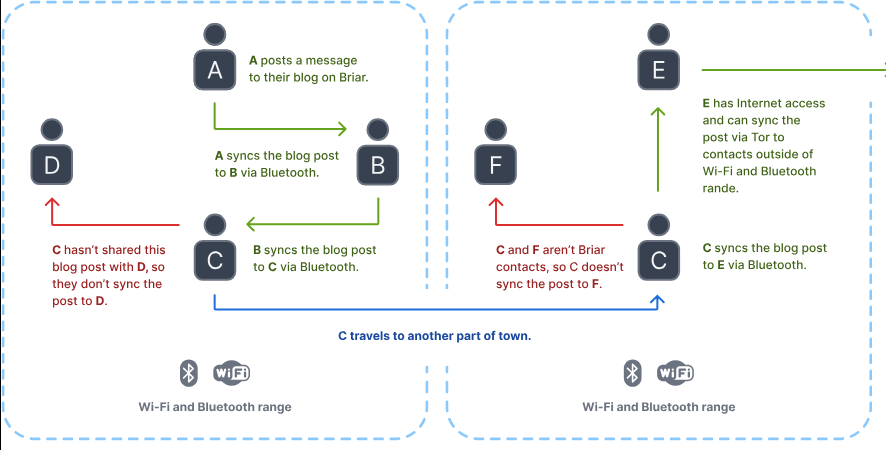
Briar and other resilient P2P messaging technologies, keeping “Iran connected via Bluetooth and WiFi,” were trending on Hacker News over the weekend.
“This should be a lesson for all of us. We should start building and maintaining lightweight mesh networks, just in case. We shouldn't take the world of cooperating ISPs, Meta, Cloudflare, Google, and AWS for granted,” one of the tech pros noted.
Unlock exclusive Cybernews content on YouTube.