Increased security and employee productivity: Why are more companies going with passwordless authentication?
Increased employee productivity is one of the “perks” of passwordless authentication.

Image by Cybernews

 Follow us
Increased employee productivity is one of the “perks” of passwordless authentication.
Keeping your devices safe is crucial, but keeping your work-related devices protected adds another layer of concern. However, signing in to accounts and devices can be a challenge due to the need for multiple passwords.
One way to solve this issue is by implementing passwordless authentication.
Portnox, a security vendor, in collaboration with Wakefield Research, has released a survey that revealed many security leaders are either considering or have already transitioned to passwordless authentication.
The survey was conducted among 200 Chief Information Security Officers (CISOs) in the US, from companies with a minimum annual revenue of $500 million, with representative quotas set for company size, between July 31st and August 10th, 2025.






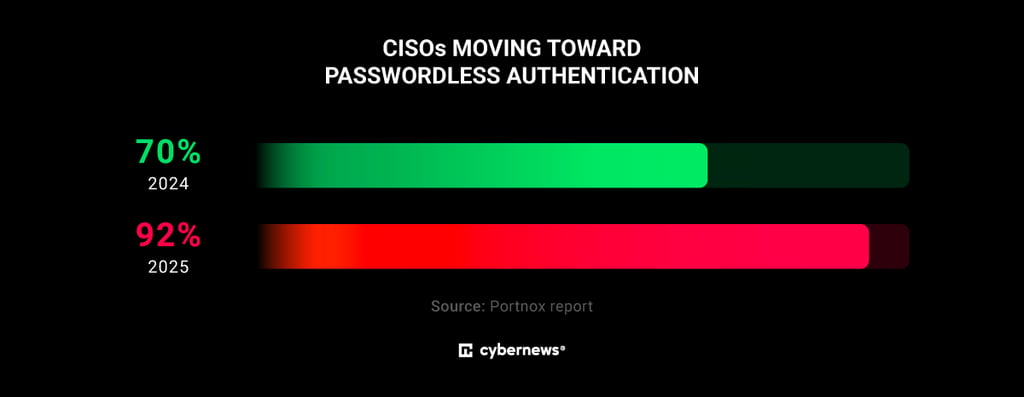
The shift to passwordless authentication isn’t sudden, as 92% of CISOs reported that they have already implemented, are in the process of implementing, or are considering implementing this method, up from 70% in 2024.
Why adopt passwordless authentication?
Passwordless authentication is a method for verifying a user's identity without requiring a password. Instead, they have to go through biometric authentication (e.g., facial recognition, fingerprints), one-time passcodes (OTPs), or physical security keys.
The research suggests that the rise of passwordless authentication can be attributed to a growing number of CISOs recognizing the advantages that this method of authentication offers.
More than half of the respondents report that it reduces the risk of password reuse, phishing, and exploits. Additionally, 41% of respondents say that it has improved employee productivity, and 39% have noticed that it provides stronger security and user experience.
When it comes to password reliability, when asked whether they think that compromised passwords cause most breaches, fewer CISOs believe that passwords are the leading cause, but they do think that it's often “the most common root cause.”
Additionally, the study found that 98% of respondents don’t think multi-factor authentication is sufficient for employee protection, with 96% of respondents thinking that it “can’t keep up with evolving threats.”

Security in times of AI
As people find more ways to utilize AI, including in their workplaces, it also brings some uncertainty.
The research reveals that security leaders who participated in the study “are still defining how to manage AI identities within zero trust frameworks,” which is a security framework that uses tight identity verification for every user or device, no matter if they’re inside or outside the organization’s network.
Seventy-eight percent of respondents expect AI to be responsible for an increase in security workloads, as it also introduces new threats.
The study reveals that while some users find zero trust as “overhyped,” 65% of respondents “anticipate major updates to their security stack to implement zero trust.”






VPNs are being replaced, CISOs are changing their opinions about NAC
The survey also revealed one more trend. Companies and organizations are shifting from VPNs to other zero-trust alternatives. Sixty-seven percent of respondents reported that they have already replaced their VPN technology.
With that being said, a significant number of respondents also shared that they have changed their opinions about Network Access Control (NAC), a security measure that applies policies to control who can access a network.
Ninety-three percent of CISOs reported that their opinion on NAC has shifted to a positive one, primarily due to the adoption of cloud-based NAC.
Security leaders still believe that NAC is essential to zero-trust strategies, an opinion that has not changed since last year.
Unlock more exclusive Cybernews content on YouTube.