Pentagon leaker was gun-loving racist, say case details
From smashed laptops, assassination vans, and bedroom walls covered from top to bottom with camouflage, the courtroom saga of accused Pentagon leaker Jack Teixeira is just beginning.

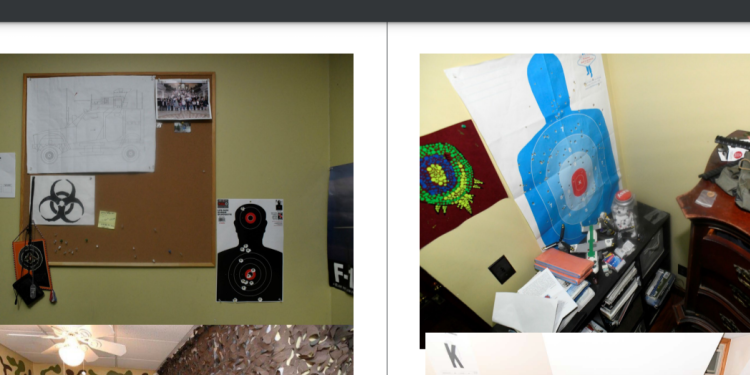
Bedroom of Jack Teixeira | courtlistener.com

 Follow us
From smashed laptops, assassination vans, and bedroom walls covered from top to bottom with camouflage, the courtroom saga of accused Pentagon leaker Jack Teixeira is just beginning.
A Massachusetts District Court judge has postponed Thursday’s expected ruling to determine whether the accused Air National Guardsman will remain in jail while awaiting trial.
Teixeira, who was arrested this month for leaking classified US military documents on Discord, appeared at the bail hearing with his lawyers, shackled in chains.
The defendant asked to be released from prison under restrictive conditions and a $20,000 bail bond.
Meantime, court filings from both sides have revealed a trove of information about the defendant, providing more insight into just who Teixeira really is.







Two sides same coin
Defense attorneys for Airman First Class Jack Teixeira portray the 21-year-old leaker as a misguided youth turned upstanding hometown hero who only now understands the gravity of his criminal actions.
Teixeira’s lawyers submitted an 89-page memorandum in court Thursday; an obvious effort to sway the judge overseeing Thursday’s pre-trial hearing to determine Teixeira’s bail conditions, if any.
The documents argue that Teixeira is far from a flight risk due to his community ties and should be remanded back to his childhood home under the supervision of his parents and military supervisors familiar with the guardsman and the charges against him.
There is no evidence that Mr Teixeira currently, or ever, “had any intent for these documents to become widely available on the internet or desired to disrupt the geopolitical affairs of the United States,” the memorandum claims.
In contrast, US government prosecutors painted a chilling picture of the active duty guardsman in a much shorter 18-page motion filed Wednesday, requesting denial of Teixeira’s release.
They see Teixeira as an unhinged egocentric radical with white nationalist tendencies who regularly glamorized violence, weapons, and mass murder.
Prosecutors say Teixeira presents a serious flight risk, is untrustworthy, and a danger to national security.
The filings also claim the Massachusetts native may still have access to “a trove of classified information” making him a high-value target for hostile nation-states who “could offer him safe harbor and attempt to facilitate his escape from the United States.”
A picture is worth a thousand words
Teixeira’s personal history is conniving and self-serving at best, according to the FBI.
Prosecutors say Teixeira repeatedly engaged in detailed and troubling discussions about violence and murder on the Discord social media platform.
In fact, before joining the military in 2020, his comments about weapons were taken seriously enough for his high school to suspend him.
Teixeira had been found to have applied for gun permits multiple times, denied at least once based on the school suspension.
When the FBI searched his room at the family home after the arrest, multiple weapons were found just feet from his bed.

The arsenal of weapons, included bolt-action rifles, rifles, AK-style weapons, and a bazooka.
Teixeira's father, a former member of the military, had his own cache of licensed weapons, but because they were locked up safely these were not taken from the home.
Perhaps most disturbing, court documents revealed that in July 2022, the defendant used his government computer to search a number of notorious mass shootings by name, such as “Ruby Ridge,” “Las Vegas shooting,” “Mandalay Bay shooting,” “Buffalo tops shooting,” and “Uvalde.”
The Air National Guard has also launched an investigation and forced some in the Massachusetts unit to step down from leadership positions because of his enlistment.
The arrest
Teixeira was arrested by federal agents at the home he shares with his father April 13 – apparently reading a Bible while waiting for the FBI to arrive.
He faces 25 years in prison for stealing hundreds of secret documents he acquired via top-secret military clearance while working for the Air National Guard.

Much of the cache contained sensitive US military and government documents about the Russian-Ukraine war, including troop movements and possible support from other nations.
Boasting about their origin, Teixeira began photographing and posting the documents in a Discord gaming chat room between February 2022 and April 2023, and possibly earlier, according to some reports.
Although the all-male “Thug Shaker Central” chat room barely had two dozen members, one member uploaded some of the leaked docs to another gaming platform, eventually spreading across the internet and catching the attention of the Pentagon.
Researcher Aric Toler from the Dutch OSINT group Bellingcat – specialists in the Russo-Ukrainian conflict – posted his own trove of files Thursday about the case gleaned from Discord files, the web, and government documents.
The evidence
Prosecutors systematically laid out an extensive list of forensic evidence why Teixeira should remain in custody.
Arguments ranged from weight of evidence and personal history, to obstruction of justice and posing a threat to himself, the community, and national security.
Prosecutors say evidence shows Teixeira did not just stumble upon a few classified documents by accident but actively conducted hundreds of keyword searches “in an effort to find classified information and even solicited requests from his online friends for specific information.”
“The defendant accessed these documents in what appears to be a deliberate effort to disseminate this country’s secrets,” prosecutors said.
The amount of data and knowledge collected by Teixeira “far exceeds what has been publicly disclosed on the internet to date,” they said.
He knew where the information was and how to access it, and based on his specialized IT skills, presumably how to disseminate that information without being immediately noticed, the documents said.
The FBI also cited proof Teixeira has already tampered with witnesses and has attempted to destroy evidence that could be used against him.
"There is nothing to suggest that the defendant would not continue to destroy evidence, influence witnesses, and otherwise seek to obstruct justice prior to trial," officials said.
Once Teixeira got wind of an investigation into the leaks, the FBI said he took multiple steps to cover his tracks, including deleting the social media server where he posted the documents, procuring a new phone number and email address, and smashing multiple electronic devices and throwing them in a random dumpster.
Defense lawyers tried to argue that if granted bond and restrictive bail, Teixeira would abide by the deal based on no prior arrest history and limited financial means to flee.
The FBI said Teixeira's history of honoring similar types of binding agreements, such as his military oath to the US, was pretty much "abysmal."