Skyrocketing RAM and storage costs push entry-level PC prices into four-digit territory
Entry-level PC prices have climbed into four-digit territory, leaving the segment in no-man’s land. Gamers can get a better deal by buying a console. For productivity, Apple’s Mac mini is still available at $599. For now. The ongoing RAM squeeze shows no sign of easing and is putting pressure on the upcoming Steam Machine.

Image by Cybernews.

 Follow us
Entry-level PC prices have climbed into four-digit territory, leaving the segment in no-man’s land. Gamers can get a better deal by buying a console. For productivity, Apple’s Mac mini is still available at $599. For now. The ongoing RAM squeeze shows no sign of easing and is putting pressure on the upcoming Steam Machine.
PCPartPicker, a free price comparison website that helps users choose PC components, usually features three PC build guides on its homepage: one for an entry-level gaming PC and one for each of the mid- and high-end machines.
A year ago, an entry-level gaming build would set you back by around $600, while two years ago, an entry-level computer was around the same price.
The situation was not much different five years ago, with a budget PC costing slightly above $600 during the great GPU shortage caused by the cryptocurrency mining boom.
But now, an entry-level PC is $1,000.






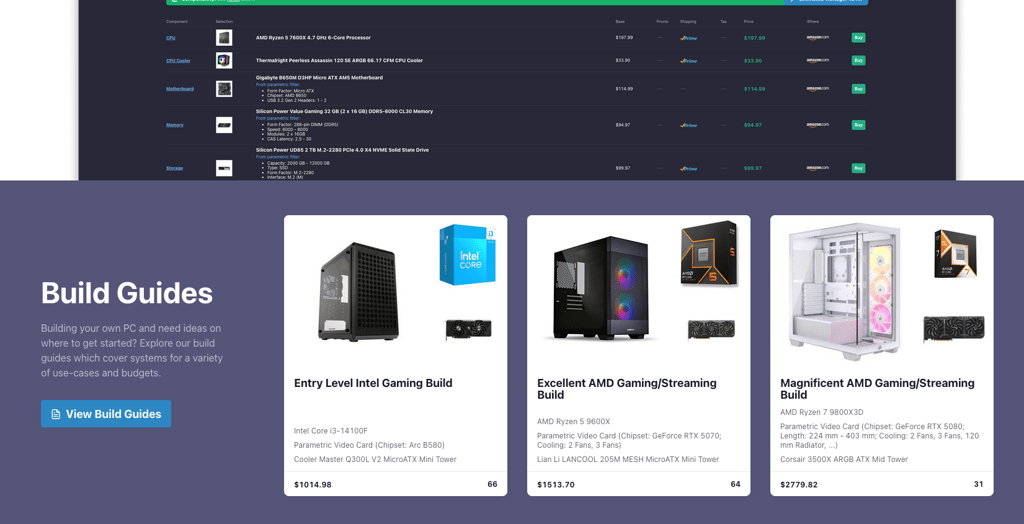
Memory (RAM) is now the most expensive component, costing around $325 for 32GB, nearly a third of the budget. That much RAM is likely unnecessary for a budget machine – halving the amount would save around $100-150.
Other than that, the $1,000 entry-level computer is not that different from those $600 models in the past. They all had just four cores and eight threads on an Intel CPU, which would be significantly outmatched by the cheapest $599 Mac mini or many Windows mini PCs.
An entry-level PC’s graphics card, like an Intel Arc B580, would be outperformed by consoles like the Xbox Series X or PlayStation 5 by a significant margin, delivering better visuals and a better overall experience.
Gamers are also waiting for Valve’s Steam Machine, which is set to release in early 2026. Valve hasn’t yet specified the price, but the machine’s specifications are very similar to those of an entry-level PC. A lot has changed since the device was announced two months ago, and the device will land in a very tough market.






RAM prices are reaching new heights
Since the beginning of November last year, when Cybernews reported on a doubling of RAM prices, the price tags have increased by another 100%.
A 32GB DDR5-6000 RAM kit was averaging below $250 two months ago, but now it is just shy of $500, according to PCPartPicker’s data.
There’s no indication that DDR5 prices are stabilizing, and the price level is already 4.4 times higher than in July 2025, according to 3dcenter.org, a German website focused on PC hardware.
AI and the expansion of data centers are creating the shortage, and three major DRAM manufacturers continue to allocate advanced process capacity to high-end server DRAM and HBM, limiting supply for consumer DRAM, TrendForce explains. The same trend affects NAND chip prices, limiting supply and raising storage costs.
All costs have likely not yet been fully passed down to all product categories in the supply chain, from smartphones to other smart devices that use RAM and NAND chips.
This creates some unusual situations, where some 16GB RAM kits cost nearly as much as a 16GB graphics card: $299 will buy the 16GB version of the Intel Arc A770 Graphics Phantom Gaming at the time of writing. There are also mini PCs and even smartphones with a similar amount of RAM selling for roughly the same price.
TrendForce forecasts further steep increases in DRAM contract prices in early 2026. Conventional DRAM contract prices are projected to surge by roughly 55-60% quarter over quarter in Q1 2026, while NAND flash is expected to jump by 33-38%.
Unlock exclusive Cybernews content on YouTube.