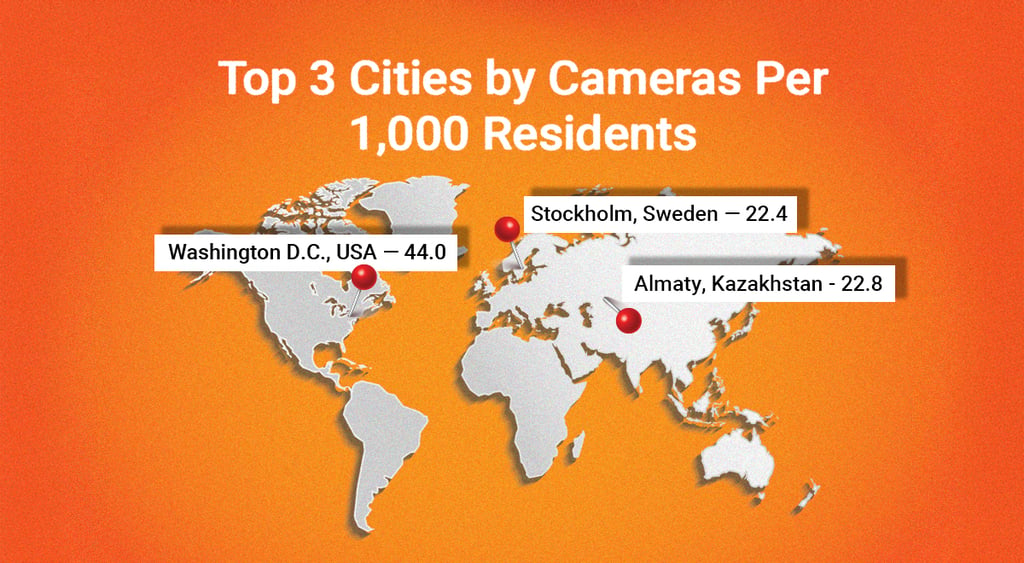
Stockholm and Almaty are the third and second most surveilled cities in the world, but which is the first?
The city at the top of the list is the most surveilled city in the world, with 44 government-accessible CCTV cameras for every 1,000 residents. These networks have supercharged governments’ ability to track people in real time.

By Cybernews.

 Follow us
The city at the top of the list is the most surveilled city in the world, with 44 government-accessible CCTV cameras for every 1,000 residents. These networks have supercharged governments’ ability to track people in real time.
A new report published by NeoMam Studios has measured two types of cameras: those owned by the government and the so-called “plug-in surveillance networks,” where private business and residential CCTV feeds are shared directly with authorities.
The collected data is summed up in a list. At the bottom of the top three is Stockholm in Sweden. The capital of the country has 22.4 cameras per capita. Second on the list is Almaty in Kazakhstan. The country’s largest city scores 22.8 per 1,000 residents. The first is Washington, DC – 44 cameras for every 1,000 residents.
Officials in Washington, DC praise the expansion of the CCTV camera network as one of the most effective means of fighting against a “generational spike in killings and robberies in 2023.”
The number of surveillance cameras in the capital has increased significantly, and the city isn’t looking to stop. In April 2004, Mayor Muriel Bowser, mayor of Washington, DC, announced plans to invest $13 million to increase MPD’s crime-fighting capabilities by nearly tripling the number of CCTV cameras in the department’s possession.






The report also ranked the most surveilled countries by cameras per square kilometre. Washington, DC, ranks 7th with 171 cameras km², more than Moscow or Singapore.
What countries dominate the cameras-per-square-kilometre list?
The number of cameras relative to the population, such as the above-mentioned per capita (cameras per 1,000 people), is a metric that shows how intensely governments monitor each resident. In contrast, cameras per square kilometre show how intensely a specific area is being “watched.”




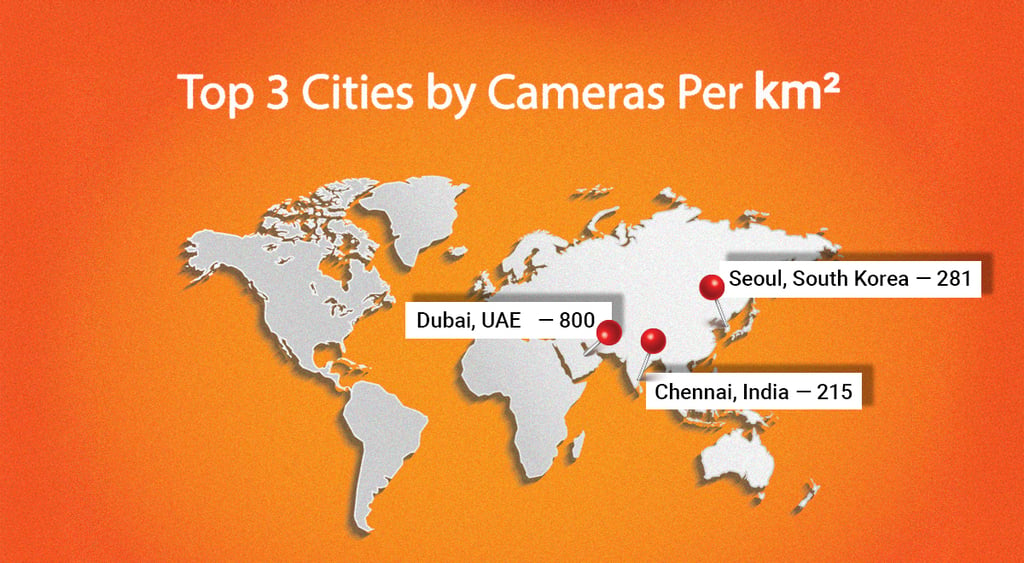
The top 3 are dominated by cities in Asia. Starting at the bottom of the top, it’s Chennai in India with 215 cameras per square kilometre. Second place is Seoul in South Korea with 281 cameras per square kilometre.
Dubai, in the United Arab Emirates (UAE), tops the list. The city has 800 cameras per square kilometre – more than three times more than in Seoul.
The UAE has often been at the center of heated discussions over surveillance lengths and human rights. For instance, just this year, a government surveillance program called Oyoon integrated over 300,000 AI-powered cameras across the city. It enables facial recognition.
Even though the country’s government is calling the expansion of cameras across the country a means to enhance public safety, activists protest that the surveillance is excessive. Critics argue that such extensive monitoring could infringe upon individual privacy rights and civil liberties, one of the latest having been in 2023 during the COP28 climate conference.
