The end of owning your computer, and why so many are pushing back
Late last year, OpenAI reportedly secured roughly 40% of the world's RAM (DRAM) production. Predictably, shortages and price hikes followed. With AI's insatiable appetite, it's increasingly in the spotlight for the strain it's putting on the world's resources. So what's the answer?
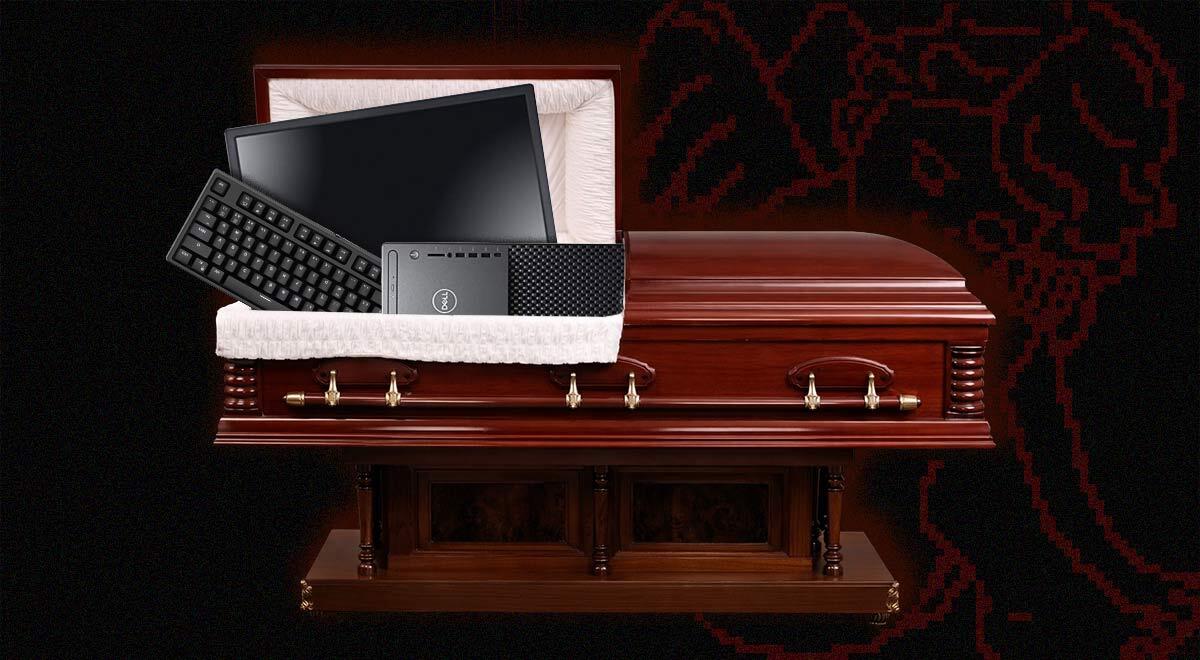
Image by Cybernews.

 Follow us
Late last year, OpenAI reportedly secured roughly 40% of the world's RAM (DRAM) production. Predictably, shortages and price hikes followed. With AI's insatiable appetite, it's increasingly in the spotlight for the strain it's putting on the world's resources. So what's the answer?
According to Jeff Bezos, your PC, no matter how high its specs are, is a museum piece and its days are numbered. This short commentary on the future of home computing and AI lit a fuse online.
As AI becomes more demanding and costs rise, the theory is that consumers could be pushed toward cloud-based processing rather than local hardware. He went on to argue that hard work and heavy lifting will take place in data centers, rather than a high-spec home or work PC.
On the surface, this sounded like a technical observation or off-the-cuff comment. But many listeners heard something else. A future where ownership gives way to access, and where your personal computer quietly stops being yours.




For many, this debate goes far beyond GPUs or inference speeds. It served as a warning about control and an ever-growing list of subscriptions in a world where nobody owns anything, and they are far from happy.
From personal power to remote dependency
Despite the backlash, Bezos' view from a systems standpoint is reasonable. To run large-scale AI models, these are massive computational systems. Advanced models are challenging to run on high-end hardware, whether for performance or low energy consumption. This is why centralizing infrastructure to allow pooled use of power, cooling, and electricity generation is better suited to a commercial environment than a home environment.
The interface in front of you becomes secondary to the much larger system running elsewhere. Ironically, it also feels like a full-circle moment and a return to the "mainframe" era.
Mainframes were early computers that used "dumb" terminals to access centrally located processing power. The personal computer revolution changed that by enabling individuals to process their own information.
Many believe that Bezos' vision will be just another name for reversing that technological advancement – "the cloud". If this trend continues, your PC will become nothing more than a streaming receiver rather than a self-contained machine.
Your operating system, application software, and other creative tools will reside elsewhere. As long as you stay connected and keep your subscription, you will be able to access those items.
Why the industry wants this future
The idea aligns neatly with the strategies of the big technology companies, which are still trying to find the elusive ROI from AI investments that are rapidly becoming money pits.
Microsoft is openly pushing toward cloud-first computing with Windows 365, streaming full desktops to any device. Copilot is being woven into the operating system itself and Office 365 in ways users did not ask for.
The result often feels like a reincarnation of Clippy from the nineties, so frustrating that it prompted the actress Emma Thompson to go into a full-on sweary rant that resonated with most people outside Microsoft's echo chamber.
Big tech companies all benefit from a world where computation happens on their infrastructure rather than yours. From a business standpoint, the appeal is obvious. Selling a product once is far less attractive than having users pay a recurring fee for your services.
Subscriptions deliver recurring revenue by locking users into ecosystems and making switching painful. But when the software, the AI, and the compute all live in the cloud, exit becomes expensive. Something many VMware customers learned the hard way.
Tensions have been building for a while as AI data centers are driving up electricity demand and pushing up household prices. Some residents are making a stand, saying 'no' to AI data centers in their backyard.
The same leaders who preached about wind and solar can now be found not-so-quietly backing coal and nuclear to feed energy-hungry AI data centers. Again, this sharp U-turn exposes how quickly climate ideals bend when compute demand hits the grid.
The price of frictionless computing
Despite the downsides, many supporters of cloud-centric AI believe the tangible benefits outweigh the negatives. In theory, hardware upgrades become less frequent or unnecessary. A cheap old laptop could perform like a new workstation. New capabilities arrive automatically without manual installs or configuration.
On the flipside, the real cost of convenience is your privacy shifts from something you manage locally to something you naively trust others to respect. Finally, without a stable internet connection and a subscription, there is no way of accessing your powerful AI computer in the cloud.






Before we grab our virtual pitches, Bezos was talking about industrial-scale computing and electricity distribution, not home PCs.
Running a personal machine does not require private power plants or perfect uptime.
While cloud infrastructure is essential for training large AI models, inference is what most users actually do, and it already runs locally at acceptable quality.
The question that has had online communities up in arms is whether it is destined to become the default for everything, and whether alternatives will be allowed to remain attractive options.

Local compute represents autonomy. When software runs on your machine, you control the environment. Your data stays closer to you. You decide when to upgrade and what to install.
A future still being contested
Many fear we are heading toward a future where choice quietly disappears. Although local capability will be technically possible, users could be economically discouraged or nudged toward the path of least resistance, ensuring that convenience quietly becomes compulsory.
Jeff Bezos's comments sparked such a fierce response online because they landed on a fault line that runs much deeper than AI hype and subscription fatigue.
Many users in tech communities will proudly declare that they will only trade their PCs in for a cloud replacement when you take it from their cold, dead hands. But beneath the sarcasm, there is a line in the sand where convenience is welcome, but not at the expense of ownership.
Unlock more exclusive Cybernews content on YouTube.