New powerful Linux malware detected targeting critical systems
Highly sophisticated and previously unseen modular Linux malware has been discovered by Check Point Research. With many capabilities, it is specifically designed to attack cloud infrastructure and lurk in virtualized environments that power critical systems.

Image by Cybernews.

 Follow us
Highly sophisticated and previously unseen modular Linux malware has been discovered by Check Point Research. With many capabilities, it is specifically designed to attack cloud infrastructure and lurk in virtualized environments that power critical systems.
The new Linux malware framework, dubbed VoidLink, is currently under development by Chinese-affiliated threat actors. It’s designed for long-term access, surveillance, and data collection, rather than short-term disruption.
“VoidLink is an impressive piece of software, written in Zig for Linux – it is far more advanced than typical Linux malware,” the CheckPoint researchers said.
The malware’s base functionality manages global state, communications, and task execution. At its core, it also includes built-in anti-analysis mechanisms, several rootkits, and tools for profiling.
VoidLink already features over 30 distinct plug-ins, including recon, credential harvesting, persistence, and other utilities, which makes the malware highly customizable.






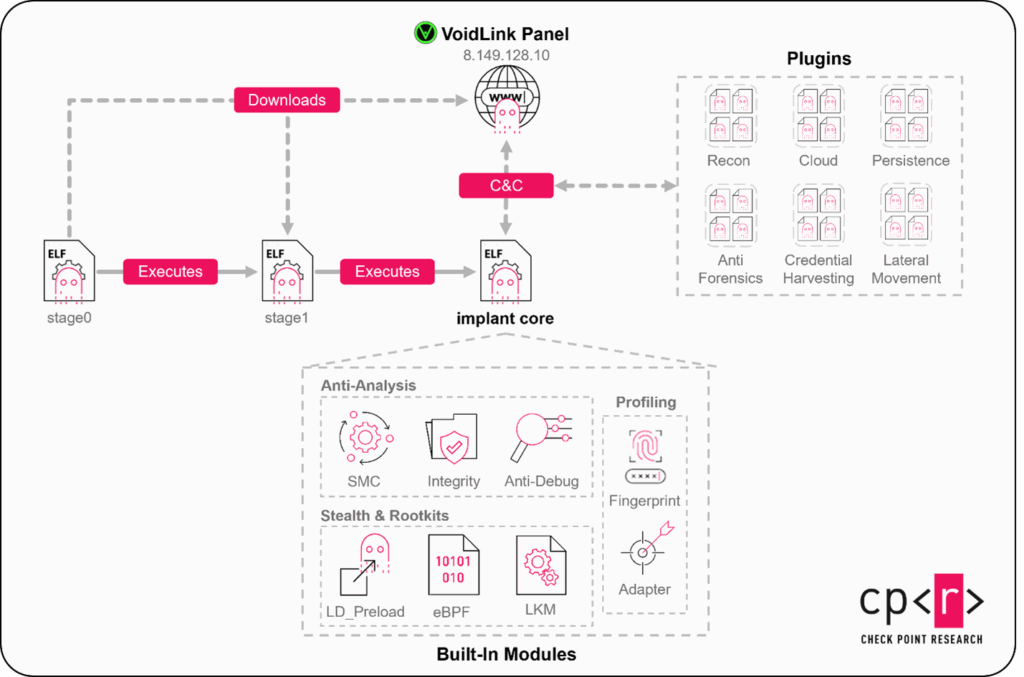
“Its plug-ins can be loaded, swapped, or removed on demand, allowing operators to tailor the framework to each target as an operation unfolds,” reads the report on the cloud-native Linux malware.
“The framework demonstrates a high level of technical expertise, combining multiple programming languages, modern development practices, and deep knowledge of Linux operating system internals.”
No real-world attacks using this malware have been reported to date, and the threat actor’s motivation is unclear. The researchers speculate that VoidLink may ultimately be positioned for commercial use by the criminal underground, dedicated to a single customer, or even sold as a legitimate penetration testing toolkit.
“Regardless of origin, powerful security and testing frameworks have historically been exploited by threat actors,” the researchers warn.
What makes VoidLink special?
Contrary to other Linux malware variants adapted for cloud use, VoidLink focuses on cloud environments from the beginning. Linux powers critical workloads and cloud infrastructure, and virtualized applications are increasingly central to enterprise operations.
“In the hands of skilled threat actors, a framework like this can turn the cloud infrastructure itself into an attack surface,” Check Point said.
On deployment, VoidLink can identify the cloud provider, whether it is operating inside a virtual machine or a container, and adjust accordingly.
To remain hidden, the malware identifies security tools and system hardening measures, and adapts its level of aggression accordingly. It prioritizes stealth and slows activity in well-defended systems. The malware calculates a risk score for the environment and suggests an evasion strategy.

The malware selects the right rootkit and deploys accordingly, depending on the Kernel version and supported features.
VoidLink also prioritizes the security of its owners – the framework incorporates multiple operational security features to encrypt runtime code and conceal components in memory. An automatic self-destruction initiates, wiping the malware entirely if tampering or analysis is detected.
The conversation on this topic is live. Join in the discussion.
For command and control, a dedicated server and a web-based dashboard are used, where an operator can choose the agents, implants, plugins and control the malware. The dashboard is in Chinese.
The feature set is also unusually broad. The capabilities span the full attack chain from initial port scanning to data exfiltration. The modules can harvest SSH keys, passwords, browser data, environment secrets, and keyring contents, enumerate users, processes, services, networks, file systems, Kubernetes resources, and map internal network topology, among other capabilities.






“At the time of our research, 37 plugins were available, organized into several categories: Tools, Anti-Forensics, Reconnaissance, Containers, Privilege Escalation, Lateral Movement, and Others,” Check Point said.
“Together, these plugins sit atop an already sophisticated core implementation.
Currently, many of the binaries include debug symbols and development artifacts, suggesting active development rather than a finished tool.
However, Check Point warns network defenders to treat cloud-hosted Linux systems as high-value targets and prepare, otherwise they “may never realize their infrastructure has been quietly taken over.”
“VoidLink may still be emerging, but its design provides a clear indication of where advanced threats are headed,” the report concludes.
Unlock exclusive Cybernews content on YouTube.