Europeans aren’t resorting to violence against data centers. Yet
But it’s quiet only on the surface.

Image by Cybernews

 Follow us
- The EU plans to triple data center capacity by 2035 and spend €10 billion ($11.5 billion) on seven AI gigafactories.
- European opposition is growing over water use, emissions, electricity costs, weak job creation, and limited transparency.
- Activists and local authorities have challenged or halted major projects in Spain, the Netherlands, Germany, and Ireland.
- Local solutions like DNSITI’s software can help reduce data centers’ electricity consumption by optimizing their operations.
Key Takeaways by nexos.ai, reviewed by Cybernews staff.
The European Union (EU) may have no choice but to ramp up its AI capabilities. To do so, the bloc must address citizens’ growing concerns about data centers and harness the latest technologies.
The EU aims to triple the continent’s data center capacity by 2035 as part of its efforts to achieve digital sovereignty.
The bloc will allocate €10 billion ($11.53 billion) to construct 7 AI gigafactories, large-scale computing facilities aimed at training the next generation of AI models.
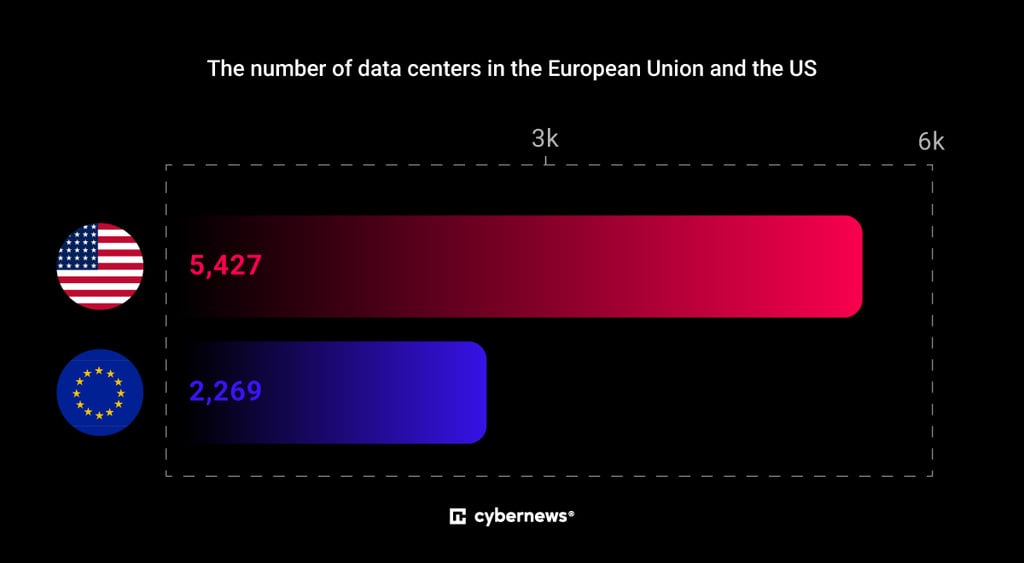






The EU currently hosts 2,269 data centers, far fewer than America’s 5,427, giving the US an edge in an intense AI race, where it is increasingly challenged by China.
The data center boom, driven by increasing use of digital services and the promise of AI’s revolutionary potential, is causing major environmental concerns globally due to heavy water consumption, greenhouse gas emissions, and water pollution.




Stay updated with our latest stories and follow us on social media
Be the first to discover new stories, ideas, and updates from our team.
Because they are extremely energy-hungry, data centers have been shown to raise electricity prices for nearby residents.
Unlike in the US, where opposition to data centers is increasingly coordinated and, on rare occasions, even resorts to violence, Europeans have taken a more restrained approach.
Asma Derja, a founder of the Ethical AI Alliance, argues that the US protest movement grew out of the “No Tech for ICE” campaign, which already tied data centers to surveillance and immigration enforcement, giving activists “a political throughline and a villain.
In Europe, Derja argues, many data centers landed in regions hit by industrial decline, “sold to local officials as a lifeline for jobs and tax revenue,” a claim that rarely proves true.
The Romanian government, for example, welcomed the ClusterPower data center in 2020 to be built in the small commune of Mischii, awarding the project €17 million ($19.36 million) in state aid.
Authorities hoped the project would contribute to the local economy, yet the data center created only 10 jobs.
“Zoning rules in places like Germany channel data centers onto pre-approved industrial land under the radar, so there’s no single visible fight for a movement to rally around, no state vote, no big moment,” Derja wrote on LinkedIn.
But things in Europe may look quiet only on the surface.
Local governments enable techno-colonialists
Aurora González, a Spanish activist and co-founder of a project called “Tu Nube Seca Mi Rio” (“Your Cloud Drives My River”), together with a broader coalition of organizations, did something no one else ever did in Spain.
They filed a legal complaint against the government of Aragón city for expedited processing of Amazon Web Services’ (AWS) data center megaproject. The litigation process, entirely crowdfunded, is still ongoing.
González tells Cybernews that local governments often act as helpers to techno-colonialists – the companies behind data centers – by changing laws, fast-tracking permissions, or giving tax exemptions.
The activist says that local governments force “powerless small towns” to accept data centers, making it impossible to say no. The resistance, however, is possible.
You have to address the specific needs of the community. People always think they have power – and we do have less power as individuals – but we are when we are in groups.Aurora González
While outright corruption is hard to pinpoint, the lack of transparency in the data center boom is well documented, as are the lobbying efforts.
A 2026 investigation by a journalist consortium revealed that Microsoft and the tech industry lobby secured a provision from the EU to keep environmental data about the massive data centers they operate in Europe confidential.
A 2025 study analyzing data centers in Amsterdam, home to nearly 60 of these facilities, suggests that, due to the low visibility of data centers’ materialities, their “extractive relationships” went unnoticed by policymakers and the broader public for a long time.
While many public protests mostly centered on hyperscale data centers, the study says, increasing complaints about water and energy utilities “pushed the materialities of data centers and their massive environmental and spatial impacts onto the political agenda.”
The fight is bearing fruit
With growing awareness of data centers’ impacts on the environment and communities, there is an increasing number of successful cases of halting large projects.
Popular backlash and the Dutch government’s efforts forced Meta in 2022 to cancel its plans to build a hyperscale data center in Zeewolde, which would have become the largest facility in the Netherlands.
Stack Infrastructure withdrew its data center project from the town of Babenhausen in southwestern Germany after the city council required greater transparency and sustainability, including reliance on renewable energy and a reduction in noise emissions.
In Ireland, where 16 of 20 world’s top tech companies operate their hubs, tensions are also simmering.
Environmental groups presented a case to the High Court against the Irish energy regulator in April 2026, arguing that its rules allowing data centers connected to a grid around Dublin to run on fossil gas failed to comply with national and EU laws.
The issue of energy is especially painful in the country, with data centers consuming 22% of Ireland’s electricity in 2025, raising household bills by a cumulative average of €360 ($415) between 2015 and 2023, according to a recent report.
The situation is even grimmer in individual regions or cities across Europe. Data centers consume up to 40% of Frankfurt’s power demand, according to 2025 data.
Unavoidable data centers require solutions
While growing attention to data centers may bring more transparency and oversight, increasing AI capacity remains on the EU’s agenda, as do data centers.
Some local entrepreneurs are looking for solutions that would satisfy both data center operators and local communities. Among them is Norway’s DNSITI, which has developed software for optimizing data centers.
Trond Straume, DNSITI’s chairman, tells Cybernews that the software can help reduce power consumption from data centers by 30-45% by moving compute load to fewer central processing units (CPUs) and graphics processing units (GPUs).

Such optimization frees up remaining capacity, Straume says, which could be sold in the future. This also reduces the need for virgin land for data center construction and for grid connections.
Increasing the load on fewer GPUs and CPUs raises the residual heat to a higher temperature of 70°C, which can be sold in the market for residential heating or industrial needs.
If you can halve the power consumption, that surplus capacity can be brought back to the community. It can lower the pressure on the system and reduce overall energy prices, so it’s a win-win for everyone.Trond Straume
In the Netherlands, the Municipality of Uithoorn signed an agreement with Switch Datacenters and a group of greenhouse growers in July 2026 to develop a heat network.
According to the agreement, heat generated by a new data center will supply greenhouses, thereby reducing strain on the power grid and helping prevent grid congestion.
Whether the EU will strike the right balance between building more data centers and shielding communities from their environmental and economic impacts remains to be seen.
If it doesn’t, citizens – like elsewhere in the world – will pay the price.