Hamburg may soon say “tschüss” to Microsoft and go open source
A change of heart in Hamburg.
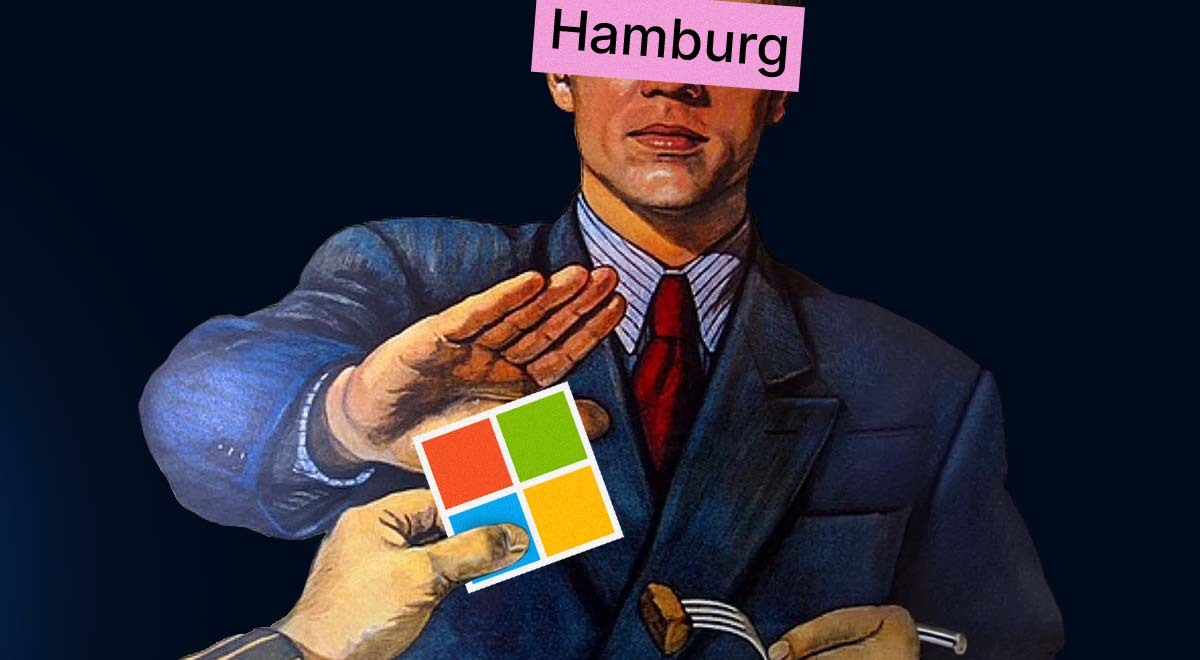
Image by Cybernews

 Follow us
- Hamburg will assess replacing Microsoft 365 with openDesk to reduce dependence on the American tech company in public administration.
- The motion passed with broad support from major parties; only the far-right AfD voted against it.
- Schleswig-Holstein’s LibreOffice migration is a key model, with estimated annual licensing savings of €15 million.
- The move reflects Europe’s push for digital sovereignty, but openDesk still has functionality gaps compared with Microsoft.
Key Takeaways by nexos.ai, reviewed by Cybernews staff.
The government of Hamburg, Germany’s second-largest city, has passed a motion to assess options to reduce its strategic dependence on Microsoft software.
The Hamburg parliament passed a motion on May 6th, 2026, calling for an assessment of the strategic implementation of the open-source productivity suite openDesk to replace Microsoft 365 in the state’s public administration, Welt reports.
The motion has attracted broad support across the political spectrum, with the Social Democratic Party (SPD), the Greens, the Christian Democratic Union (CDU), and the Left voting in favor. Only the far-right party Alternative for Germany (AfD) voted against.
The motion marked a U-turn from January, when lawmakers defended Microsoft as the de facto market standard, saying the software is highly integrated in inter-agency collaboration.




Tim Stoberock, the SPD parliamentary group’s spokesperson on digitalization and the motion’s co-author, says the concerns focus on political assessment of strategic dependencies rather than technical status, according to Welt.
The German city isn’t entirely a novice in open source. In the Dataport data center, which powers Hamburg and neighboring states, 40% of servers and 70% of middleware run on open source.
A success story next door
The motion sets a deadline of December 1st, 2026, for the government to complete an analysis of the Schleswig-Holstein case, the northernmost German state.
Nearly all of the state’s administrative workstations have already migrated from Microsoft software to the open-source productivity suite LibreOffice.




Stay updated with our latest stories and follow us on social media
Be the first to discover new stories, ideas, and updates from our team.
The government estimates that the switch saves €15 million ($17.05 million) in licensing costs per year.
Dirk Schrödter, Schleswig-Holstein’s minister for digital affairs, told Welt am Sonntag that about 20% of workstations still need individual Microsoft Word and Excel for specialized applications.
However, the state government’s existing contracts with Microsoft won’t be renewed after they expire in 2029.
Rebellion against Microsoft’s cloud push
Germany’s Green Party has described its reliance on Microsoft, an American technology giant, as comparable to its reliance on Russian gas, according to Welt.
Berlin’s position reflects the broader European push towards digital sovereignty, which partly stems from concerns about data privacy.
US law, such as the 2018 Cloud Act, compels American companies to provide US law enforcement agencies with requested data, regardless of where the data is stored.
The conversation on this topic is live. Join in the discussion.
As a result, Microsoft, which recently made cloud the default save location for its productivity suite and shifted from one-time purchases to a subscription model, has become one of the major targets in Europe’s sovereignty efforts.
Germany’s shift to open source isn’t limited to Hamburg and Schleswig-Holstein.
The Federal Ministry for Digital Transformation and Government Modernization introduced a framework in March 2026 that will require all official documents to be issued only in open formats, excluding proprietary formats like Microsoft Word.
The ruling coalition of Munich, the capital of the state of Bavaria, committed to making open-source software the standard for municipal software procurement to avoid expensive license fees and prevent vendor lock-in.
The state of Mecklenburg-Vorpommern is rolling out an open-source collaboration platform in hopes of migrating more than 50,000 public-sector employees.
Despite the enthusiasm across Europe, it remains to be seen whether migration from Microsoft software and other American technologies will be smooth.
A recent study suggests that openDesk cannot fully replace Microsoft yet, as it has limited functionality for notifications, data exchange, and access to sensors and security features.
However, the authors emphasize that openDesk is continuously updated, and some missing features can be compensated for by open-source software, such as LibreOffice and Thunderbird.