Free Qwen3.8-27B AI model lands, grabs over 3 million downloads in one weekend
This is going to sting – Qwen is stealing the show from the AI giants.
Image by NurPhoto via Shutterstock.

 Follow us
- Alibaba's free Qwen3.8-27B surpassed 3 million Hugging Face downloads within three days of its August 14 release.
- Its Apache 2.0 license and 17GB compressed variants let users modify it and run it on capable consumer hardware.
- Alibaba reports near-frontier results, but independent testing remains unavailable and full-quality operation requires 56GB of graphics memory.
- Uncensored adaptations may help cybersecurity defenders, but their willingness to answer harmful requests also creates risks for misuse.
Key Takeaways by nexos.ai, reviewed by Cybernews staff.
Alibaba’s Qwen team has stirred up the AI market with a small, free model, Qwen3.8-27B, which racked up over 3 million downloads in its first weekend alone, before independent benchmarks were released. Qwen pits its minuscule model against Claude Opus 4.6, Anthropic’s flagship from February 2026.
Reddit users are praising Qwen3.8-27B as punching far above its weight class, even though it’s just a 17GB file. It can run on older graphics cards like the RTX 3090 or a MacBook with enough memory.
“The fact that a 17GB file can do all of this stuff on my home machines is a miracle … A year ago this would have been competitive with the best and most expensive of the proprietary models – today it can run on a capable laptop,” said Simon Willison, a renowned British software engineer and open-source developer, in a blog post.
Alibaba’s Qwen team released Qwen3.8-27B on Friday, August 14th, 2026. It instantly became the number one trending model on Hugging Face. Three days later, on the platform alone, Qwen3.8-27B has been pulled over 3 million times at the time of writing.






Artificial Analysis, an independent platform that benchmarks AI models, has yet to update its comparison list to include the model’s capability scores. Alibaba’s own cloud services haven’t yet included the model in their offerings.



Stay updated with our latest stories and follow us on social media
Be the first to discover new stories, ideas, and updates from our team.
Meanwhile, the open-source community has already published hundreds of Qwen3.8-27B adaptations (quantizations). Unsloth’s variants are ahead of the pack, with nearly 2M downloads, followed by the LMStudio community’s versions, which have garnered 500,000 pulls.
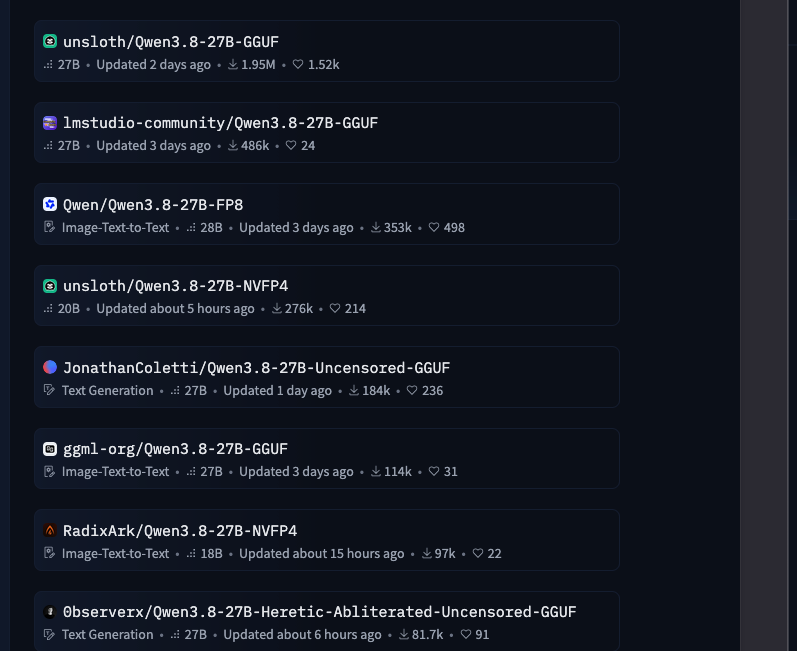
Some uncensored versions already exist, in which the small model will respond even to dangerous queries it otherwise refuses.
What’s driving the enthusiasm?
Qwen3.8-27B appears to tick many of the boxes that many users look for in AI models.
It's free, and the Apache 2.0 license allows users to modify or run it commercially, delivering immediate ecosystem support.
The model fits on a single GPU, enabling hobbyists to run it on their own machines. This also means that the model is very fast, delivering dozens or even hundreds of tokens every second.
Users are also familiar with the technology because Qwen3.8-27B replaces Qwen3.6-27B, which was already one of the most praised local AI models.
And this package reportedly delivers capabilities close to those of the best AI models. Alibaba reports a big jump in capabilities over its predecessor.
According to Qwen’s own testing, the model “excels in real-world software engineering and office workflows.” It scores close to, and sometimes even beats, the Opus 4.6 Max, Anthropic’s flagship model released in February 2025, which has since been replaced by even more capable models.
Qwen3.8-27B solves LiveCodeBench v6 with 90.3% and GPQA Diamond with 89.2% accuracy. The model also has native vision recognition and understands images and videos.
However, it doesn’t mean that the model is perfect.
Kingy AI reports that Qwen’s model reaches frontier-level performance only on select self-reported benchmarks, falling short of a true apples-to-apples win.
“Qwen3.8 is impressively close for its size, while the best current systems still hold meaningful leads,” the Kingy AI’s report reads.
“Qwen3.8-27B looks like the new model to beat when the requirement is strong multimodal intelligence in a checkpoint that can realistically be quantized onto a high-end workstation.”
Another common complaint concerns its default “xhigh” reasoning-effort setting – it leaves the model deliberating for far longer than necessary. The process burns a lot of tokens to deliver even short answers. This reasoning effort can be reduced or turned off completely, at a cost of answer quality.

Qwen3.8-27B supports a 262,000-token context length, which can be extended up to 1 million tokens.
Because the model is “dense,” it is not as fast as some models that use a mixture-of-experts architecture. The community anticipates that Qwen3.6-35B, which is even faster on consumer hardware, might also receive version 3.8.
Also, full capabilities are only available when running the full model, which takes a lot more – 56GB of VRAM in 16bit accuracy. Downscaled versions require 28GB at FP8, and around 17GB at 4-bit quantization, but lose some accuracy. Still, other large AI models often require over a terabyte (TB) of memory to store hundreds of billions, or even trillions, of weights.
Qwen3.8-27B is excellent, but it defaults to wildly overthinking things,Simon Willison sums up.
Both hackers and defenders to put it to work
Both sides on the cybersecurity front – threat actors and defenders – are already leaning on AI automation, and the broad availability of the Qwen3.8-27B model appears to raise the ceiling for both.
“Pair this model with tools like OWASP ZAP or the Burp Suite API, run it through a browser that avoids captcha detection, use a mobile or residential proxy, throw in a Kali setup for other scanning tools, and just let the model run 24/7 looking for vulnerabilities to complete bug bounties or even land contracts in the field,” one user on Reddit suggested.
According to uploader “orcarouter,” who released a stripped-guardrail version called Qwen3.8-27B-Uncensored-FP8, the small model can comply with harmful, unethical, offensive, or illegal requests.
This can be useful for defenders dealing with incidents where proprietary models refuse to assist. Threat actors, however, are likely to weaponize that same lack of restraint even faster.
Bloomberg reports that Alibaba Group Holding’s open-weight models amassed a total of over 3 billion global downloads in the past 6 months, surpassing Meta Platforms, Alphabet, and domestic peers to become the world’s number one.