GoodbyeDPI and free bypass tools stop working in Korea as VPN demand surges


South Korea’s internet blocks are becoming harder to bypass, and many free tools that once worked are now failing. As restrictions expand, users are running into more blocked pages, broken connections, and limited access.
That’s why more people are turning to premium VPNs. Unlike basic bypass tools, a reliable VPN hides your real IP address, encrypts your traffic, and helps restore access to restricted global websites.
NordVPN is the strongest option for South Korea, thanks to its fast servers, strong privacy features, and obfuscated servers built for restrictive networks.
Why GoodbyeDPI and free tools stopped working in Korea
For many years, users in South Korea relied on free bypass tools to get around local censorship. However, such tools as GoodbyeDPI and Unicorn HTTPS aren’t working anymore because the government has found a new, harsher way to restrict online activity.
Before, the restrictions relied on local internet service providers (ISPs) to use simple DNS and SNI blocks. Free tools could easily bypass them by slightly adjusting how your browser sends requests.
Now, the government has moved straight to the destination and is forcing content delivery networks (CDNs) – massive infrastructure companies like Cloudflare that host and deliver website content worldwide – to block Korean IP addresses directly. Because free tools don’t actually hide your real IP, the hosting servers immediately recognize your location and drop your connection.
What is changing after May 11?
On May 11, 2026, South Korea is scheduled to implement a strict new emergency website blocking system to shut down pirate sites and restrict offshore content at the CDN level. This escalation in Korea's internet censorship completely blocks connections from Korean IP addresses to protect copyright laws, uphold national security, and curb the distribution of adult materials and illegal gambling.
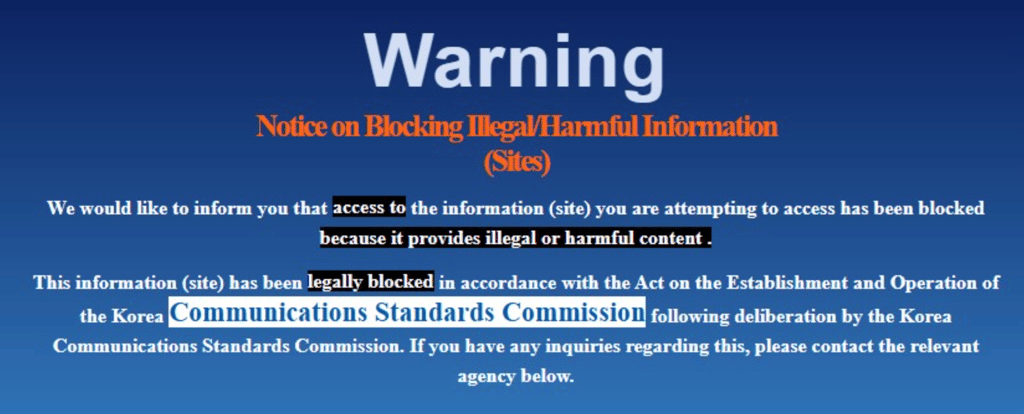
Since the measures may also impact legitimate websites, the market has seen a massive VPN surge in Korea. Many affected online communities and restricted platforms started displaying pop-ups and notices that directly recommend that their visitors use a VPN to avoid losing access.
Why premium VPNs still work
While free tools only tweak how your local data is sent, premium VPNs completely change how you connect to the internet. The best VPNs for Korean restrictions bypass server-level roadblocks rather than just local ISP filters, thanks to the following features:
- Full IP masking routes your connection through a remote server, completely hiding your actual Korean IP address and replacing it with one from another country. When the CDN checks your location, it sees not yours but the VPN's foreign IP and allows the connection.
- Encrypted tunnel prevents your local ISP and government monitors from seeing what websites you’re visiting, completely bypassing local surveillance and DNS filtering.
- Obfuscation disguises your VPN traffic as regular, everyday web traffic. To the censors, it just looks like you’re visiting a standard, secure website. It’s extremely useful because some platforms can block you if they detect that you’re accessing them via a VPN.
- Residential and dedicated IPs make your connection look like it’s coming from a standard home network rather than a commercial VPN server, making it difficult for the CDN to detect and block you, which they may do if they identify that your IP is associated with a massive server data center.
Best VPNs that work in Korea
- NordVPN – best VPN to quickly bypass Korean restrictions
- Surfshark – cheapest VPN for Korea
- Proton VPN – privacy-focused Korean VPN with a free version
VPN not working in Korea? Try these fixes
If your VPN suddenly drops or gets blocked, here are a few ways to get your connection back up and running:
- Switch your protocol. Sensors often target and block standard VPN traffic ports, so if you use common protocols like WireGuard or OpenVPN (UDP), try switching to OpenVPN (TCP) or a proprietary protocol if your provider offers one, e.g., NordLynx in NordVPN.
- Use obfuscated servers. DPI can easily spot VPN traffic. Obfuscated servers make your VPN tunnel look like regular, non-VPN web traffic, helping it slip past firewalls.
- Change regions. Sometimes a specific server IP gets flagged and blocked. So, simply disconnect, choose a different server, or change your region entirely (e.g., switch from Japan to the US). It’ll give you a fresh IP address that hasn't been blacklisted yet.
- Clear your DNS cache. Your device stores old network routes and DNS requests to load pages faster. These records can leak your real location, which may lead to blocking.
- Disable IPv6. Most VPNs are optimized for IPv4 and sometimes struggle to route IPv6 traffic properly. If your device leaks an IPv6 address outside the encrypted tunnel, local blocks can catch it.
- Avoid free VPNs. Free services use easily identifiable IPs, lack obfuscation, and don’t refresh their blocked servers. When dealing with country-wide network restrictions, a paid VPN is a must to consistently and safely bypass the blocks.
Are free VPNs still enough for Korea?
No, free VPNs don’t have the resources or technology to keep up with the aggressive server-side blocks in South Korea. Just like the older free bypass tools that recently stopped working, free VPNs tend to use obvious, easily identifiable IP ranges that censors and CDNs block immediately.
To get stable access to the blocked online content in Korea, a paid VPN with obfuscation and dedicated IPs is your only option. I recommend testing out NordVPN – it has a 3-day free trial, so you can make sure it works for you to bypass local blocks.