Agentic AI vs generative AI: what's the difference?

By now, you’ve probably heard the terms generative AI and agentic AI everywhere. Yet, they’re still often mixed or misunderstood. This confusion is understandable: both are powered by large language models (LLMs), and both take routine tasks off our shoulders by automating them. To distinguish them, think of generative AI as something that creates, and agentic AI as something that acts.
Generative AI responds to prompts by producing various forms of content – be it text, images, or code. Agentic AI is more autonomous – it pursues goals, makes its own decisions, and executes multi-step actions. This article breaks down both concepts in detail, exploring their key differences, real-world use cases, and how they can work together. For a deeper dive into related concepts, read our article on AI agents vs agentic AI.

What is generative AI?
True to its name, generative AI is a type of deep learning model that generates new content based on patterns it learned from massive amounts of training data. This includes various forms of content: text, images, audio, video, and even software code. If you’re using tools like ChatGPT, Claude, Gemini, Midjourney, DALL-E, or GitHub Copilot, you’ve already encountered it, as they’re all examples of generative AI systems.
Generative AI works reactively. It doesn’t act on its own – it waits for a prompt and produces the most likely response based on what it learned during training. For example, LLMs predict the new word or token in a sequence, so they can generate writing and conversations that sound human. Image models (like diffusion models) create visuals step by step, gradually refining an image until it matches the given prompt.

What defines generative AI is that it’s usually stateless – meaning that it doesn’t remember previous interactions or information you exchanged between requests. Unless you intentionally add memory features, each interaction is treated as new, as if you’re creating on a blank piece of paper. As a consequence, the model doesn’t naturally maintain long-term goals, plans, or persistent context across sessions.
Over a relatively short period of time, generative AI has already accelerated or even replaced manual, time-consuming tasks. Now, instead of spending hours or weeks of work, you can use it to write articles and marketing copy, generate code, and design stunning images. Moreover, it’s taking over static search results and blank-page workflows with interactive systems that can generate drafts, ideas, and solutions in seconds.
If you’d like to see how generative AI works in practice, read our reviews on Claude Code, ChatGPT 5, Midjourney, or the best AI coding assistants. They can give you a more tangible look at how these kinds of solutions can make your work life easier, along with their strengths and weaknesses.
What is agentic AI?
Agentic AI is the polar opposite of generative AI – instead of waiting for prompts, it pursues goals through continuous planning and action. More like a project manager than a specialist, it can plan what needs to be done, take actions, use external tools, and adjust its approach based on results – all to complete a defined objective.
In theory, agentic AI can be defined by four core characteristics:
- Goal-oriented: upon receiving an objective, it independently determines what steps need to be taken to achieve it and acts on them without step-by-step instructions
- Tool use capabilities: it interacts with APIs, browses the web, executes code, queries databases, or sends messages and emails, making use of different kinds of tools
- Memory use: maintaining context across multiple steps (and sometimes sessions), it can stay consistent on long-running tasks
- Adaptation: when conditions change or when earlier attempts fail, it can adjust and improve its strategy
All in all, generative AI is smarter than a chatbot, which simply answers questions – it owns tasks from the beginning to the end. However, it’s worth noting that most agentic systems are highly dependent on generative AI models like ChatGPT or Claude as their reasoning engine, but add layers of planning, orchestration, and action on top.
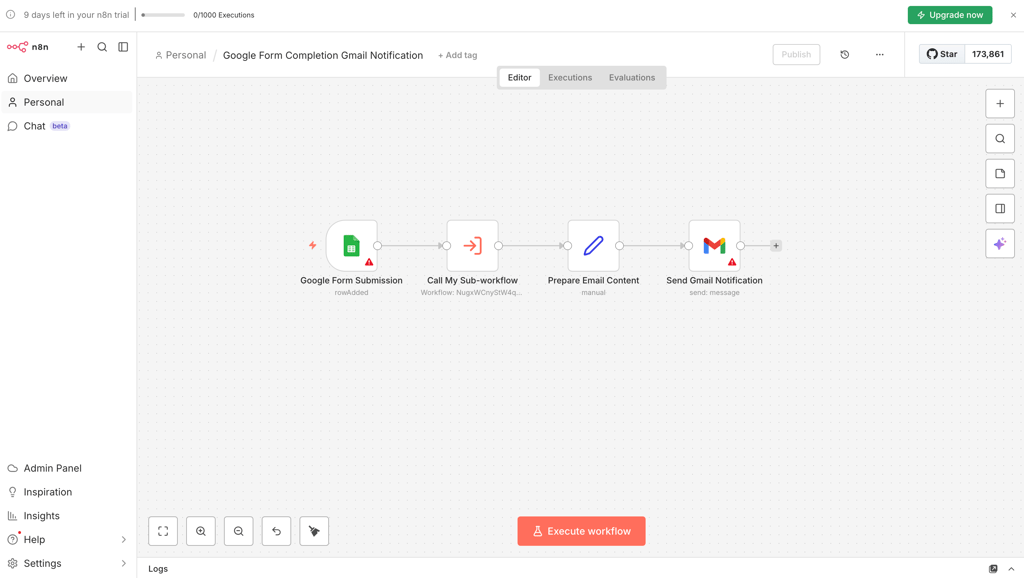
Examples include tools like CrewAI, n8n (we have a full n8n review), Relevance AI, AutoGPT, and autonomous coding agents such as Devin.
Agentic AI vs generative AI: 5 key differences
Although agentic AI and generative AI are often grouped together, they are built for fundamentally different purposes. Generative AI creates content by responding to prompts, while agentic AI pursues the given objective by making decisions and taking actions. Below, I list the key distinctions between these models, from how they operate to how much autonomy they have:
| Dimension | Generative AI | Agentic AI |
| Primary purpose | Creates content | Executes tasks and achieves goals |
| Mode of operation | Reactive (prompt-driven) | Proactive (goal-directed) |
| Human involvement | Needs a prompt for every output | Can run multi-step tasks with minimal human input |
| Memory | Stateless by default | Persistent context across steps |
| Tool use | None natively; can be added | Core capability – calls APIs, runs code, uses external systems |
| Output type | Content (text, image, code) | Outcomes (tasks completed, workflows executed) |
| Error handling | Produces the best answer it can | Can retry, reroute, or escalate when a step fails |
One of the biggest distinctions between these models is their behavior: one is reactive, the other is proactive. Generative AI responds to a prompt with an output, asking, “What should I create?” On the other hand, agentic AI reframes the problem into action: “What should I do to achieve this goal?”
Another important distinction is autonomy. While both systems require some level of human input, generative AI typically needs continuous prompting and guidance to produce results, whereas agentic AI can operate more independently once given a goal. It can make its own decisions, take actions, and complete multiple steps on your behalf without constant oversight.
Finally, in terms of scope, generative AI handles single tasks, while agentic AI can manage entire workflows from start to finish. In short, generative AI is best suited for simple, prompt-based tasks, whereas agentic AI is built for more complex, multi-step workflows.
Where generative AI excels
Generative AI is best suited for tasks that need content, insight, or an answer that a user will review and act on. Such tasks include creating content, generating ideas, or summarizing information to name a few. Essentially, it works like an assistant that can help you with manual, time-consuming work. Here are the areas where generative AI can give you the most value:
- Content and creative work. Generative AI can help with different content tasks like drafting emails, blog posts, marketing copy, social media captions, and product descriptions. Tools like ChatGPT and Claude are widely used to overcome creative blocks and speed up content production.
- Code assistance. AI coding assistants such as GitHub Copilot can generate boilerplate code, explain functions, suggest improvements, and assist with debugging. For developers, it helps prototype and ship software fast without writing every line manually.
- Research and summarization. Generative AI can summarize long reports, extracting key insights, comparing sources, and simplifying technical information. This is especially useful for researchers and analysts working with large volumes of text.
- Visual content generation. Tools like Midjourney, DALL-E, and Adobe Firefly can generate stunning images, mockups, and design variations from simple text prompts. This not only speeds up creative workflows but also makes it easier for non-designers to create professional-looking visuals.
- Conversational interfaces. Generative AI powers chatbots, customer support assistants, and internal knowledge systems where the primary goal is answering questions or retrieving information rather than taking actions autonomously.
Where agentic AI takes over
For more advanced tasks that require planning, decision-making, and execution across multiple steps, agentic AI is the better fit. It doesn’t just assist users – it independently manages workflows, interacts with external tools, and adapts when conditions change. Here’s where it thrives:
- Business process automation. Agentic AI can manage and own complex workflows. For instance, it can research a sales prospect, score them against an ideal customer profile (ICP), draft personalized outreach, send the email, and log the interaction in a CRM system. As you see, each step depends on the previous one.
- Software development. Autonomous coding agents like Devin can plan features, write code, run tests, fix errors, and open pull requests without being manually instructed through every step. This makes it more than just a coding assistant, but like an independent junior developer.
- Customer support triage. Agentic systems can classify support tickets, search internal knowledge bases, draft responses, and escalate only the cases that require human intervention. Using their help, businesses can automate large portions of Tier 1 support workflows.
- Research pipelines. Agentic AI can search multiple sources, synthesize findings, identify missing information, and compile structured reports. Tasks that previously required hours of manual research can now be completed in minutes.
- Scheduling and calendar management. To coordinate meetings, agentic AI can check the availability across participants, propose times, send invites, and take care of rescheduling without any human involvement.
How generative AI and agentic AI work together
An important point to understand is that agentic AI doesn’t replace generative AI – it builds on it. In modern systems, they work in synergy: generative AI (typically, an LLM) acts as the reasoning engine, while agentic AI provides the structure that turns that reasoning into action. The LLM interprets instructions, understands context, and decides what should happen next. The agentic layer then adds memory, tools, and execution capabilities, so those decisions can be carried out in real workflows.Imagine generative AI as the brain of the operation, and agentic AI as the body, hands, and nervous system. The brain does the thinking, while the full system performs the work. Here I put an example of how they work together:
- You assign a goal, let’s say, “Research our top 10 competitors and compile a report”
- The generative AI (LLM) breaks it into an actionable, step-by-step plan
- The agentic system acts on these steps by calling tools like web search, databases, or APIs
- The LLM interprets and synthesizes the gathered information into coherent insights
- The agent performs actions, such as formatting the report, saving it, or emailing it to stakeholders.
Many modern businesses now use both together: generative AI handles content creation and reasoning, while agentic AI adds orchestration and automation on top. You don’t have to choose one over the other – they work best as complementary parts of the same system, combining intelligence with execution to reap the best results.
This shift is already reflected in adoption trends: Gartner predicts that by 2028, 33% of enterprise software applications will include agentic AI capabilities, signaling a rapid move from standalone generative tools toward agent-driven, execution-oriented systems.
Limitations and risks to know about both
Both generative AI and agentic AI can significantly improve efficiency by automating routine tasks and reducing the time needed to complete them. However, like any technology, they also come with limitations and risks that you should be aware of. These aren’t reasons to avoid using them, but rather to implement them thoughtfully, with the right safeguards, oversight, and use cases in mind.
Here are the areas where generative AI can be limited:
- Hallucination: generative AI can produce fluent but incorrect information, particularly on niche, technical, or rapidly changing topics
- No real-world actions: it generates content but cannot execute tasks or interact with systems unless paired with external tools or agentic layers
- Context window limits: long documents or complex multi-step inputs might exceed the model’s processing capacity when used at once
- Prompt dependency: output quality heavily depends on how clearly and precisely the prompt is written
And here are the limitations of agentic AI:
- Errors compound: mistakes in early steps can cascade through an entire workflow, amplifying the impact compared to single-response systems
- Unpredictable costs: because agents might call tools and models multiple times, usage and computing costs can be harder to forecast
- Security risks: access to APIs, email, or databases increases security risks compared to standalone generative models
- Oversight requirements: human checks are often necessary to ensure safe and correct execution
- Reliability challenges: agentic systems can behave non-deterministically, requiring robust fallback logic and error handling in production environments
Which one do you actually need?
If you’re weighing generative AI vs agentic AI, consider what you want the system to do after it produces an output. Both of these models are powerful, but they solve different types of problems. Let’s see how they compare.
Choose generative AI if:
- You’re looking for a solution to create content, such as text, images, code, summaries, or translations
- You'll review, refine, or act on the output afterward
- It’s a standalone task that doesn’t require interaction with external systems or tools
- You want fast, low-friction value – enter a prompt and get an immediate result
Choose agentic AI if:
- The task involves multiple dependent steps that must be executed in sequence
- The AI needs to take real-world actions, such as sending emails, updating a CRM, calling APIs, or running code
- You want ongoing autonomous execution without manually triggering each step
- Your goal is to reduce or eliminate human effort in repetitive, multi-step workflows
Use both if:
- You need content generation as part of a larger automated process – for example, an agent that researches a topic, uses generative AI to draft a report, then automatically formats and sends it to stakeholders
A simple way to decide is to ask: “Does the task end when the AI produces an output, or does it begin?” If it ends at the output, choose generative AI. However, if it begins at the output, go for agentic AI.
For tools that implement both approaches in practise, read our review of the best AI tools.
FAQ
Is agentic AI the same as an AI agent?
No, agentic AI and AI agents are closely related but not exactly the same. Agentic AI refers to AI systems that act autonomously toward goals, while an AI agent is a specific application or program that uses those capabilities to perform tasks and make decisions.
Can generative AI become agentic AI?
Yes, generative AI can become part of an agentic AI system when it’s combined with memory, planning, decision-making, and tool-use capabilities. In these setups, generative AI creates content or responses, while the agentic layer enables the system to act autonomously and complete multi-step tasks.
Which type of AI is ChatGPT?
ChatGPT is primarily a generative AI because it produces human-like text based on user prompts. However, when it’s extended with tools, memory, or automation workflows, it can be used as part of an agentic AI system in more autonomous applications.
Is agentic AI safe to use in business workflows?
Yes, agentic AI can be safe for business workflows, but it needs to be properly designed with clear boundaries, permissions, and human oversight. Without these controls, its autonomy can introduce risks such as unintended actions or incorrect decisions.
What comes after agentic AI?
What comes after agentic AI is still evolving, but many experts point to more advanced autonomous systems that can collaborate with other AI agents and adapt continuously across complex environments. This could lead to highly integrated multi-agent or even self-improving AI ecosystems that operate with minimal human intervention.