Anthropic is building a surveillance system to monitor anti-AI activists
The company lists activism as a “global threat.”
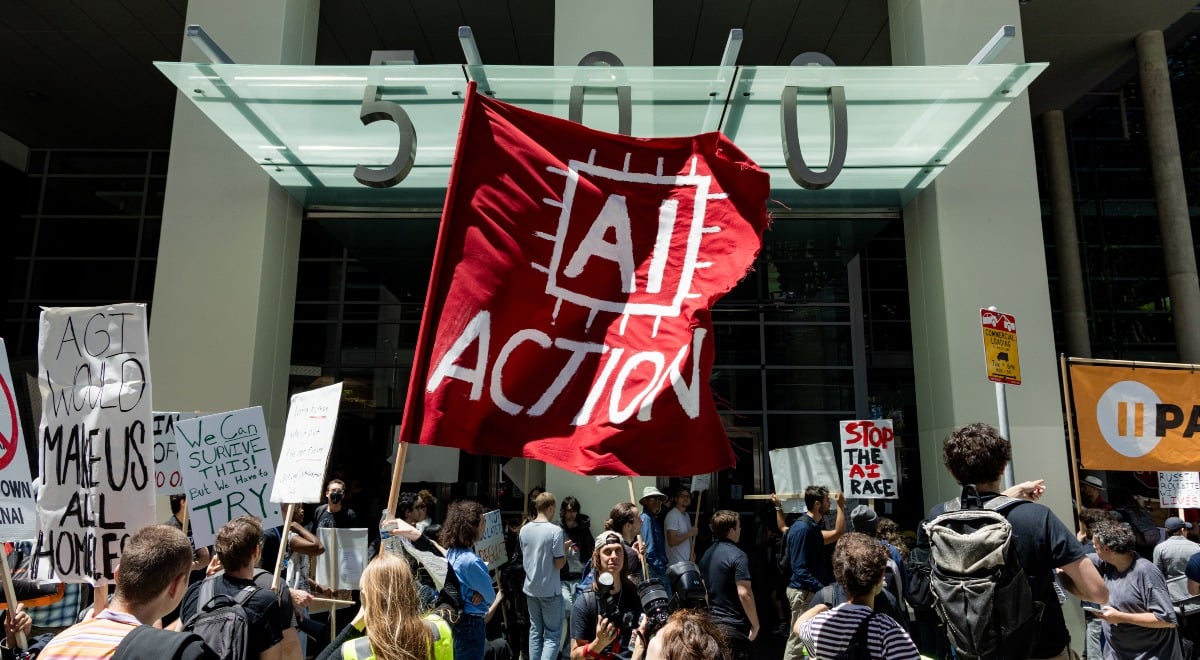
Image by Jason Henry/Bloomberg via Getty Images

 Follow us
- Anthropic is hiring a specialist to track activism as a global threat alongside terrorism and crime.
- The system that is being developed could monitor protests near Anthropic sites and help reroute executives away from activists.
- Security officials cite violent anti-AI incidents, but critics warn legitimate dissent could be treated as extremism.
- Anthropic did not respond to The American Prospect’s request for comment on the surveillance project.
Key Takeaways by nexos.ai, reviewed by Cybernews staff.
Frontier AI lab Anthropic is hiring an enterprise intelligence specialist to track and investigate activism as a “global threat.”
This is according to a recent analysis by The American Prospect, a progressive political magazine, based on Anthropic’s job postings and interviews with the company's senior employees working on security.
The system would allow the company to monitor activists protesting near physical Anthropic assets as anti-AI sentiment grows in the country, with 52% of Americans more concerned than excited about the increased use of AI in daily life.
In addition, its “pre-crime” approach, attempting to predict incidents before they happen, could involve reporting suspects to the police before they commit a crime.






Anthropic did not respond to The American Prospect’s request for comment.



Stay updated with our latest stories and follow us on social media
Be the first to discover new stories, ideas, and updates from our team.
The surveillance project was first mentioned in an interview with Anthropic senior employees Keon Ellison and Zach Melvin, who both work on security operations, and James Neufeld, CEO of Samdesk, the AI lab’s contractor for risk detection.
Ellison described a situation in which an Anthropic executive traveled to a major city, and Samdesk warned the AI lab about a planned protest, which was moved up by 60 minutes due to permitting issues.
The intelligence from Samdesk was used to change the executive’s route through a service entrance at the hotel, which Ellisson said allowed avoiding “a high-stress situation.”
The company told The Wall Street Journal in July 2026 that it was tracking “concerning behavior over time,” allowing it to “catch escalation patterns early,” after a man sneaked into Anthropic’s lobby, threatening to kill executives.
Several individuals involved in incidents reported to police were already being tracked by Anthropic security,Anthropic's spokesperson told The Wall Street Journal
While Anthropic cannot be blamed for wanting to prevent murders, its job posting for an enterprise intelligence specialist raises questions over efforts to stifle dissent.
The London-based employee would work on “identifying, assessing, tracking, and investigating global threats,” including activism, which falls under the same category as terrorism and crime.
Activism or extremism?
Anthropic is increasingly targeted by protestors, despite its efforts to build a reputation as an ethical AI lab, after it refused to cede to the Pentagon’s demands to drop guardrails over autonomous weapon systems and mass surveillance.
While these protests are overwhelmingly peaceful, some security concerns may be justified.
The home of OpenAI CEO Sam Altman was targeted with a Molotov cocktail in April 2026. Prosecutors say a 20-year-old from Texas was driven by hatred of AI technology and traveled to San Francisco with the intent to kill.
The home of Ron Gibson, a Democrat on Indianapolis’s city council, was shot multiple times over his support for a $500m datacenter project in Martindale-Brightwood.
The US law enforcement agencies privately warn about the emerging risk of violent “anti-AI extremism,” according to the Wired report.

A movement of concern is Zizians, the cult-like group linked to a string of violent murders, who believe that superintelligence could be used to torture humanity.
While Zizian ideology is undoubtedly fringe, some of its beliefs are not that different from those of Anthropic employees.
An Anthropic researcher, Jacob Coxon, recently resigned, accusing the company of developing superintelligence irresponsibly and “gambling with our lives,” as people building AI “earnestly believe” that the technology could wipe out humanity by the end of the decade.
The conversation on this topic is live. Join in the discussion.
Two current AI lab employees acknowledged concerns within Anthropic, with researcher Evan Hubinger saying there’s more than a 10% chance that AI will kill all humans.
The lines between legitimate anti-AI activism and extremism can be easily blurred.
Wynd Kaufmyn, a 69-year-old retired teacher from Berkeley, California, became the first anti-AI protestor sent to jail for participating in a sit-in protest at OpenAI’s headquarters in February 2025.
Kaufmyn said it was “unconscionable and reprehensible” that AI is being pursued despite CEOs and AI experts knowing the technology's dangers.