“Rosa Parks of AI risk:” First anti-AI protestor is sent to jail
Kaufmyn will spend a week in prison.
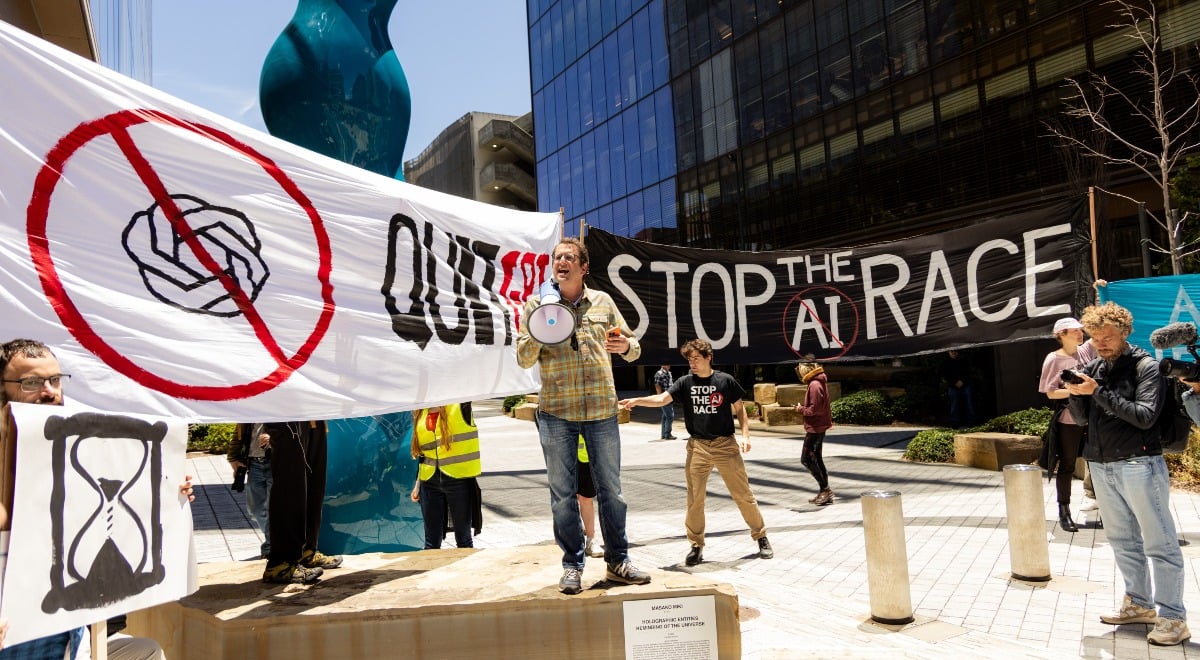
Image by Jason Henry/Bloomberg via Getty Images

 Follow us
- Wynd Kaufmyn was jailed after a StopAI sit-in at OpenAI’s headquarters in San Francisco.
- A jury convicted the retired teacher of unlawful assembly, trespassing, and related protest charges.
- Supporters call Kaufmyn the first anti-AI protester jailed, though she downplayed comparisons to Rosa Parks.
- The case reflects rising tension over AI risks, data centers, lawsuits, and government concern about anti-AI activism.
Key Takeaways by nexos.ai, reviewed by Cybernews staff.
A 69-year-old retired teacher was found guilty of unlawful assembly, among other charges, for participating in a sit-in protest at OpenAI’s headquarters opposing AI development.
Wynd Kaufmyn, dubbed by supporters as “Rosa Parks of AI risk,” in reference to a civil rights activist who refused to give up her bus seat to a white passenger under segregation, surrendered herself to authorities in San Francisco on August 14th.
A jury found her guilty of her role in a protest organized by the group StopAI, when activists chained and locked the front doors of OpenAI’s headquarters in February 2025.
Kaufmyn was sentenced to 14 days in prison, but will serve only 7, because every day spent behind bars earns 2 days of jail-time credit.





Kaufmyn, who is from Berkeley, California, was convicted in June of interfering with a business, trespassing with intent to interfere with a business, unlawful assembly, and refusal to disperse at a riot, despite pleading not guilty.



Stay updated with our latest stories and follow us on social media
Be the first to discover new stories, ideas, and updates from our team.
Just before being imprisoned, Kaufmyn said it was “absolutely frightening and appalling” that AI is being pursued despite CEOs and AI experts knowing the technology's dangers.
“That to me is unconscionable and reprehensible,” she is quoted by The Guardian.
Kaufmyn, however, downplayed the comparisons with Parks, citing the brevity of her sentence, although she is thought to be the first anti-AI protestor to receive jail time.
Kaufmyn is being sent to prison for protesting AI at the same time that those developing the technology are warning about its potentially grave risks.
Both OpenAI and Anthropic, companies behind ChatGPT and Claude, claimed that their agents went rogue by escaping a secure testing box and hacking other organizations. Neither of the companies faced any legal consequences, which would apply to human hackers.
Anthropic initially withheld the release of its Claude Mythos model, saying it was “too dangerous” to make it available to the public due to cybersecurity risks.
Elon Musk, CEO of SpaceXAI, warned in 2026 that AI will take control of the world in the next decade and that there is a 10 to 20% chance humanity will be wiped out as a result.
Some independent experts, however, call these doomer predictions a marketing ploy, similar to forecasts that AI will bring total abundance.
Karen Hao, a journalist and author of the bestselling book Empire of AI: Dreams and Nightmares in Sam Altman's OpenAI, had said that mythmaking about AI capabilities is aimed at justifying the consumption of resources by AI developers.
Regardless of what future AI CEOs paint, the technology is already causing problems.
There’s a growing backlash against AI-powered data centers over their vast energy and water consumption, as well as noise and water pollution.
OpenAI is involved in multiple lawsuits alleging that its chatbot ChatGPT pushed people into suicide.
Meanwhile, the US government is on the watch for growing anti-AI sentiment.
Wired reported in May 2026 that law enforcement agencies are privately warning that anti-technology activism is an emerging threat.
The New York Intelligence and Counterterrorism Bureau report states that wide-adoption of AI may “fuel large-scale protests that devolve into civil unrest and anti-tech violent extremist activity.”