Silicon Valley thinks it is building a machine god, AI researcher says
Timnit Gebru, a renowned researcher in artificial intelligence (AI), compares Silicon Valley companies trying to build superintelligence – or a machine god – with true believers of a secular religion.
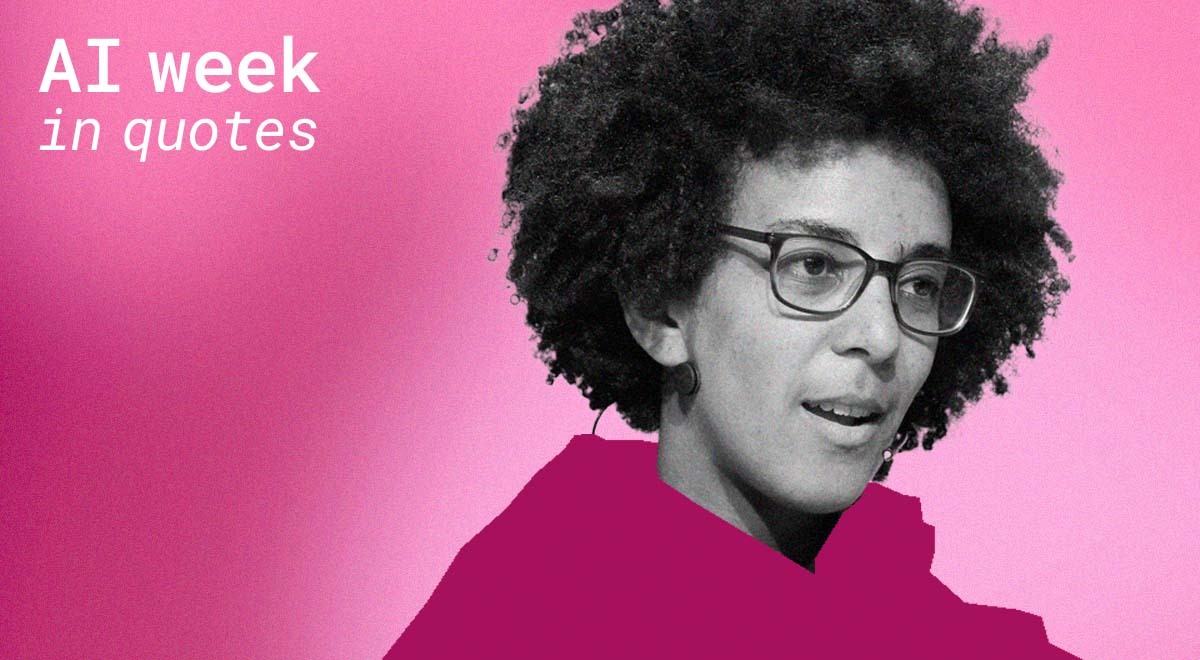
Image by Kimberly White/Getty Images for TechCrunch via Wikipedia

 Follow us
Timnit Gebru, a renowned researcher in artificial intelligence (AI), compares Silicon Valley companies trying to build superintelligence – or a machine god – with true believers of a secular religion.
This article is part of Cybernews’s weekly series, “AI week in quotes,” summarizing the most important developments in AI by quotes from the industry leaders, independent experts, and decision makers.





“Almost like a secular religion”
Timnit Gebru, a computer scientist, former co-lead of Google's ethical AI team, and executive director of the Distributed AI Research Institute, spoke in a SXSW panel about reclaiming humanity in the age of AI.






She said she has long been confused about why the field of AI is moving in a singular direction toward creating “a machine god.”
Gebru recalled speaking with Elon Musk in 2015, who said that climate change wasn’t an existential risk because it wouldn’t kill every single person, unlike a fictional superintelligent machine.
I understood that it was an ideological thing. It was almost like a secular religion, and these are true believers.Timnit Gebru
Karen Hao, a journalist and author of the bestselling book Empire of AI: Dreams and Nightmares in Sam Altman's OpenAI, spoke on an SXSW panel about tech companies pushing narratives that portray AI as both a panacea and a doomsday scenario.
She said the reason the companies perpetuate these narratives is that they are two sides of the same coin.
When they are mythmaking about the machine god that they are trying to build, and trying to justify all the consumption of resources, they will paint the vision that, ultimately, this will bring us to utopia.Karen Hao
She added that regardless of which narrative is being pushed, the conclusion is always that a small group of people – Silicon Valley entrepreneurs – should be the ones controlling the development of technology.
AI against educated women
The remarks of Palantir’s CEO, Alex Karp, about AI undermining the influence of “highly educated, often female voters” and empowering the working-class men, remained widely discussed this week.
Nancy Lyons, a founder and CEO at Everdare Advisors, has urged in her LinkedIn post to start treating “AI governance as a democratic project.”
When someone who sells advanced analytics and AI into the US national security ecosystem tells you his technology will shrink your own power, you should not hear it as a neutral forecast. You should hear it as an admission of intent.Nancy Lyons
Nvidia’s CEO: avoid AI fearmongering
Jensen Huang, CEO of Nvidia, has said tech leaders need to be careful not to scare people about AI, in response to a question about how Anthropic could have better handled contract negotiations with the Pentagon.
The desire to warn people about the capability of the technology is really terrific. Warning is good, scaring is less good, because this technology is too important to us.Jensen Huang
Anthropic, a major client of Nvidia, refused the Pentagon’s demands to drop its safeguards against using the technology for mass domestic surveillance and powering autonomous weapons.
AI isn’t a standard IT product
Ethan Mollick, an associate professor at the Wharton School and the author of a best-selling book Co-Intelligence: Living and Working with AI, has argued that the current form of AI is “deeply weird in ways that we don't fully understand yet.”
Thus, attempts to pretend AI is not weird and apply it like a standard IT product will inevitably result in far less useful & far less reliable AI implementations than those that embrace this weirdness.
Unlock more exclusive Cybernews content on YouTube.