Google and Meta release rival AI detectors, but they’re blind to each other
Meta's siloed approach highlights the need for a meta AI detector.
Image by Matteo Della Torre/NurPhoto via Getty Images

 Follow us
- Google’s public SynthID Detector checks images, video, and audio for AI watermarks from Google and its partners.
- Google says SynthID has watermarked more than 180 billion AI-generated images and videos.
- The tool cannot reliably detect AI media from unsupported models, heavy edits, or heavy compression.
- Meta is testing a separate watermark detector, but it does not work with Google’s system.
Key Takeaways by nexos.ai, reviewed by Cybernews staff.
Google has launched a public tool to detect AI-generated media – images, video, and audio with SynthID watermarks. But the scanner only works on content from Google, OpenAI, Nvidia, Kakao, and soon, Apple. Meta is testing its own tool, which is incompatible with the rest.
Over 180 billion images and videos have already been watermarked by SynthID, Google’s watermarking technology that adds imperceptible signals to pixels or audio to AI-generated content.
Google has released the public SynthID Detector. It allows anyone with an account to easily check whether an image, video, or audio file was created using AI tools from Google or its partners.
“Having clear context about the content you encounter online helps you make informed decisions about what to trust,” said Pushmeet Kohli, vice president of Science and Strategic Initiatives at Google DeepMind.





Google Search, the Gemini app, and Chrome already have built-in verification features, the tech giant also said. Combined, they handle over 1 million requests daily.
If the tools detect SynthID signals, they label the image as AI-generated content. However, the system is not perfect and is not an industry-wide solution.
SynthID was created to help distinguish original from AI-generated media, detect deceptive content, and provide transparency. The embedded digital watermarks are imperceptible to humans but detectable for identification.
SynthID watermark is added even when the content is edited with AI tools. However, the absence of this signal doesn’t automatically rule out AI-generated or manipulated content.
Google provides several scenarios when the detector won’t work:
- When content was created by a third-party AI model without SynthID.
- Heavy modifications can degrade the watermark signal.
- Heavy compression and editing can impact detection.
For example, Cybernews asked ChatGPT to generate a completely white blank white image, but the tool didn’t recognize it as AI-generated. However, it correctly identifies simplistic images, even with a very few elements.

False positives are less likely but possible.
“In very rare cases, SynthID can also falsely trigger on non-watermarked content,” the FAQs read.
Meta has its own incompatible tool
Meta has its own watermarking system called Content Seal and is previewing a separate AI identification system – a public tool that only detects Meta’s AI signatures. It couldn’t identify an AI-generated image with SynthID.
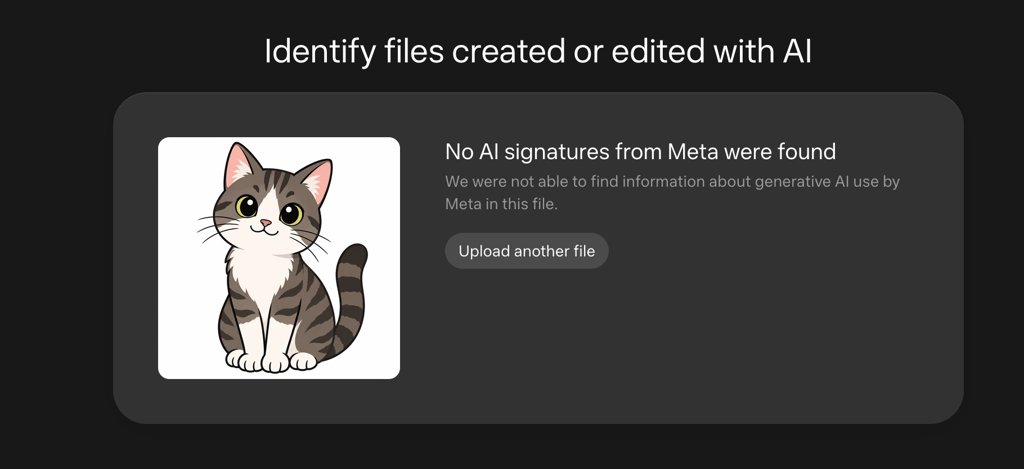
At the same time, Google's tool also didn't detect AI signals in this image generated by Muse, Meta’s AI assistant.
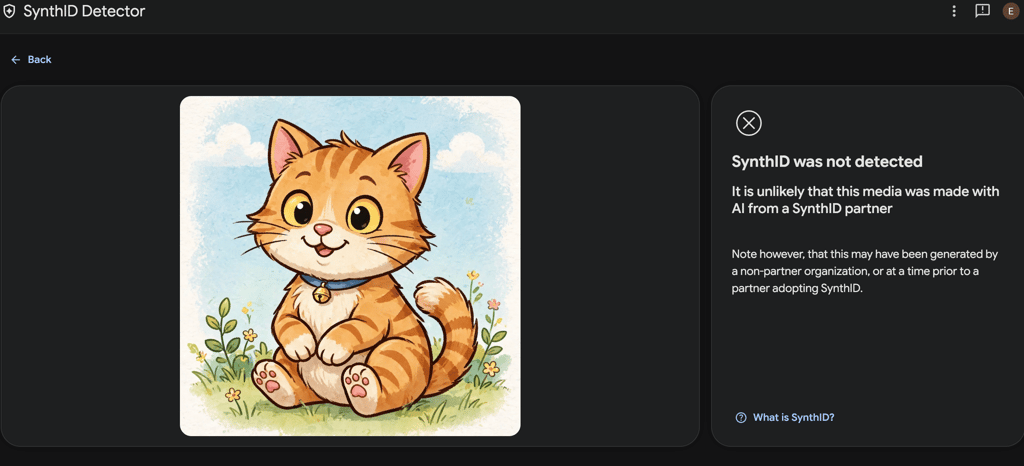
Both tools failed to recognize an image generated by Midjourney, another popular AI tool, which reportedly doesn't add synthetic watermarks.
Meta previously said that it watermarks the images, aiming “to help people verify whether an image is AI-generated.” The signal remains intact “even when cropped, compressed, resized, or screenshotted.” Meta plans to add these watermarks to video soon.
The EU AI Act now requires AI companies to clearly watermark and label AI-generated content, even text. Cybernews reported that watermarks are seen as “technically, legally, and ethically" wrong by some users, causing the surge in popularity of watermark removal tools. Several paid services already advertise SynthID removal tools.
However, it’s not clear how effective they are.
