Donald Trump, Marco Rubio and JD Vance are the most deepfaked U.S. government officials in office today
In the past two years, there have been 156 deepfake instances involving currently serving U.S. government officials: the President, Vice President, Cabinet members, governors, and Congress members. Cybernews analyzed these cases to figure out who is targeted most often, which parties experience the most deepfakes, and which political roles are targeted the most.

 Follow us
In the past two years, there have been 156 deepfake instances involving currently serving U.S. government officials: the President, Vice President, Cabinet members, governors, and Congress members. Cybernews analyzed these cases to figure out who is targeted most often, which parties experience the most deepfakes, and which political roles are targeted the most.
The research is based on data from the Resemble.ai deepfake incident database, which includes over 2,000 cases of deepfake instances recorded in the last two years, starting on March 11, 2024.
Donald Trump was deepfaked 90 times in the past two years
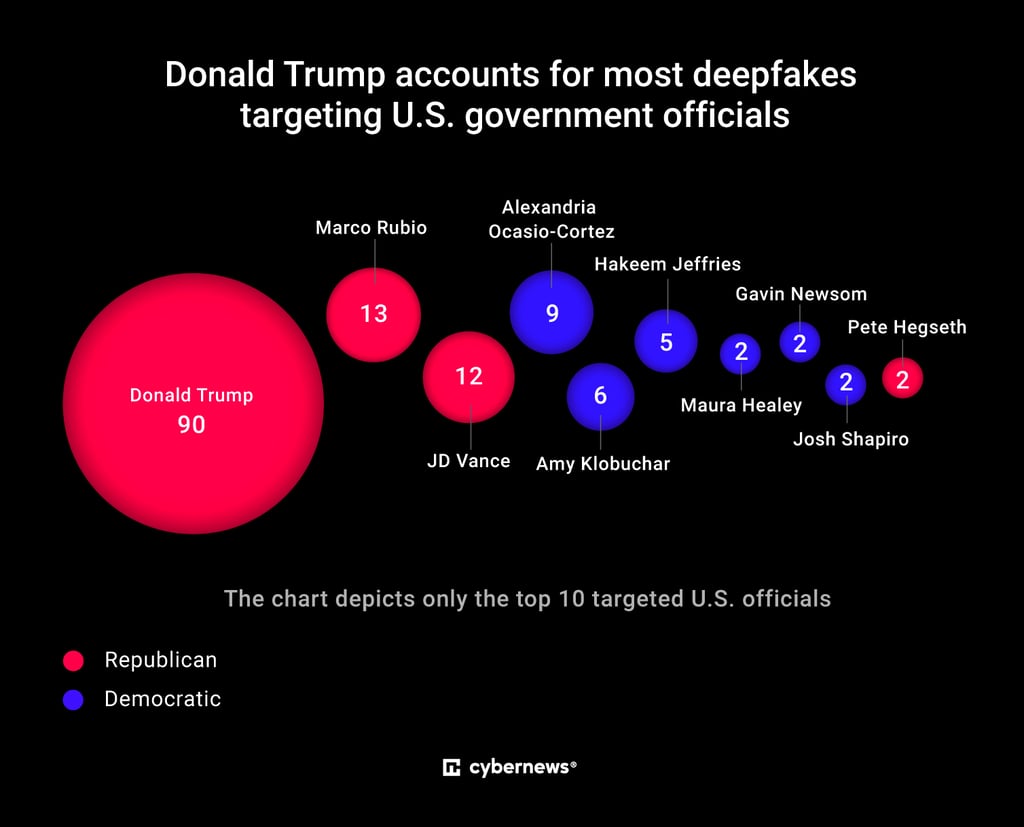
A small number of individuals account for most deepfakes targeting U.S. officials. President Donald Trump alone accounts for 90 of the 156 recorded instances, or 58% of all deepfake incidents in the dataset. However, unlike most deepfakes that are created by third parties with malicious intent, Donald Trump commonly posts deepfakes of himself. For instance, in November of 2026, he posted an image on Truth Social of him holding a blue sign that read “TRUMP 2028, YES!”. In another case, the White House posted an AI-generated image of Trump as the pope.


The next most targeted figures are Marco Rubio (13 instances) and JD Vance (12 instances). Together, the top three account for 115 out of 156 instances, or 74% of all recorded cases.
The most-deepfaked Democrat is Alexandria Ocasio-Cortez with 9 instances recorded. One notable case was when TV host Chris Cuomo shared a deepfake of Cortez arguing on the floor of Congress about Sydney Sweeney’s American Eagle ad. Other commonly-deepfaked Democrats include Amy Klobuchar (6 instances) and Hakeem Jeffries (5 instances).
Beyond the top six individuals, incident counts drop to two or fewer per person. This means that deepfakes largely target a small number of highly recognizable figures in the U.S. government. Overall, 23 out of 602 officials were targeted at least once during the analyzed period.
76% of deepfakes targeted Republicans – but without Trump, the distribution is more balanced

At first glance, deepfakes of U.S. government officials seem to largely target Republicans (119 out of 156 cases). But this is largely because of one individual – Donald Trump. If Donald Trump is excluded from the dataset, the distribution is much more balanced: Republicans account for 29 instances, while Democrats account for 37, meaning that Democrats represent 56% of non-presidential cases.
Congress members are less likely to be targeted by deepfakes compared to other officials
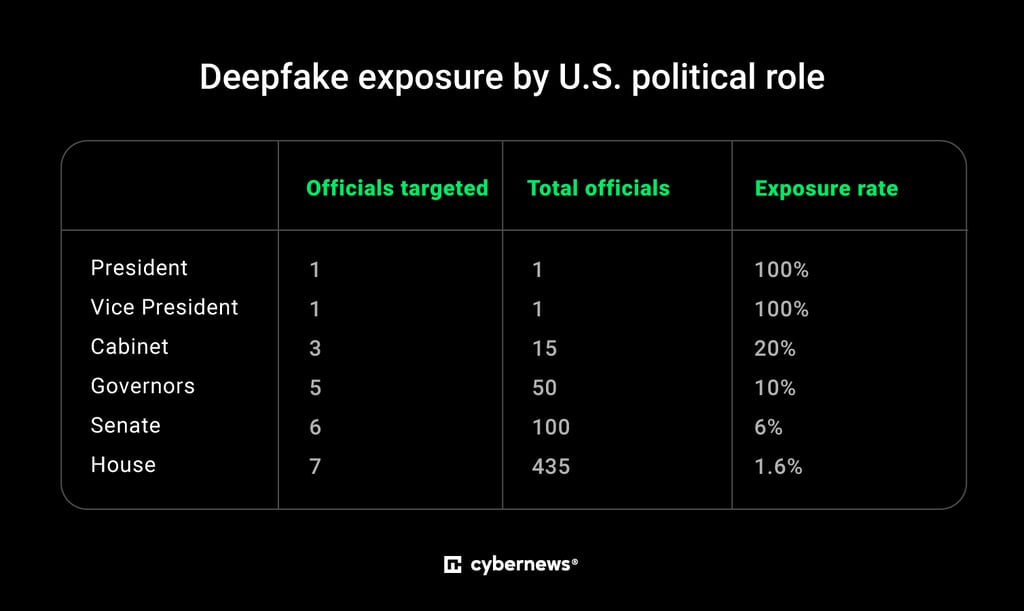
The likelihood of being targeted by deepfakes drops sharply in larger groups, such as the House and Senate, where individual members are less visible to the public.
The Cabinet, which has 15 members, has a deepfake exposure rate of 20%, meaning one in five officials was targeted at least once. In contrast, the House (the largest group in the U.S. government with 435 members) has an exposure rate of just 1.6%. This suggests that deepfakes tend to focus on a small number of widely recognizable figures.
Methodology
This study examines deepfake incidents targeting currently serving United States politicians at the federal and state level. By cross-referencing a curated deepfake incident database from resemble.ai with a list of U.S. officeholders, we quantify the frequency, partisan distribution, and institutional targeting patterns of deepfake attacks directed at elected and appointed officials.