Trump’s new AI Action Plan sets bold course - with cybersecurity at strategic core
The White House released its new AI Action Plan on Wednesday, including four key policy initiatives that, according to President Trump, will usher in “a new golden age of human flourishing.”
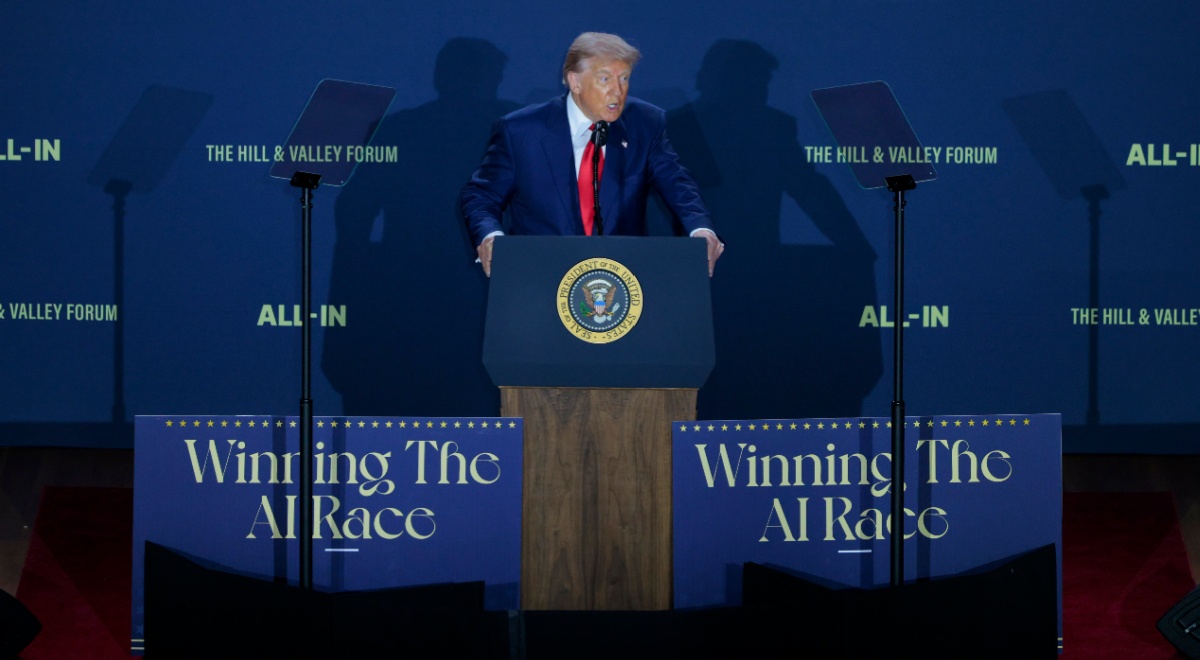
Chip Somodevilla/Getty Images

 Follow us
The White House released its new AI Action Plan on Wednesday, including four key policy initiatives that, according to President Trump, will usher in “a new golden age of human flourishing.”
- White House unveils new AI Action Plan to "cement US dominance in artificial intelligence" and win the tech race with China.
- The plan identifies 90 policy recommnedations that the Trump administratrion expects to take action on over the coming months.
- The plan describes myriad ways to bolster the security of AI systems, including information sharing among global allies, beefing up semiconductor export controls, and building high-security US military and intelligence data centers.
The President, releasing the bold plan earlier in the day, spoke in Washington, declaring that “America will win” the technological arms race with China, calling it a fight that will define the 21st century.
Along with a brand new AI.gov website, the 28-page plan builds upon President Trump’s executive order issued in January, identifying three pillars: accelerating AI innovation, creating the physical infrastructure to support AI at scale, and asserting American dominance on the international stage through diplomacy and security.
While the document tackles everything from loosening regulations and semiconductor production to education reform and public-private sector investments, one theme cuts across all the ambitions: cybersecurity.






But will it be enough to guarantee first place over China and other adversarial nations while protecting America’s critical infrastructure?
Encouraging AI innovation and infrastucture
“Winning the AI Race is non-negotiable. America must continue to be the dominant force in artificial intelligence to promote prosperity and protect our economic and national security,” said Secretary of State and Acting National Security Advisor Marco Rubio about the plan.
“Powering a new age of American leadership in science, technology, and global influence,” the plan provides over 90 Federal policy actions, and four key policy initiatives, including:
- Exporting American AI - deliver secure, full-stack AI export packages – including hardware, models, software, applications, and standards – to America’s friends and allies worldwide.
- Promoting Rapid Buildout of Data Centers: Expediting and modernizing permits for data centers and semiconductor fabs, creating new national initiatives to increase high-demand occupations like electricians and HVAC technicians.
- Enabling Innovation and Adoption: Removing onerous Federal regulations that hinder AI development and deployment with input from the private sector.
- Upholding Free Speech in Frontier Models: Updating federal guidelines to ensure government only contracts with frontier LLM developers who ensure models are objective and free from top-down ideological bias.
“Artificial intelligence is a revolutionary technology with the potential to transform the global economy and alter the balance of power in the world, said Crypto Czar David Sacks.
“To win the AI race and remain the leading economic and military power, the US must lead in innovation, infrastructure, and global partnerships,” adding that the plan is a roadmap to do just that.
Securing AI systems from foreign adversaries
Moving past the first two pillars on innovation and infrastructure, the third pillar, “Lead in International AI Diplomacy and Security,” addresses some of the most pressing cybersecurity challenges the US will face in the coming years.
As AI systems become more powerful and capable, their potential misuse – especially by hostile governments or non-state actors – poses growing risks.
The plan states the US must not only defend against these threats within its borders, but also ensure global safeguards are in place, primarily by building a coalition of allies around shared cybersecurity protocols and export controls while denying adversaries access to American tech.
This includes building a global Cyber-AI Alliance, where allies would share investments in AI security, cross-border standards, and collaborative research.
Using economic levers like the Foreign Direct Product Rule or secondary tariffs to align incentives, the plan will also expect allies to commit to adopting similar export technology controls, such as on many critical components and processes in the semiconductor manufacturing pipeline.
Tightening loopholes in how advanced AI chips and their computational infrastructure are exported will help prevent foreign actors from leveraging US innovation to build rival capabilities.
This will include using geolocation and verification tools to track where exported AI chips end up and penalizing companies or countries that circumvent restrictions.
In addition, the plan will promote secure-by-design AI technologies and applications.

Another centerpiece of the cybersecurity strategy is to ensure the federal government leads in evaluating national security risks from powerful AI models—often referred to as "frontier models."
These cutting-edge systems, if left unchecked, could be manipulated to facilitate cyberattacks or aid in creating weapons of mass destruction, the plan says.
This will require coordinated efforts led by the Commerce Department’s Center for AI Standards and Innovation (CAISI), alongside national security agencies, to evaluate the models for security issues such as backdoors, vulnerabilities, or malign influence, way before they could escalate.
The teams would be responsible for assessing the risks of, not only American AI large language frontier models, but also foreign models, including those from adversarial nations like China.




Bolstering critical infrastructure cybersecurity
Finally, the plan states that the use of AI in cyber and critical infrastructure will also expose those AI systems to adversarial threats.
To combat this, the plan encourages, both enterprises and cash-strapped organizations, to continue adopting AI-enabled cyberdefensive tools, in hopes of helping to defend against emerging threats.
“As AI systems advance in coding and software engineering capabilities, their utility as tools of both cyber offense and defense will expand,” the plan claims.
The plan recommends taking advantage of existing cyber mechanisms already in place.
- Establishing an AI Information Sharing and Analysis Center (AI-ISAC) to share AI security threat intelligence across US critical infrastructure sectors.
- Issue and maintain guidance to private sector entities on remediating and responding to AI-specific vulnerabilities and threats.
- Ensure collaborative and consolidated sharing of known AI vulnerabilities from within Federal agencies to the private sector as appropriate.
- Develop and incorporate AI Incident Response actions into existing incident response doctrine and best-practices for both the public and private sectors.
Part of the federal AI overhaul would also include creating new technical standards for high-security AI data centers, which will be built for use by the US military and government intelligence agencies.
The Action Plan also highlights the growing concerns of using AI in synthetic biology, specifically nefarious nation-state actors who could use AI to design dangerous pathogens.
To get ahead of the threat, the plan recommends requiring federally funded institutions to use secure DNA synthesis tools with customer verification protocols, while relying on enforcement mechanisms to replace voluntary guidelines to close gaps.
Further, data-sharing networks between synthesis providers will be developed to flag suspicious activity, similar to a “cybersecurity watchlist,” but for bio threats, it says.