I cloned my voice with AI and tried to scam my mum
Trust has glitched.

Family values. Image by Cybernews.

 Follow us
- The writer cloned his own voice with AI to test whether his mother would detect a phone scam.
- His mother noticed the voice sounded wrong and asked for a family password, exposing the fake call.
- The experiment showed AI voice-cloning tools can make impersonation attempts easier, even for non-experts.
- The article warns older relatives may face greater risk and says family safewords can help prevent scams.
Key Takeaways by nexos.ai, reviewed by Cybernews staff.
I cloned my own voice using AI to see whether my mum could spot the fake. Her answer was a family password, a reminder that AI voice cloning scams are making trust itself a target.
As the phone rang, she could tell something was a bit off. Even though I’d applied the “scared” filter on the AI program I’d chosen to try and scam my mother with, my accent somehow sounded like a London one, even though I’m from the north.
“Erm... OK... erm... what’s the password?” she asked, incredulously.
That was when I came clean and spilled the beans. It had all been a little experiment.




Wait, what just happened?
After hearing various reports of the proliferation of AI-generated deepfake phone scams, I wanted to find out how easy it could be to give it a go. For some techy-savvy scammers, it’s not difficult at all, especially if your voice ends up leaked on the (dark) web.
Rather than wait for someone else to clone my voice, I thought I’d do it myself. And don’t get me wrong – I realize the ethics of rattling those closest to me – but we had agreed on a safeword for a reason.
As I scrambled around for the right software – technically challenged as I am – I did my best to figure out Omni Voice Studio on GitHub.
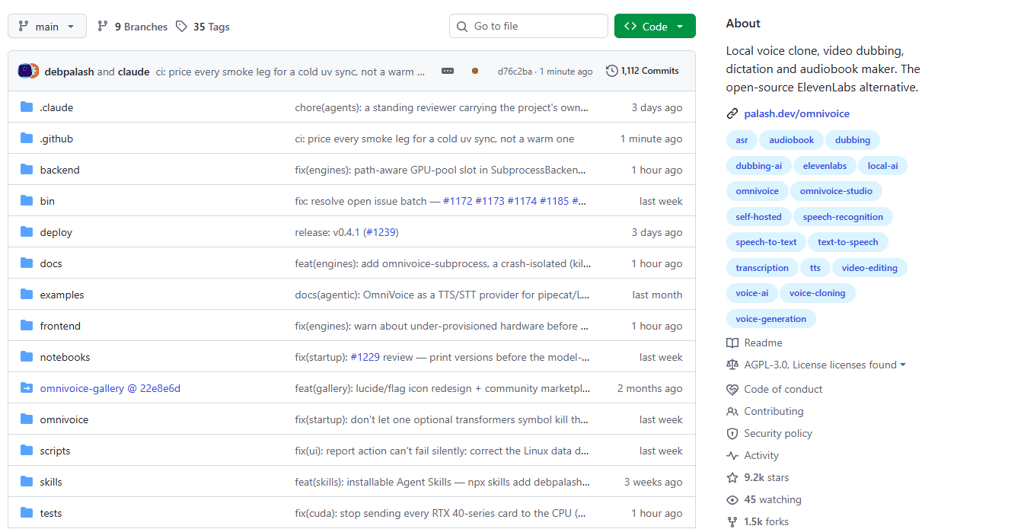
That’s not for me," I thought, while once again questioning my ethical boundaries.
After a short chat with Google Gemini, it recommended Artlist, a generative AI suite supposedly used by filmmakers and other creative-industry professionals.
One crucial point: I had to pay a $26 monthly subscription fee, so the quality had better be good.
Making no bones about it, I knocked together a script. I decided on the following:
"Hi Mum. I’m in a spot of trouble, I’m afraid. I played poker with a group of gangsters, and I owe them €5,000. Also, they insisted I have a kidney transplant and pay €25,000. Could you help me?"
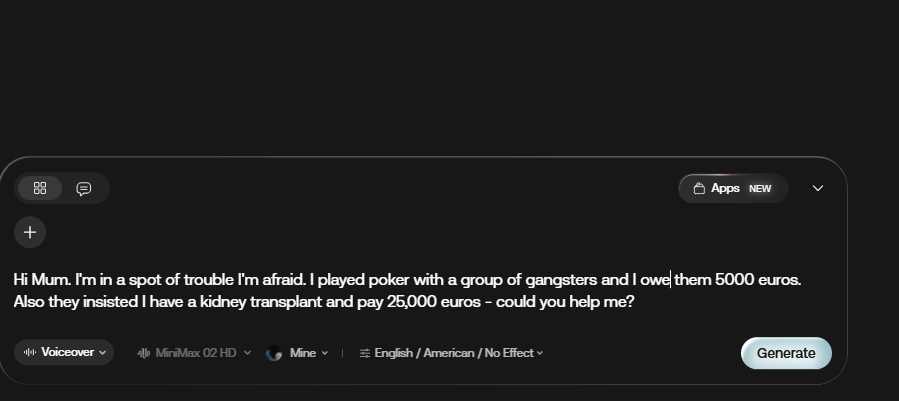
I know there are a couple of leaps of the imagination there, but that’s the whole point, right?
Using my own number, I hit dial. A bit nervously, I pressed play as my mum answered after just 4 rings.
Almost immediately, I noticed the "scared" filter didn’t really make me sound scared. Worse still, for some reason, it made me sound Cockney.
Perhaps that gave the game away, or maybe it was the absurd script. Either way, my mother, clearly shaken, asked:
“What’s the password?”
I gave it.
Then I came clean.
She gasped. She understood the point, and I apologized profusely.
Has your password leaked?
So, what’s the point in all this?
I wouldn't consider my mother, who is approaching 65, particularly vulnerable to voice-cloning scams.
My grandmother, at 85, is another story.
I honestly believe that if I ran the same experiment on my gran, she would fall victim to this kind of scam, no matter how many times we calmly explained the dangers of the web.
And maybe, just maybe, with a more sophisticated app and a more believable script, I might have pulled it off.
It just goes to show the importance of having a family safeword.