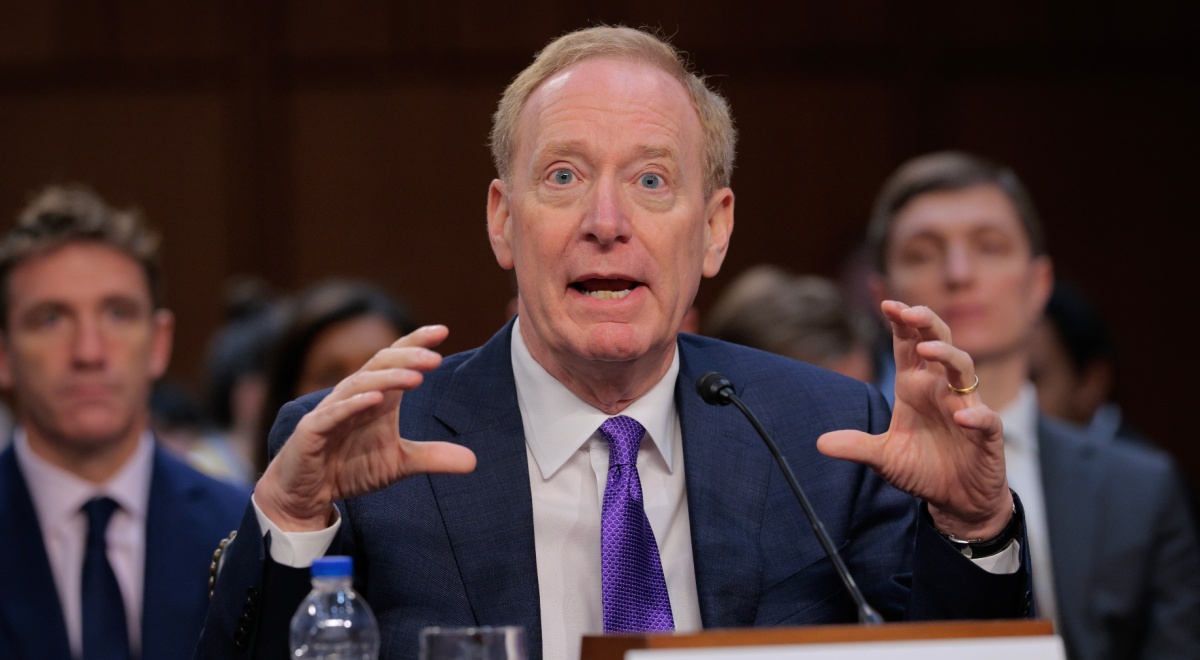
We should be able to turn off the AI, Microsoft’s Brad Smith says
There are two major issues when it comes to AI, Smith tells journalists ahead of the AI Summit in Dublin.
Chip Somodevilla/Getty Images

 Follow us
- Brad Smith says users and organizations should be able to switch off AI.
- He says governments and companies must do more to address AI safety risks.
- Smith calls for independent testing of frontier AI models with transparent findings.
- He says AI can boost productivity, but workers should benefit from how they use it.
Key Takeaways by nexos.ai, reviewed by Cybernews staff.
“I don't think people want AI worms in their refrigerator any more than they want real worms in their refrigerator. I mean, let's be serious about this,” Smith told a room full of journalists when talking about regulating and controlling AI.
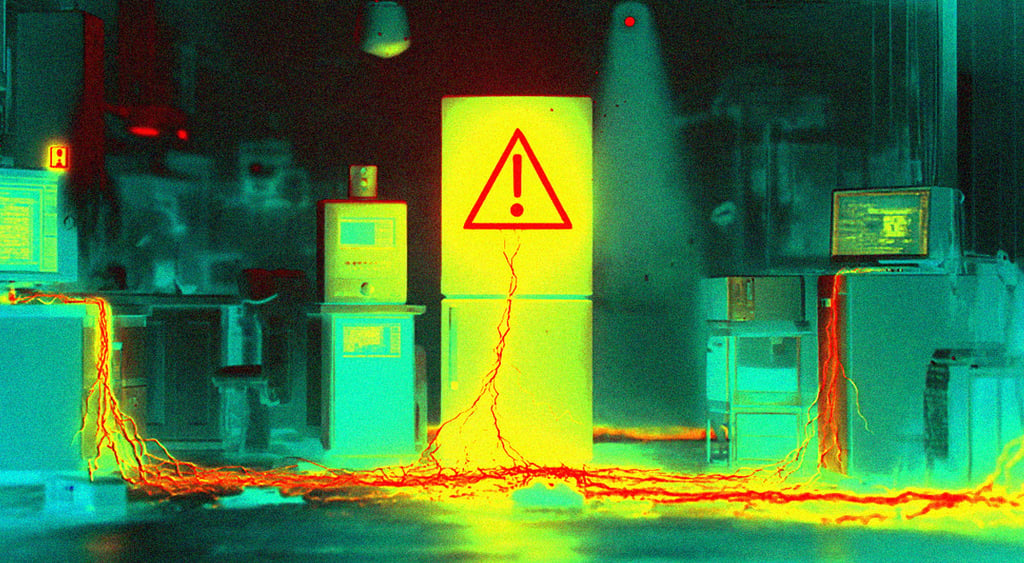
He was referring to recent research by Anthropic stating that rogue AI models might start worming their way into smart home devices, such as refrigerators and ovens.
“It’s uncertain exactly what form autonomous AI replication will take. It could be a slow, distributed “digital slime mold,” living on relatively insecure compute. It could also be a powerful cyber model that breaches datacenters at a high pace, or a model that scams people for compute credits,” the report reads.
Ahead of the International AI Summit held under the Irish EU Presidency, Smith addressed journalists, saying the public has more questions than ever around AI. Microsoft’s boss himself emphasized two of them: safety and the impact on the economy.


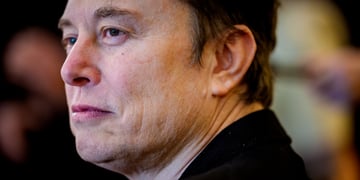

I don't think people want AI worms in their refrigerator any more than they want real worms in their refrigerator. I mean, let's be serious about this,Microsoft CEO Brad Smith said.
Microsoft boss on the AI brake
“I do think we reached a point where we obviously need companies in the industry to step up and do more to address AI safety issues. But more than that, I think we've reached the time when we're going to need governments to do more as well,” Smith said.
He emphasized the importance of having an emergency brake for AI. It makes sense not only in a lab environment, but also for any user – be it a person at home or an entire organization.
The AI brake should be at any user's fingertips.
We should have the ability to turn off the AI that is running, especially since Anthropic started warning the world about rogue agents or AI worms that might take over your appliances,Smith said.
Every organization and home user should be able to switch off AI, especially if facing immediate danger.
“We should put a safety break as close as we can to the user of the system,” he said.
Calls for truly independent AI testing
Another important point he raised regarding safety is that frontier models need independent testing — an unbiased party should evaluate how capable a certain model is and what the associated risks are.
Who should the evaluators be, though?
“I think right now, there's a mood in Silicon Valley that says, let us hire our own independent evaluators. We'll bring them in, we'll decide who we pay, we'll be the ones to pay them. [...] That does not sound like a recipe for independent and effective evaluation,” Microsoft’s CEO said.
As per Reuters, Anthropic and OpenAI have sought “significant control” over what outside evaluators can publish. The companies are worried that some proprietary information could end up in the rival’s hands.
“There needs to be transparency for the findings from these evaluations. I think there needs to be learning from these evaluations, so the learning can be shared, and others can benefit from them as well,” Smith added that typically evaluators work for or are closely managed by the public sector, following the rules defined by the government.
Smith on the AI and economy
“We are at a time where we need new sources of innovation and new drivers of productivity growth. You see this across Europe, you see this around the world, especially where you see aging populations or even declining populations, we need more growth. AI can help bring that,” Smith said.
PwC estimates that AI could add 7% to 15% to global GDP (gross domestic product) by 2035.
“The good news for Europe is that 6 of the 10 countries in the world that are at the highest level for AI use on a per capita basis are in Europe. The third in the world, the first in Europe, is where we sit today, in Ireland, 49%. But I think we have a lot of work to do to spread the benefits of AI more broadly,” Smith said.
It means that AI needs to be more accessible to people and organisations worldwide, it needs to be used to address societal problems, and continue to make the European economy more competitive.
“I don't think Europe can afford to be in a position where other countries and other parts of the world reap the benefits of those advances,” he said.
The future of the economy (and of the jobs) depends on whether people using AI are actually the ones benefiting from this technology.
“What is a very important issue when companies, when newspapers, when media outlets, when you as employees or journalists use AI, are you the one reaping the advances in your knowledge? Or is your know-how, is your learning, is your way of working, in effect, being transmitted to an AI lab so that your work is training a model? I think it is a critical issue for the future of not just the economy, but for the future of jobs,” he said.