Best AI tools for weather forecasting
Being behind major reports like The Mother of All Breaches and RockYou2024, our in-house cybersecurity experts and journalists provide unbiased, real-world testing and in-depth analysis.
We maintain complete transparency by openly sharing our testing methodologies with our audience.
Learn more

The average global temperature is steadily rising, and the past ten years (2015-2025) became the world’s warmest in 176 years. The trend affects the global ecosystem, and increased climate volatility with extreme weather events becomes harder to predict using traditional models alone.
That’s why AI for weather prediction has emerged – it provides faster, precise, and more cost-efficient ways to forecast upcoming changes. I decided to review the 5 best tools for AI weather forecasting. Below, I explain the technologies they run on, their pricing, efficiency, and accuracy levels to help you choose the one that works for you.
At a glance: the top 5 AI weather prediction tools in 2025
- Google WeatherNext 2 – overall best weather prediction AI tool
- NVIDIA Earth-2 (FourCastNet) – best AI for fast weather forecasts
- Huawei Pangu-Weather – best AI for high-accuracy forecasting of extreme weather
- IBM Environmental Intelligence Suite – best AI for assessing weather-related business risks
- Tomorrow.io – best AI for predicting operational timing
Why AI is revolutionizing meteorology
AI’s subset, Machine Learning (ML), is primarily responsible for the revolution in weather forecasting. In essence, AI systems learn patterns from lots of meteorological data, including historical observations and real-time sensor data, to predict what’s going to happen next.
Recent research shows that traditional numerical weather prediction (NWP) takes up to 30 minutes to produce a 10-day weather forecast. AI models, on the other hand, learn the weather dynamics statistically to generate a more accurate forecast within a minute. Due to less computing power spent, generating AI forecasts is 1000 times more energy-efficient.

AI models perform about 20% better across various measures than most modern traditional tools, but the current trend is to apply both simultaneously for the most reliable results. For example, it can take rough NWP data to downscale a 20–25km global forecast and create hyper-local predictions, within 1km and below. NWP alone often requires additional computational steps for the same results.
Detailed review: best AIs for weather prediction in 2026
Each AI tool in the list below is evaluated based on its levels of accuracy, reliability, speed, and research underpinning its mechanisms.
1. Google WeatherNext 2 – best overall tool for weather prediction

| Starting price: | Free |
| Best for: | AI-based weather forecasts with balanced accuracy, speed, and ease of setup |
| Free version: | ✅ Yes, for non-commercial usage |
| Top features: | Analysis of marginal weather elements for comprehensive forecasts |
Google WeatherNext 2 is an AI-based global forecasting model for medium-range (up to 15 days) predictions. It’s trained on official data from the National Center of Environmental Information (NOAA) and the European Centre for Medium-Range Weather Forecast (ECMWF) – public organizations responsible for weather forecasting worldwide.
The main breakthrough of WeatherNext 2 is using a Functional Generative Network. It means that the tool interprets only marginals – the specific weather elements, such as wind speed, at a particular location. By analyzing how all the marginals interconnect, it can make more precise predictions with a resolution of up to one hour. Other models consider only the global trend without specifics, which makes forecasts more blurry

As an individual user, you can see WeatherNext 2’s forecasts in Gemini, Google Maps, and Pixel Weather. For businesses, the model is available on Earth Engine, BigQuery, and Google Cloud’s Vertex AI. Companies have to apply for the model’s usage. The pricing is revealed after the application is approved.
2. NVIDIA Earth-2 (FourCastNet) – best for quick weather forecasting
| Starting price: | Free |
| Best for: | Fast AI-based forecasts |
| Free version: | ✅ Yes, for non-commercial usage |
| Top features: | Analysis of the atmosphere as waves for high speed and resolution |
NVIDIA Earth-2 is used for short and medium-range weather predictions. It’s also trained on ECMWF datasets, but unlike WeatherNext 2, it runs on Fourier Neural Operators (FNO). It’s a mathematical method that allows the AI model to see the atmosphere as waves instead of calculating weather variables point-to-point.
By processing weather patterns as continuous waves, it can model global atmospheric dynamics at high resolution with extreme speed. For example, it can generate a 7-day forecast within two seconds, creating 1000 simulations for the same weather scenario. The traditional model can generate only one simulation in the same amount of time and, in simple words, check only one possible future.

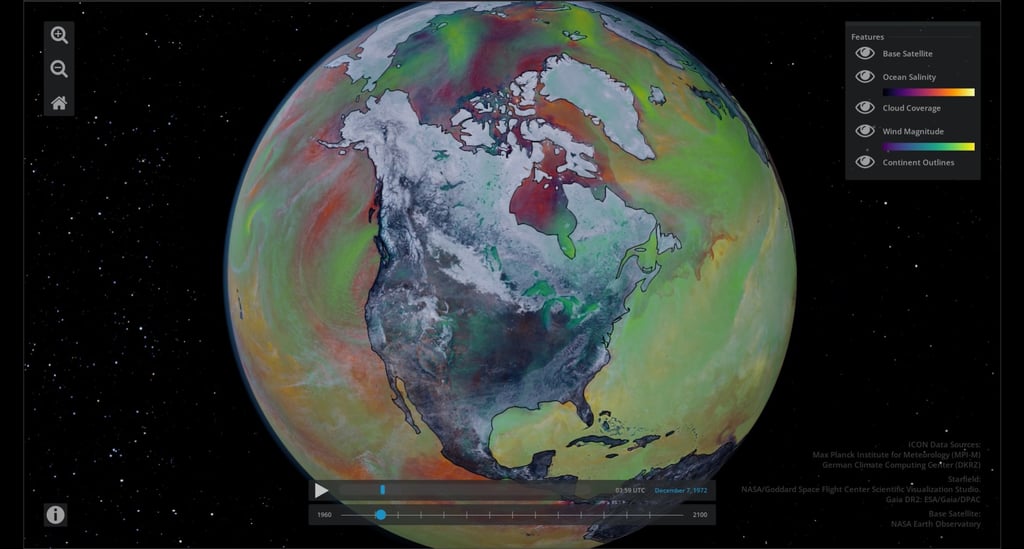
You can view FourCastNet’s forecasts on ECMWF’s Open Charts website or access the code for free via GitHub. Businesses can buy it on the NVIDIA Earth-2 digital twin platform and through the commercial API, Meteomatics.
3. Huawei Pangu-Weather – best for forecasting extreme weather conditions with high precision

| Starting price: | Free |
| Best for: | Forecasting extreme weather conditions in distant locations |
| Free version: | ✅ Yes, for non-commercial usage |
| Top features: | Analysis of the atmosphere as a 3D volume |
Pangu-Weather is the first to outperform the traditional NWM in overall forecast accuracy. It works on a 3D Earth-specific transformer architecture, treating the atmosphere as an actual 3D volume. So, it can analyze the vertical structures of the atmosphere like storm columns and jet streams.
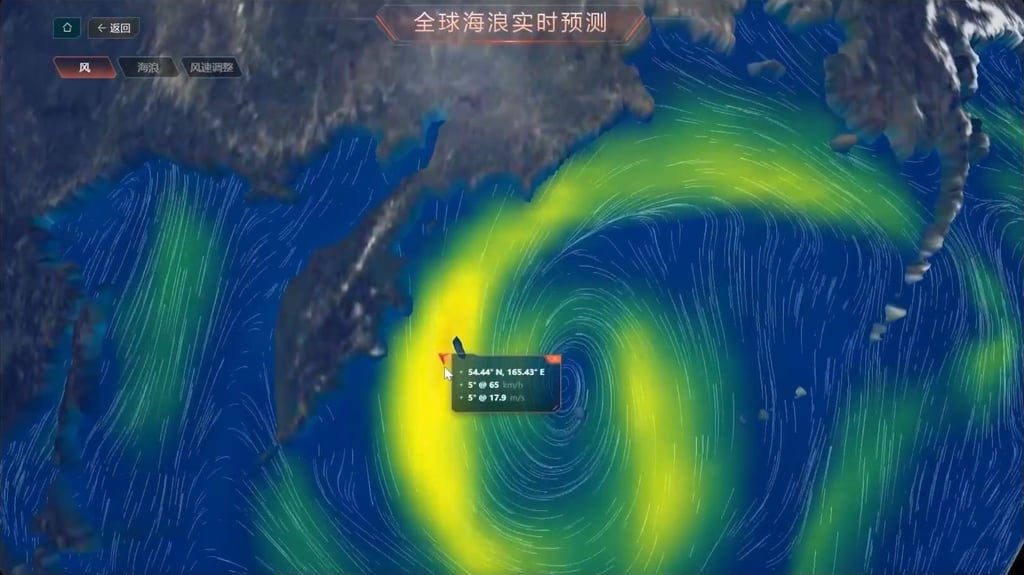
That’s why Pangu-Weather is most famous for predicting extreme weather conditions in distant areas, as broad, global forecasts don’t cover small, local regions. For example, it helped to timely predict Tropical Cyclone Alvaro in Madagascar and save rural areas from a long and disastrous storm. Also, it predicted the path of Typhoon Yutu 48 hours earlier than the world’s best traditional systems.
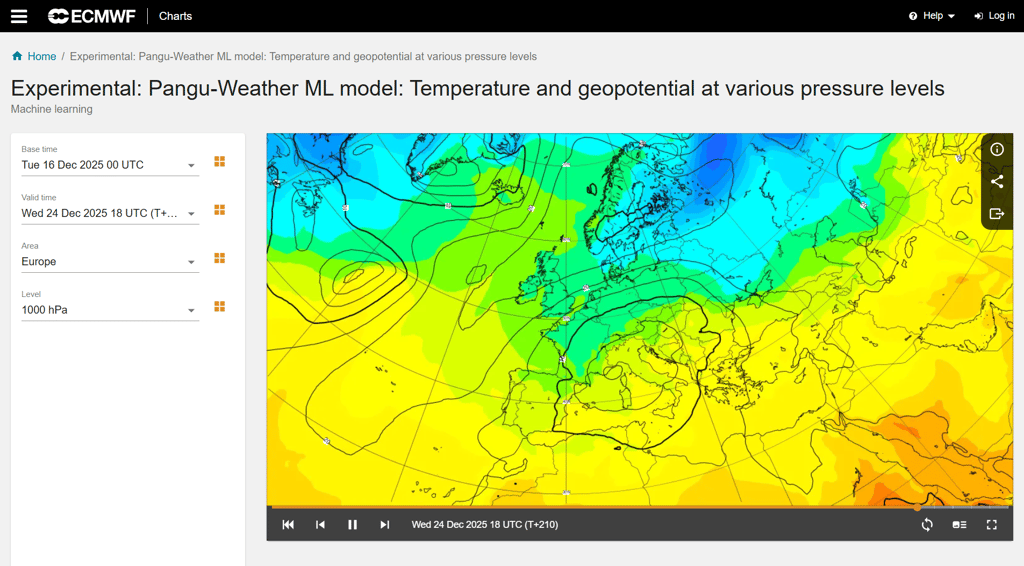
Pangu-Weather’s forecasts are available online on the ECMWF charts website. Researchers and students can use it for free through GitHub for non-commercial purposes. Businesses, however, must access it through Huawei Cloud and pay for commercial usage.
4. IBM Environmental Intelligence Suite (EIS) – best for generating weather-related business insights
| Starting price: | $500/month |
| Best for: | Predicting business risks |
| Free version: | ❌ No |
| Top features: | Detecting changes on the Earth’s surface, e.g., floods, vegetation |
EIS is a cloud-based platform for weather and environment-related business insights. It predicts not so much the weather conditions themselves but how they affect business operations.
It uses the Geospatial Foundation Model, built in collaboration with NASA and known as Prithvi. Analyzing satellite images, it can detect changes in land use, flood extent, or fire burn scars with 15% better accuracy than traditional deep learning models. Together with satellite information, EIS analyzes the company’s own data and weather variables to calculate business risks.
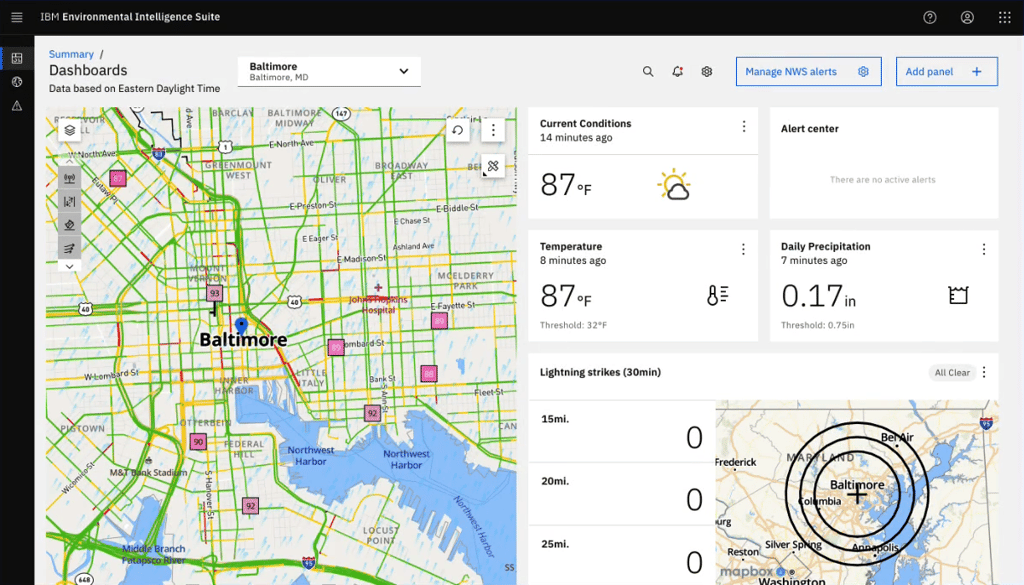
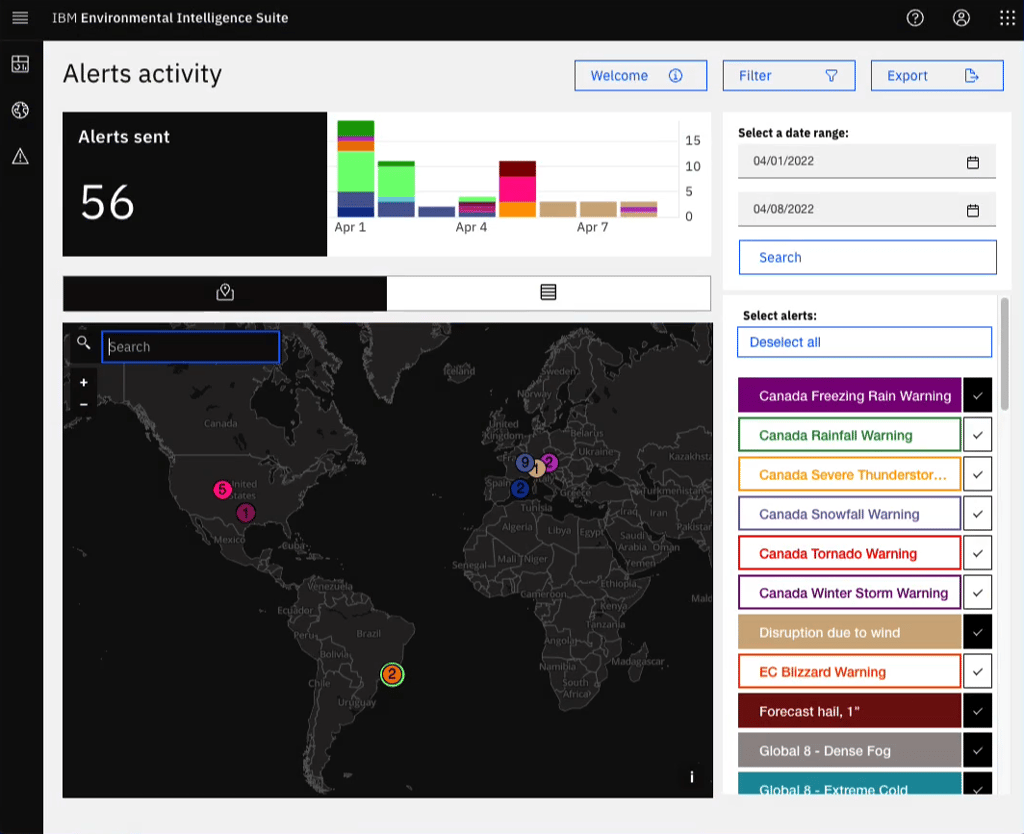
Businesses access EIS through a subscription that starts at $500/month, but the final price varies according to the custom requirements of each company. The tool is primarily used for vegetation management and mitigating supply chain disruptions. It can predict everything from where trees fall on power lines to heat waves lowering the efficiency of a solar farm by a certain percentage.
5. Tomorrow.io – best for forecasting operational timing
| Starting price: | Custom |
| Best for: | Predicting operational timing |
| Free version: | ✅ Yes, API with basic data endpoints |
| Top features: | Closing global data gaps with proprietary radar satellites |
Tomorrow is the only weather-prediction tool on the list that runs on proprietary data. Most global forecasts rely on government data that have blind spots over oceans and deserts, which may leave storms unseen in the middle of the Atlantic Ocean. Tomorrow launched its own 30+ radar satellites to generate exclusive data that government models (e.g., ECMWF) may miss.
This unique data is further fed to their proprietary NextGen AI model. The platform showed 5–10% better accuracy in precipitation forecasts compared to public datasets, as it gets updated every five minutes.
One of the primary use cases of Tomorrow is predicting operational timing. For airlines, it can be knowing the exact minute the snow will start for cost-efficient de-icing, while gig platforms may use it to trigger surge pricing before the rain actually starts.


While the API with basic data endpoints is free, businesses can also subscribe to the advanced Tomorrow’s web platform and API. Both plans are paid, but the exact price is custom.
Comparison: AI weather prediction tools side-by-side
Here’s a quick comparison of each tool across four main aspects:
| Pricing | Popular use cases | Core technology | Free for non-commercial usage | |
| Google WeatherNext 2 | Custom | Severe event prediction, renewable energy planning, and medium-range global forecasting | Functional Generative Network builds coherent weather scenarios by learning from individual weather variables | ✅ Yes |
| NVIDIA Earth-2 (FourCastNet) | Custom | Climate risk simulation, interactive weather visualization | Fourier Neural Operators predict weather flow by analyzing the atmosphere as waves | ✅ Yes |
| Huawei Pangu-Weather | Custom | Typhoon trajectory tracking, rapid 10-day forecasts, and disaster prevention | 3D Earth-specific transformers processes the atmosphere as a 3D volume | ✅ Yes |
| IBM Environmental Intelligence Suite (EIS) | From $500/month | Supply chain disruption monitoring, vegetation management, and sustainability tracking | Geospatial Foundation Model analyzes satellite images to spot land changes | ❌ No |
| Tomorrow.io | Custom | Operational time management, aviation and logistics safety, and event management | 30+ proprietary radars analyzed by proprietary NextGen AI model | ❌ No |
AI models vs traditional numerical weather prediction (NWP)
AI models produce forecasts by analyzing large amounts of meteorological data and the cause-and-effect relationships among their variables. It can be observational data over a period of time, satellite and radar imagery, and datasets with temperature and precipitation metrics.
Traditional NWP models literally simulate the atmosphere using complex mathematical representations of fluid dynamics, thermodynamics, and radiation. They compute how the atmosphere changes, based only on physical laws rather than real-life patterns and relationships. Due to a more complex process, traditional NWP consumes more time, energy, and effort.
Both models can complement each other – one of the AI models’ data sources can be the calculation of NWP. AI can reprocess NWP’s outputs to get rid of biases and enhance the speed of forecasting by stepping in between NWP calculation cycles.
The impact of AI forecasting on global industries
AI forecasting tools work across various industries. Here are only a few of them:
- Agriculture. AI tools can forecast when a rainstorm is likely to hit a specific part of a field, communicate it to the irrigation system, and automatically cancel the scheduled watering to save resources. Similarly, it can prevent fungal outbreaks by analyzing humidity and temperature trends. This way, farmers spray only the areas at risk of fungal growth, cutting chemical costs.
- Renewable energy. AI predicts direction and speed of the wind with minute-level precision. This allows workers to adjust the wind turbine angles accordingly at just the right time to increase the total energy output. Also, AI is often used to scan clouds in real-time via satellites. It can predict drops in solar energy generation, allowing operators to spin up a battery backup and prevent blackouts.
- Aviation. Here, AI helps to cut fuel consumption by predicting headwinds. That lets airlines carry less extra safety fuel, reducing the aircraft’s weight and, in turn, lowering fuel burn. Also, AI helps to achieve sustainability goals, as it calculates the altitude and humidity layers at which an aircraft will form contrails, the white clouds that warm the Earth. As the pilot receives the information, they can adjust their route and reduce harmful impact on the climate.
- Gig economy. Taxi apps use AI to detect when heavy rain starts in a certain city area to raise the prices and incentivize drivers to head there in advance. Food delivery platforms use AI to monitor extreme weather conditions. The system then automatically gives orders to car drivers instead of couriers on bicycles until conditions improve.
Conclusion: which AI weather tool is best?
My review shows that Google WeatherNext 2 is the best as it offers a perfect balance among speed, accuracy, and ease of setup. It also gathers data from traditional, mathematical models, so you can get the best from both worlds. Your ultimate goal is to make the tool work for you, so feel free to explore other tools on the list as well, since they have free versions for non-commercial purposes.
Overall, AI tools generate forecasts more quickly and with greater accuracy compared to traditional, complex systems. You should be ready to pay a substantial sum to use those tools for commercial purposes. Still, there’s a good chance you’ll save more resources by eliminating the risks AI identifies early.
FAQ
Is AI weather prediction more accurate than humans?
Yes, but only across specific benchmarks. For example, in 2023, AI models like GraphCast and Pangu-Weather statistically beat the accuracy of the world's leading traditional physics model (ECMWF IFS). At the same time, human forecasters are still better at predicting extreme, unprecedented events.
Can AI predict weather months in advance?
No, not for specific daily weather. Predicting the exact weather beyond two weeks is scientifically impossible. However, AI is getting much better at predicting general trends, e.g., when a month is going to be warmer than average.
Are there free AI weather prediction tools?
Yes, Google WeatherNext 2, NVIDIA Earth-2, and Huawei Pangu-Weather are free for research and other non-commercial purposes. Also, the Google Weather app is free for users. However, those AI tools are paid for business purposes.