Best AI visibility tools for marketing teams in 2026
Being behind major reports like The Mother of All Breaches and RockYou2024, our in-house cybersecurity experts and journalists provide unbiased, real-world testing and in-depth analysis.
We maintain complete transparency by openly sharing our testing methodologies with our audience.
Learn more
For the last two decades, marketers measured search success by where they ranked on search engines. In 2026, that covers only half the job. Most people now get answers from AI platforms like ChatGPT, Perplexity, Gemini, and Google AI Overviews. They ask, they read the answer, and they never see a list of blue links. If your brand is not named in that answer, your brand is invisible, no matter what position you hold in the classic search results.
That is the gap AI visibility tools fill. They show you if AI engines mention your brand, how often, in what context, and who gets named instead of you. To pick the best AI visibility tools for marketing teams in 2026, I looked into the main platforms different companies are actually using, what separates a serious tool from a dashboard with a chart on it, and what you can do once you have the data. Keep reading to find the best AI visibility tool for your business.
My top picks for AI visibility tools for marketing teams
- Semrush – top all-round AI visibility tool
- Profound – deepest prompt-level analytics
- Ahrefs Brand Radar – strongest pick for backlink-led SEO teams
- Otterly.AI – most affordable AI brand visibility
- Peec AI – leading AI visibility tool for agency client reporting
What are AI visibility tools and how do they work?
An AI visibility tool tracks how your brand appears in AI-generated answers. Traditional rank trackers ask a search engine for a results page and record your position. AI visibility tools do something different because there is no position to record.
These are the mechanics of an AI visibility tool:
- Prompt simulation. The tool sends real buyer questions to each AI engine on a schedule, usually daily. Instead of one keyword, you track prompts like “best project management software for agencies” or “is my brand good for enterprise teams.”
- Mention and citation tracking. An AI visibility platform reads each answer and records if your brand was named in the text and if your site was cited as a source link. These are not the same, since you can be recommended without being linked, and vice versa.
- Sentiment scoring. Being mentioned is not automatically good, and AI visibility tools classify each mention as positive, neutral, or negative. So, by employing an AI visibility tool, you can catch an engine that keeps describing your product as expensive or hard to set up.
- Share of voice benchmarking. The tool counts how often you appear across your tracked prompts versus your competitors. This is the closest thing AI search has to a ranking, and it is the number most teams end up reporting to leadership.
Key features to look for in the best AI visibility tools
Plenty of AI visibility tools for marketing will show you a mention count. These are the features that separate the best software for AI visibility in search from a basic tracker.
- Multi-engine coverage. ChatGPT, Perplexity, Google AI Overviews, Google AI Mode, Gemini, and Copilot behave differently and cite different sources. A tool that only watches ChatGPT gives you a fraction of the picture. Check exactly which engines are included in your plan and which cost extra, because add-on pricing for engines is common.
- Prompt tracking at scale. Ten prompts tell you nothing, since you need enough coverage to see patterns across your category. Plus, you need daily refreshes, since AI answers change faster than search rankings. Most plans are priced by prompt volume, so this is usually what you are really buying.
- Share of voice and competitor benchmarking. Your own mention count means little without context. The useful view shows your share relative to competing brands.
- Sentiment and context analysis. Being mentioned negatively is worse than not being mentioned at all. Sentiment tracking catches problems that raw mention counts hide completely.
- Actionable recommendations. Data alone does not move anything. The better platforms tell you which pages to update, what schema to add, and which prompts you are closest to winning.
- Integration with your existing stack. If AI visibility lives in a separate tool with its own login and report, it remains a side project. Tying it to your keyword, backlink, and traffic data is what turns it into a strategy.
The best AI visibility tools for marketing teams
After extensive research, I found 5 platforms that cover most of what marketing teams are evaluating right now. They split cleanly into integrated suites and specialist point tools.
1. Semrush – best overall AI visibility tool for marketing teams in 2026
| AI engines tracked: | Google AI Overviews, AI Mode, ChatGPT, Perplexity, Gemini |
| Prompts tracked: | 50–200 daily, depending on plan |
| Sentiment and competitor tracking: | ✅ Yes |
| Starting price: | $99/month (AI Visibility Base plan) |
Semrush is the strongest option for marketing teams because its AI tracking sits alongside everything else the team already uses. Semrush One bundles the SEO Toolkit and the AI Visibility Toolkit into one subscription.
Keyword research, site audits, rank tracking, backlink analysis, and competitor research live in the same account as your AI answer engine monitoring. For a team already running on Semrush, there is no new platform to learn, no second contract, and no separate report to reconcile at the end of the month.
On the AI side, you can measure visibility across Google AI Overviews, AI Mode, ChatGPT, Perplexity, and Gemini. Coverage splits by report type:
- AI Analysis: AI Overviews, AI Mode, and ChatGPT
- Brand Performance: AI Mode, ChatGPT, Perplexity, and Gemini
- Prompt Tracking: AI Overviews, AI Mode, and ChatGPT
Across all report types, the toolkit records mentions, prompts, sources, and sentiment. Plus, Semrush also has the Site Audit feature, which checks whether your domain is blocking AI crawlers.
Semrush’s standalone AI visibility tool costs $99/month/domain. However, I personally suggest going for the SEO + AI Search bundle and the Starter plan, which costs $99.00/month. With this plan, you can take advantage of one of the top SEO tools, plus get 50 prompts to track daily, 1 domain for AI brand performance, 300 AI visibility reports per day, and an AI-ready Site Audit.
Semrush also offers a 7-day free trial and a 7-day money-back guarantee.
2. Profound – best for enterprise prompt-level analytics
| AI engines tracked: | Major LLMs, including ChatGPT, Perplexity, and Google AI surfaces |
| Prompts tracked: | Custom volumes, scaling by plan |
| Sentiment and competitor tracking: | ✅ Yes |
| Starting price: | $99/month (Agency Growth plan) |
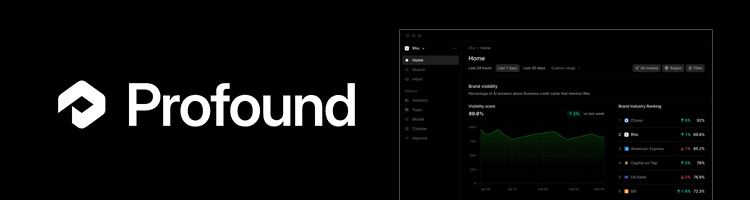
Profound is a platform built only for AI visibility, and the prompt-level analytics are genuinely deep. If your only goal is understanding how LLMs talk about your category, it gives you more granularity than most suite tools.
Profound’s Prompt Volumes analyzes real user conversations to show what people actually ask AI about your category, while Answer Engine Insights shows how those engines describe it back. Its agents then act on the gap, rewriting pages that are losing citations, building pages for questions you have no answer for, and flagging content that AI crawlers cannot read.
Drafts are staged in your CMS for approval rather than being published automatically. A Context Manager keeps your positioning current so that agents work from your messaging rather than guesswork, and the platform layers in enterprise governance through RBAC, SCIM, SOC 2, and 200+ integrations.
The trade-off is structural, though. It is another platform to log into, another subscription to defend, and its data sits outside the SEO workflow your team already runs.
Public pricing starts at $99/month, but the tiers most teams actually need are more expensive, and larger deployments are quoted on request. It suits enterprise budgets and dedicated AI search specialists more than a general marketing team.
3. Ahrefs Brand Radar – best for backlink-led SEO teams

| AI engines tracked: | AI Overviews, AI Mode, ChatGPT, Perplexity, Gemini, Copilot (Claude via custom prompts) |
| Prompts tracked: | 5–20 daily by the Ahrefs plan, 83 daily on the AI Visibility Index |
| Sentiment and competitor tracking: | ✅ Yes |
| Starting price: | $50/month Custom Prompts add-on, or $199/month standalone Index ($699/month for all platforms) |
Ahrefs Brand Radar monitors brand mentions across AI Overviews, AI Mode, ChatGPT, Perplexity, Gemini, and Copilo. Moreover, it tracks mentions on YouTube, TikTok, and Reddit, but these features are still in beta. Custom Prompts start at $50/month on top of a paid Ahrefs plan, with daily quotas tied to your tier.
The standalone AI Visibility Index starts at $199/month and provides access to a large library of pre-collected AI responses. If you wish to gain access to 455M+ organic prompts across all platforms, the total bill is $699/month.
It fits backlink-minded SEO teams who already live in Ahrefs. It is less developed on the reporting and campaign attribution fronts than marketing teams need to present results to stakeholders.
4. Otterly.AI – best budget AI brand visibility tool for small teams
| AI engines tracked: | AI Overviews, ChatGPT, Perplexity, Copilot (AI Mode, Gemini, Claude as paid add-ons) |
| Prompts tracked: | 15–400 monthly by plan |
| Sentiment and competitor tracking: | Basic brand reports, limited competitive depth |
| Starting price: | $29/month |
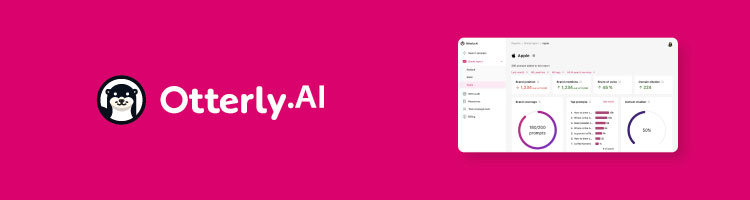
Otterly.AI is the most accessible entry-point provider on this list. Lite plans start around $29/month, and the structure is simple: Lite tracks 15 prompts, Standard ($189/month) tracks 100, and Premium ($489/month) tracks 400, all with daily updates and unlimited brand reports.
Core coverage includes Google AI Overviews, ChatGPT, Perplexity, and Copilot, with Google AI Mode, Gemini, and Claude available as paid add-ons. That add-on model is worth checking before you commit, since it can quietly change the real monthly cost.
For a small team that wants to know whether ChatGPT mentions them and how that changes week to week, it does the job at a price that doesn't require an approval process. For enterprise competitive analysis, it runs out of depth fast.
5. Peec AI – best AI visibility tool for agency client reporting
| AI engines tracked: | Choice of 3 models per plan from ChatGPT, AI Mode, AI Overviews, Copilot, Perplexity, Gemini; up to 13 on Enterprise |
| Prompts tracked: | 50–350 by plan |
| Sentiment and competitor tracking: | Competitor comparison included |
| Starting price: | From $85/month |
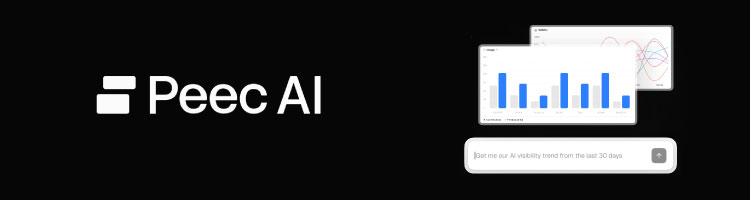
Peec AI is built around clean, visual dashboards, which makes it popular with agencies presenting to clients who do not want to read a spreadsheet.
Plans scale with prompts and projects: Starter ($85/month) covers 50 prompts and 1 project, Pro ($205/month) covers 150 prompts and 2 projects, and Advanced ($425/month) covers 350 prompts across 5 projects with multi-country tracking and a Looker Studio integration. Enterprise (custom pricing) unlocks up to 13 models and unlimited projects.
The catch is engine coverage. Most Peec AI plans let you pick only three AI models from the available list, so you are choosing which engines to watch rather than watching all of them. For an agency running clean monthly reporting across several clients, that is often an acceptable trade. However, for a brand that needs full coverage of every major engine, it is a real limitation.
How to improve brand visibility in AI answer engines
Every tool in my list reports the same thing: the prompts where you appear, and the ones where a competitor appears instead. Closing that gap is a content and technical job, and these are the six changes I’d suggest to improve brand visibility in AI answer engines:
- Add structured data. Schema markup helps engines understand what your page is, who wrote it, and what it claims. Organization, product, FAQ, and article schema all make your content easier for a model to parse and quote correctly.
- Write content that can be quoted. LLMs pull clear, factual statements. A page that answers a question directly in two sentences gets cited more often than a page that takes six paragraphs to get there. Lead with the answer, then explain it.
- Build topical authority through consistent entity mentions. Models associate brands with topics based on repetition across many sources. Describe your brand the same way everywhere, and publish consistently in the topic area you want to own.
- Earn third-party citations. LLMs weigh trusted external sources heavily, which means a mention in a respected industry publication can influence AI answers more than anything on your own site. Digital PR now feeds AI visibility directly.
- Keep content fresh and clear. Models favor recently updated pages with specific claims. Outdated pricing, old statistics, and vague marketing language all reduce your odds of being cited.
- Check that you are not blocking AI crawlers. If your robots.txt blocks GPTBot, PerplexityBot, or Google-Extended, your content simply won’t be picked up by an AI-powered search engine.
How to choose the best AI search visibility tool for your team
The tools above are not competing on the same terms, so the useful question is not which one is best overall, but which profile you fit into. Find your situation in the table below.
| Your situation | What to prioritize | Realistic budget |
| Solo marketer | Basic mention tracking on major engines | Under $50/month |
| Your in-house marketing team is already running SEO | Unified reporting and recommendations you can act on | $150–500/month |
| Agency reporting to several clients | Multi-project support and clean client-facing dashboards | $90–500/month, scaling per client |
| The SEO team has already invested in backlink tooling | Engine breadth added to an existing plan | $50–$200/month on top of current tools |
| Enterprise with a dedicated AI search specialist | Prompt-level depth, governance, and automation | $500/month and up, often on custom contracts |
The one question that decides most of this is whether you want a specialist tool or an integrated suite. If AI visibility is one part of a broader marketing job, the suite wins, because the data adds to everything else you report on. If you have someone whose entire role is AI search, a standalone solution can be justified.
Marketing teams’ AI search visibility challenges
Most teams run into the same problems, which is why a dedicated tool stops being optional.
- Fragmented reporting. Checking different AI models manually one by one is not a process. It is a person with twelve browser tabs producing numbers nobody trusts.
- Attribution gaps. AI-driven traffic often arrives with no clear referrer, or as direct traffic after someone reads about you in an AI answer and types your name later. Standard analytics cannot see that path.
- No agreed KPI framework. Traditional SEO has rankings, impressions, and clicks. AI visibility has mentions, citations, share of voice, and sentiment, and the industry has not settled on which one matters most.
- Hard to prove ROI. Without attribution or a standard KPI, getting a budget approved for AI visibility work is a difficult conversation.
Common mistakes marketing teams make with AI visibility tracking
- Treating it as a vanity metric. Mention counts mean nothing until you connect them to the pipeline and revenue.
- Tracking only ChatGPT. It is the biggest engine, but not the only one. Perplexity, Gemini, and AI Overviews reach different audiences and cite different sources.
- Ignoring sentiment. Frequent negative mentions are worse than silence, and mention-count dashboards hide that entirely.
- Never acting on the data. Visibility reports without content and schema follow-through are an expensive way to feel informed.
Conclusion
AI search is not replacing traditional search. However, it is now a second front, and brands that measure only one are flying blind. Among the AI visibility tools we tested, Semrush is the strongest pick for marketing teams because it treats AI visibility as part of the search strategy rather than a separate discipline. You get AI Overviews, AI Mode, ChatGPT, Perplexity, and Gemini tracking, sentiment and prompt monitoring, and an AI crawler audit, all sitting next to the keyword and backlink data your team already works from.
That said, all tools on my list cater to different needs and goals. So, it’s best to evaluate your needs before picking an AI visibility tool for your marketing team. Profound goes deeper if you have an enterprise budget and a specialist to use it. Ahrefs suits backlink-led SEO teams; Otterly.AI is the cheapest way to get started; and Peec AI is built for agency reporting.
FAQ
What is an AI visibility tool?
An AI visibility tool is software that tracks how and if your brand is mentioned or cited in AI-generated answers across engines like ChatGPT, Perplexity, Gemini, and Google AI Overviews. It monitors mentions, citations, sentiment, and how you compare to competitors.
How is AI visibility different from traditional SEO rankings?
There is no position in AI answers. Either the engine names you, cites you, or recommends you, or it does not. AI visibility measures presence and share of voice rather than rank, so the metrics and reporting are fundamentally different.
What is the best AI search visibility tool for marketing teams specifically?
Semrush is the best AI search visibility tool for marketing teams. It combines AI visibility tracking with the SEO, content, and competitive data marketing teams already use. Unified reporting means AI performance sits in the same view as rankings and traffic, and teams already on Semrush do not need to learn a new platform.
How much do AI visibility tools cost?
Entry tools for small teams start around $29/month. Mid-market platforms run roughly $150–500/month, depending on how many prompts you track. Enterprise specialist tools are typically quoted on request. Suite tools often bundle AI visibility into an existing subscription, which makes them cheaper in practice than adding a separate tool.
Which AI engines should marketing teams monitor?
Marketing teams should focus on multi-engine monitoring, including ChatGPT, Perplexity, Google AI Overviews, Google AI Mode, Gemini, and Copilot. Each pulls from different sources and reaches different audiences. So, strong visibility in one tells you very little about the others.
Can AI visibility tools improve my brand’s visibility in AI answers?
No, AI visibility tools can’t improve a brand’s visibility on their own. Most tools provide monitoring and optimization recommendations, but improvement comes from the work you do afterward: schema markup, clearer, more citable content, third-party mentions, and keeping pages accurate and up to date.
How often should marketing teams check AI visibility data?
Marketing teams should check AI visibility data at least once a week. AI answers shift much faster than search rankings. Add a monthly strategic review to look at trends, sentiment changes, and competitor movement rather than week-to-week noise.
Do I need both an SEO tool and a separate AI visibility tool?
No, you don’t need both an SEO tool and a separate AI visibility tool. Integrated platforms like Semrush cover both in one subscription, removing the need for separate logins, costs, and reporting mismatches that come with running two systems.