DeepSeek vs ChatGPT – which one is better in 2026
Being behind major reports like The Mother of All Breaches and RockYou2024, our in-house cybersecurity experts and journalists provide unbiased, real-world testing and in-depth analysis.
We maintain complete transparency by openly sharing our testing methodologies with our audience.
Learn more

The AI chatbot landscape has seen a dramatic change over the past year. The pioneers remain, such as OpenAI’s ChatGPT – a household name and the reigning king of AI tools. Then there are the innovators, modern takes on an existing frameworks designed to be better, faster, and more accessible. DeepSeek fits perfectly into this category.
In January 2025, DeepSeek launched its DeepThink-R1 chatbot (along with the regular DeepSeek chatbot), which quickly surpassed ChatGPT as the most downloaded free app in the US.
But what’s the difference between these two? Should you be using ChatGPT or venturing into DeepSeek? With the help from the Cybernews research team, for this DeepSeek vs ChatGPT comparison, I analyzed both to help you answer those questions. Let’s compare their features, performance, subscription options, and data privacy.
Below, you can quickly compare both providers to see their similarities and differences at a glance.
| Quick facts | DeepSeek | ChatGPT |
| Rating | ||
| Launch year | 2023 | 2022 |
| Developer | DeepSeek (China) | OpenAI (US) |
| Architecture | Mixture of Experts | Dense transformer |
| Supported languages | 50+ | 80+ |
| API availability | Yes, ultra-cheap | Yes, premium pricing |
| User base | Growing rapidly | 100M+ active users |
Features and performance comparison
Here's where things get interesting. Both AIs can write, code, and reason, but they do so differently.
ChatGPT feels like interacting with someone extremely knowledgeable across countless subjects. Its responses are smooth, conversational, and polished. Standard models don’t explain where the information comes from, but the Thinking model adds transparency by showing sources and reasoning. It remains strong at creative writing, handles complex conversations naturally, and rarely gives you something that feels robotic.
On the other hand, DeepSeek shows its reasoning process. It thinks out loud, showing you each step of its logic. This transparency is both a feature and a distraction, depending on what you're after. For coding and math problems, seeing the thought process is genuinely helpful. For casual conversation, it can feel excessive.
To see how both tools perform, I ran identical prompts. Read further to learn what I found.
Natural language quality and dialogue flow
ChatGPT sets the standard for conversational quality. Its responses feel natural, polished, and capable of carrying nuanced discussions without slipping into robotic phrasing. In creative writing tests, I asked ChatGPT to produce short story outlines, develop original characters, and suggest possible plot arcs. It not only generated coherent structures but also delivered strong character concepts and compelling story directions.
That level of fluency is what makes it a favorite for casual and professional users alike. From a technical perspective, ChatGPT’s dense transformer architecture and reinforcement learning from human feedback (RLHF) give it a strong ability to track conversation context, adapt tone, and maintain coherence across extended dialogue sessions. It also handles long-context prompts efficiently, preserving style consistency while introducing subtle variation that prevents outputs from feeling repetitive.
By contrast, DeepSeek prefers clarity and directness. It shows its reasoning chain step by step, which is useful for factual queries but can feel mechanical in casual dialogue. While its Mixture-of-Experts architecture improves efficiency and reasoning accuracy, the transparency of thought processes often interrupts flow. In longer conversations, this structured reasoning can feel stiff compared to ChatGPT’s fluidity.
DeepSeek’s latency is also slightly higher when reasoning traces are enabled, since the model generates intermediate tokens to explain its logic before producing the final answer. This design benefits technical audits but reduces conversational smoothness.

Coding and technical tasks
To compare technical performance, I gave both models the same buggy Python script.

DeepSeek took about 10 seconds to fix it. It carefully explained the off-by-one error, walked through the loop values, and corrected the code with range(1, n+1). More importantly, it suggested two alternative solutions: adjusting the loop or using the mathematical formula n*(n+1)/2. That flexibility shows deeper technical reasoning.

ChatGPT replied in 6 seconds, identifying the off-by-one bug as well. Its explanation was concise and beginner-friendly, but it only provided the corrected code. Unlike DeepSeek, it didn’t suggest alternative approaches.


Mathematical reasoning
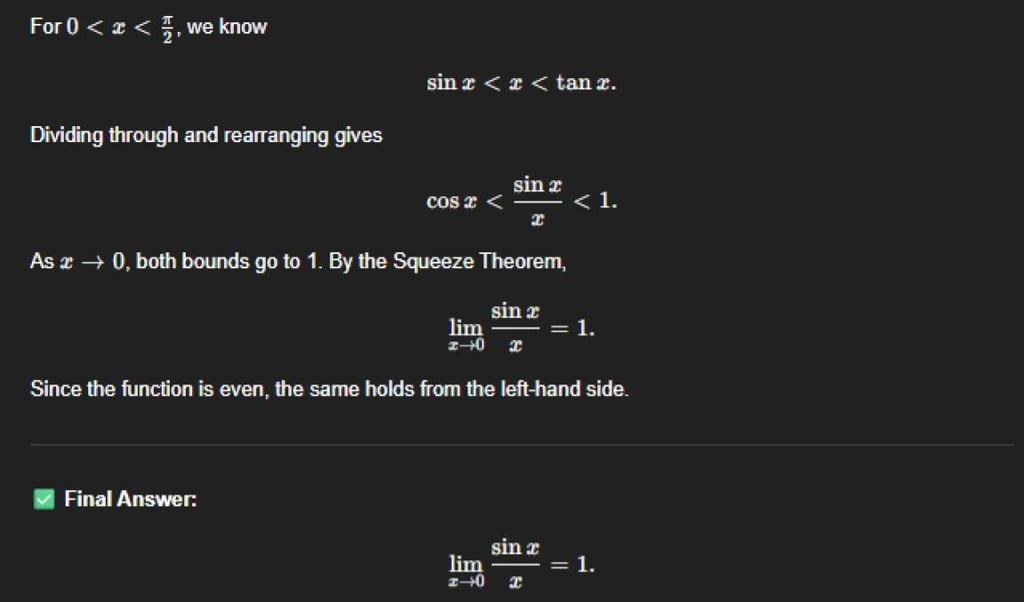
DeepSeek shines when doing structured problem-solving. For a calculus proof, it laid out every step, making verification straightforward. This transparency is especially valuable in academic or technical environments where accuracy is important.
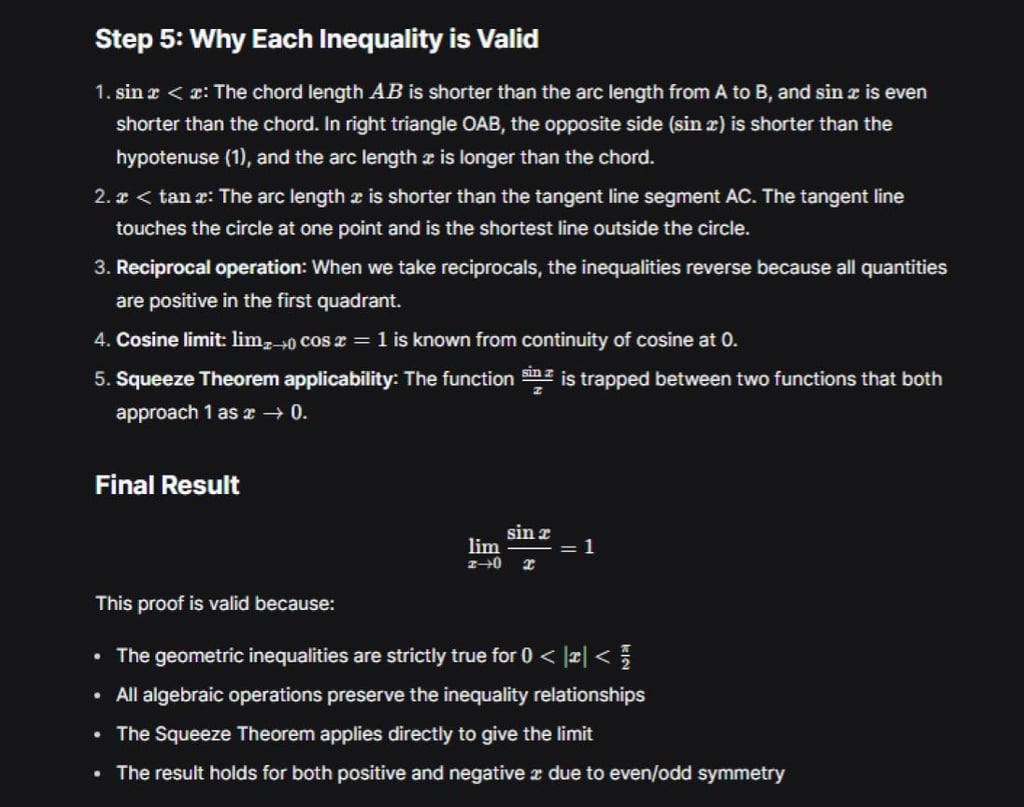
ChatGPT also produced the correct proof but skipped over much of the logic. While the final answer was correct, the lack of detailed reasoning could be a limitation for those needing a clear trail.
Multilingual translation
To test my ability to translate, I used a portion of Despacito's Spanish lyrics. Both tools returned correct English, but their styles diverged. DeepSeek’s translation was precise yet formal, using phrases like “turn your body into a whole manuscript.” While accurate, the wording leaned toward literal interpretation, which works well in legal, academic, or technical contexts where formality is valued.
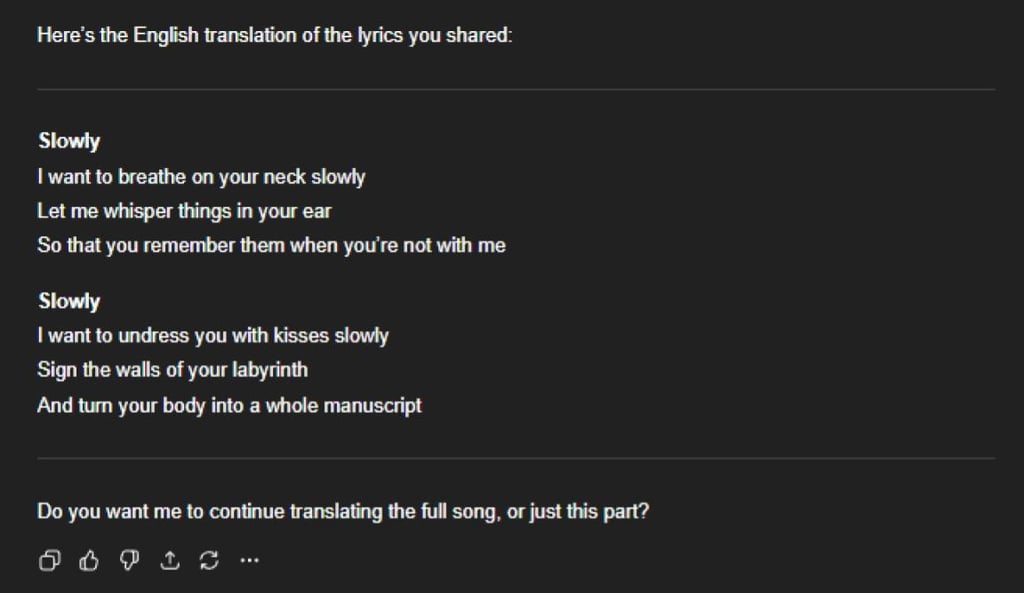
By contrast, ChatGPT’s output felt more natural and culturally tuned. It produced phrasing closer to how a native speaker would express the lyrics, such as “make your body into a manuscript.” This version sounded less stiff and better captured the rhythm of everyday speech.
Speed and efficiency
Performance benchmarks show DeepSeek producing between 45 and 60 tokens per second, which is noticeably faster than ChatGPT’s 35 to 50 tokens per second. The speed advantage comes from DeepSeek’s Mixture-of-Experts architecture, which routes tasks through specialized sub-models. For users processing large amounts of text or code, this difference can save time.
Context window
DeepSeek supports a context window of up to 128,000 tokens, which is enough to handle long research papers, extended chat histories, or multiple documents without breaking coherence.
By contrast, ChatGPT 4.1 goes further with a context window of 1 million tokens. That scale makes it capable of processing entire books or massive datasets in a single conversation.
Multimodal and ecosystem support
This is where the gap becomes clear. ChatGPT goes beyond text with features like image recognition, image generation, and an advanced voice mode. It also supports custom instructions, memory across chats, custom GPTs, and both desktop and mobile apps. For automation, it integrates with scheduled tasks and connects to a wide ecosystem of third-party apps.
On the contrary, DeepSeek is primarily text-based. Its strength lies in being open-source, energy-efficient, and privacy-friendly through self-hosting. While appealing to developers and enterprises with custom needs, it lacks the consumer-facing breadth of ChatGPT.
| Feature | DeepSeek | ChatGPT | Winner |
| Natural language and dialogue flow | Clear and structured, but rigid in long chats | Polished, engaging, humanlike | ChatGPT |
| Coding and technical tasks | Faster, transparent, offered alternative fixes | Clear and beginner-friendly, but less complete | DeepSeek |
| Mathematical reasoning | Step-by-step logic, easy to verify | Correct but less transparent | DeepSeek |
| Multilingual translation | Accurate, slightly formal | Natural, culturally aware | ChatGPT |
| Speed and efficiency | 45-60 tokens/sec, faster with MoE | 35-50 tokens/sec | DeepSeek |
| Context window | 128K tokens | 1M tokens | ChatGPT |
| Multimodal and ecosystem support | Text-only, open-source, self-hosting | Images, voice, apps, memory, custom GPTs, integrations | ChatGPT |
Pricing and subscription options
For everyday users, DeepSeek is effectively zero cost, as its chatbot app provides unrestricted access to advanced models with no message caps and no hidden paywalls. Developers also benefit from its aggressively low API pricing, which is way cheaper than OpenAI’s.
On the other hand, ChatGPT follows a more traditional SaaS pricing ladder. The free plan comes with limits, while Plus, Pro, Business, and Enterprise unlock broader features like image generation, voice, file uploads, memory, and integrations. Business and Enterprise plans also include admin controls, compliance certifications, and enterprise-grade support.
Here’s how the two stack up:
| Plan/feature | DeepSeek | ChatGPT |
| Free tier | Unlimited chat access with full model use | GPT-5 access, limited file uploads, image generation, and voice mode, ~15 messages per 3 hours |
| Monthly price | $0.00 (consumer app) | Plus: $20.00, Pro: $200.00, Business: $30.00/user, Enterprise: custom |
| Annual price | $0.00 (consumer app) | Business: $25.00/user, Enterprise: custom |
| API pricing (per 1M tokens) | Input: $0.07 (cache hit), $0.56 (cache miss), output: $1.68 | Input: $0.050-1.250, output: $0.400-10.000 |
| Business features | Self-hosting options, open-source deployment, energy efficiency | Admin console, SAML SSO, SOC 2 and ISO certifications, connectors (Google Drive, GitHub, SharePoint), team workspaces, compliance tools |
| Enterprise features | Custom deployment with on-premise hosting | Enterprise-grade security, custom data retention, domain verification, role-based access, 24/7 support |
| Last checked | September 23, 2025 | September 23, 2025 |
DeepSeek’s pricing is refreshingly simple and free for consumers, with a developer API that undercuts rivals by a massive margin. But the trade-off is that its consumer app feels bare-bones: no voice mode, no image generation, and no ecosystem of custom apps. ChatGPT costs more, but those premium features and enterprise controls make it appealing to businesses that need more than just text generation.
Data privacy and security
This topic gets complicated quickly, especially with DeepSeek's Chinese origins.
ChatGPT offers enterprise-grade controls when you pay for them. You can choose specific data regions, control how information is processed, and access clear documentation about retention policies. Business and Enterprise tiers include SOC 2 Type 2, ISO/IEC 27001 compliance, SAML SSO, and role-based access controls. For most professional settings, ChatGPT Plus or Team provides adequate privacy coverage, but regulated industries often require those enterprise add-ons.
Key security features in ChatGPT’s Enterprise tier include:
- Encryption: AES-256 at rest, TLS 1.2+ in transit
- Data residency: options in the US, EU, and several Asia-Pacific regions
- Training exclusion: enterprise data is not used for model training by default
- Audit tools: admin consoles and SCIM provisioning for large teams
DeepSeek presents a more complex picture. The company is based in China, and that raises questions about local data governance rules and state access. Recent reports highlight how China’s evolving AI regulations could influence companies like DeepSeek. For sensitive or regulated work, it’s risky to rely solely on DeepSeek’s public cloud.
The good news is that DeepSeek’s open-source models give you an exit strategy. You can download weights, run everything offline, and avoid cloud exposure entirely. That means no data sharing, no external logging, and complete lifecycle control, appealing to industries bound by HIPAA, GDPR, or financial compliance.
For most casual users, both platforms handle data reasonably well. But if you’re working with confidential business information, medical records, or anything heavily regulated, here’s my take: use ChatGPT with enterprise controls, or self-host DeepSeek. Avoid putting sensitive material into any free cloud AI service.
User experience and ecosystem
ChatGPT is way more polished and easily takes the win. The interface is clean, intuitive, and packed with features. Voice conversations feel natural. The mobile app is genuinely good. Desktop integration works smoothly. Custom GPTs let you create specialized assistants for specific tasks.
Plus, the ChatGPT ecosystem is mature. Plugins, integrations, documentation, and community resources are extensive. If you want to integrate AI into existing workflows, ChatGPT probably has a solution ready to go.
Key advantages of ChatGPT’s ecosystem include:
- Full multimodal support with text, voice, images, and limited video with Sora
- Custom GPT creation with shared libraries
- Business/Enterprise add-ons like connectors to Google Drive, GitHub, and SharePoint
- Reliable desktop and mobile apps with sync
DeepSeek’s interface feels plain by comparison. It’s fast, functional, and gets the job done, but it won’t win design awards. The reasoning traces are fascinating if you’re into that, but they can clutter the experience for simple requests.
DeepSeek is also highly flexible. Open-source models mean unlimited customization possibilities. You can fine-tune the model for your specific use case and run everything offline if needed.
DeepSeek’s technical flexibility allows:
- Model fine-tuning for domain-specific data
- Offline or on-premise deployment for privacy
- Transparent reasoning chains for auditable outputs
- Lower resource consumption (90% less energy than peers)
The DeepSeek community is growing rapidly, but it’s still catching up to ChatGPT’s established ecosystem. Documentation is improving, but finding specific answers sometimes requires digging.
Which should you use?
After extensive testing, below is my honest breakdown.
Choose DeepSeek if:
You’re a developer or technical user who values transparency in reasoning chains. Its step-by-step logic makes it ideal for math, coding, and structured problem solving. Budget-conscious users will appreciate that it’s free for consumers and drastically cheaper on the API side.
Self-hosting options allow full control over data, which is beneficial for privacy-conscious industries. If you enjoy experimenting with open-source models, DeepSeek gives you that freedom without locking essential features behind paywalls.
Choose ChatGPT if:
You want the most polished, user-friendly experience. Its conversational flow, memory, and creativity stand out, making it excellent for educators, writers, and teams. It also delivers strong multimodal features like image generation, voice, and file uploads, plus seamless integrations with popular apps.
For organizations, Business and Enterprise tiers add compliance, admin controls, and guaranteed support. If you’re willing to pay for reliability and richer functionality, ChatGPT offers the complete package.
In short, DeepSeek fits technical and budget users best, while ChatGPT excels in meeting mainstream and enterprise needs.
In the table below you can explore some specific scenarios.
| Use case | Recommendation | Key factors |
| Software development | DeepSeek | Reasoning transparency, cost efficiency |
| Content creation | ChatGPT | Creative quality, voice features |
| Business analysis | ChatGPT (Plus/Pro) | Security controls, integrations |
| Academic research | DeepSeek | Open-source flexibility, detailed reasoning |
| Casual users | ChatGPT free → DeepSeek | Try free options first |
| Privacy-critical work | Self-hosted DeepSeek | Complete data control |
From my testing, I found both AIs genuinely impressive. ChatGPT feels more refined and conversational. DeepSeek offers remarkable value and transparency. Your choice depends on whether you prioritize polish or price, features or flexibility.
However, the real winners here are the users. Having legitimate competition in the AI space means better products, lower prices, and more innovation. Whether you choose ChatGPT or DeepSeek, you're getting AI capabilities that seemed impossible just a few years ago.
FAQ
Can AI detectors identify content generated by multiple AI models in one piece?
No, AI detectors are trained on single-model outputs, so mixing ChatGPT and DeepSeek confuses them. Some sections may be flagged, others ignored, making detection unreliable.
Is DeepSeek faster than ChatGPT in generating responses?
Yes, DeepSeek is designed to generate responses very fast. However, ChatGPT also prioritizes speed while balancing accuracy and context, so the difference depends on the task and server load.
Does DeepSeek or ChatGPT handle creative writing better?
ChatGPT generally handles creative writing better. It has been trained with a strong focus on storytelling, tone, and style, which helps it produce more engaging and human-like narratives than DeepSeek.
Is DeepSeek more up-to-date with real-time information than ChatGPT?
No, DeepSeek is not more up-to-date with real-time information than ChatGPT. Both rely on their training data, but ChatGPT can access web sources when enabled, providing fresher insights.