Gemini 3 Flash review 2026 – hands-on testing for accuracy and speed
Being behind major reports like The Mother of All Breaches and RockYou2024, our in-house cybersecurity experts and journalists provide unbiased, real-world testing and in-depth analysis.
We maintain complete transparency by openly sharing our testing methodologies with our audience.
Learn more
Gemini 3 Flash is the new, lightweight Google Gemini model optimized for fast execution of tasks, based on advanced Pro reasoning. Google produces specialized models in each generation, and this one is focused on speed and efficiency – it’s three times faster than Gemini 2.5 Pro and four times cheaper than Gemini 3 Pro.
Together with the Cybernews research team, I checked how Gemini 3 Flash works in practice and how it compares to Gemini 3 Pro. The tests showed that Gemini 3 Flash was considerably faster than Pro when effectively tackling real-world problems. However, the compromise for speed is more high-level and abstract answers. In this Gemini 3 Flash review, you can find a more detailed overview of the test results and the model’s pricing and limitations.
Quick overview of Gemini 3 Flash
| Best for: | Quick answers and simple tasks that require high-speed execution |
| Key features: | Video, image, audio, and text inputs, a 1-million input token window, agentic workflows for multi-step tasks, and online web search |
| Free version: | ✅ Yes |
| Starting price: | $19.99 |
Pros and cons of Gemini 3 Flash
What is Gemini 3 Flash?
Google releases its Gemini models in Pro and Flash versions. Pro is all about intelligence, while Flash focuses on cost and affordability. This time, Gemini 3 Flash is still the speed-first model, but it runs on Gemini 3 Pro intelligence at a lower price. That’s why it works well for everyday agentic tasks, vibe coding, and multimodal analysis, which means combining insights from various input formats (i.e., texts, images, videos, and audio files).
In the past, using Flash often meant putting up with occasional mistakes and subpar outputs. This generation aims to balance speed and performance without compromises. Gemini 3 Flash ranks second on the LMArena, right after Gemini 3 Pro, a platform for anonymous blind testing of AI models. Competing lightweight models of other companies lag far behind in the ranking.
How the Gemini 3 Flash is positioned vs other Gemini models
Gemini 3 Flash is the third iteration of the Flash models, so it’s much faster, smarter, and more humane than its predecessors. Google’s own evaluation shows that Gemini 2.5 Flash scored only 11% in academic reasoning and visual puzzle-solving tests. Gemini 3 Flash, in contrast, gained 33.7% and 33.6%, respectively. Also, it uses 30% fewer tokens compared to Gemini 2.5 Flash.
Compared to Gemini 3 Pro, Flash is slightly better at agentic coding, long-horizon real-world software tasks, and multimodal reasoning. Pro outperforms Flash across all other benchmarks. So, if you need a smart AI for fast agentic coding, multimodal analysis, and everyday tasks at a lower price, Flash does the job. If you don’t mind a slower speed and spending more on in-depth analysis and rich, extensive outputs across all tasks, Pro is the right choice. We already tested Gemini 3 Pro, so feel free to read more about the hands-on results of the more intelligent model.
Gemini 3 Flash in practice
Google’s marketing campaigns tend to present each new model as exceptional in every aspect. To verify the claims, I tested Gemini 3 Flash on a range of real-world tasks and, where possible, compared the results with Gemini 3 Pro’s performance.
Coding and debugging
I asked Gemini 3 Flash to create a snake game. It produced a simple interface, but the game itself wasn’t entirely bug-free. I had difficulty moving the snake, and the game would suddenly end when I hit the borders. Still, it was functional from the first prompt.
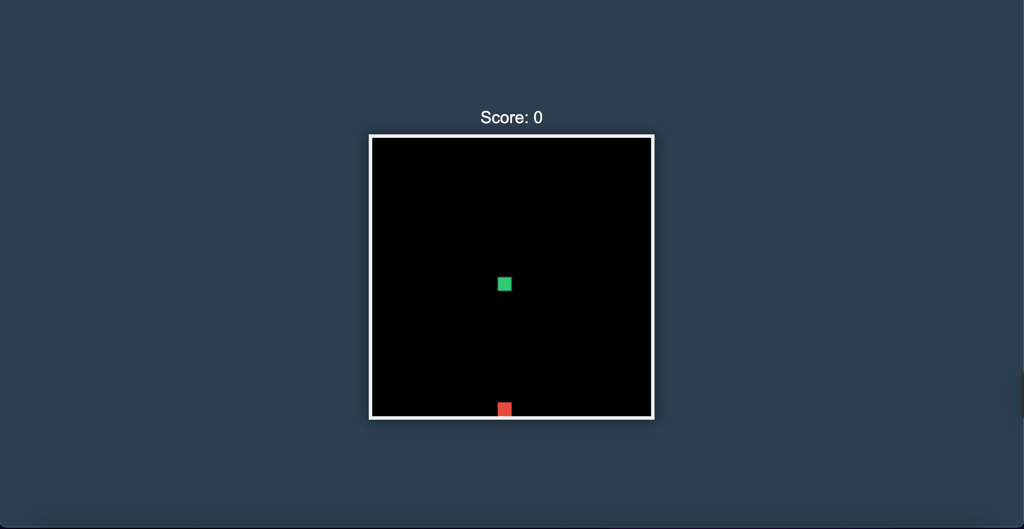
I gave Gemini 3 Pro the same task. Surprisingly, Pro gave out a non-functional code, although it had more complex elements. I couldn’t move the snake with the keyboard arrows, and it displayed a Game Over message that wouldn’t go away.
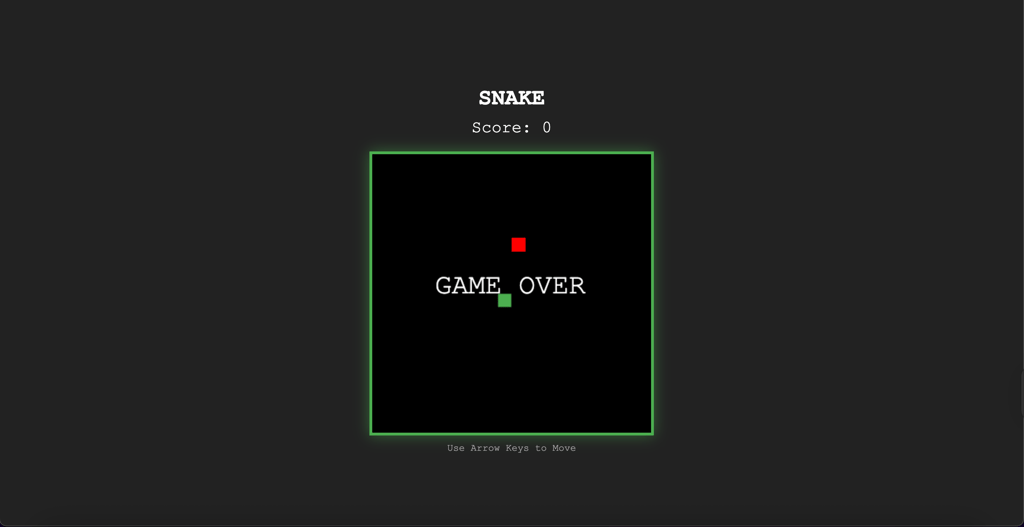
After I asked Gemini 3 Pro to debug the code, it provided a fully working version without any errors. It modernized the interface by replacing legacy key codes with arrow keys, stopped the page from scrolling when arrows were clicked, and adjusted related key values for better reliability in modern browsers.
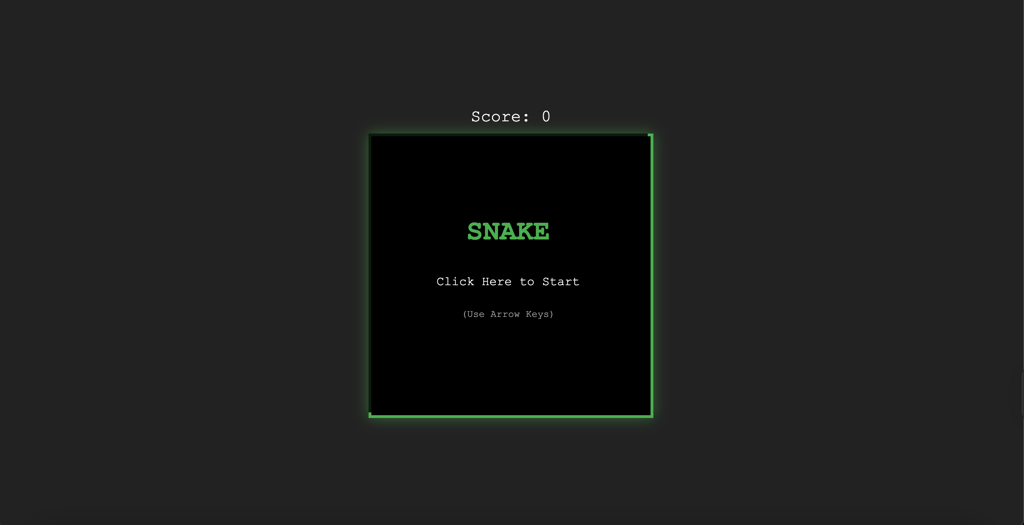
Then, I came up with the idea to debug the faulty Pro code with Flash. After Flash’s tweaks, my game was fully functional too, but the fixes focused on gameplay flow rather than input handling. The model prevented unwanted browser scrolling, fixed game-state logic so the snake only starts moving when the first button is pressed, and added a simple on-screen prompt telling the player to press any key to start.
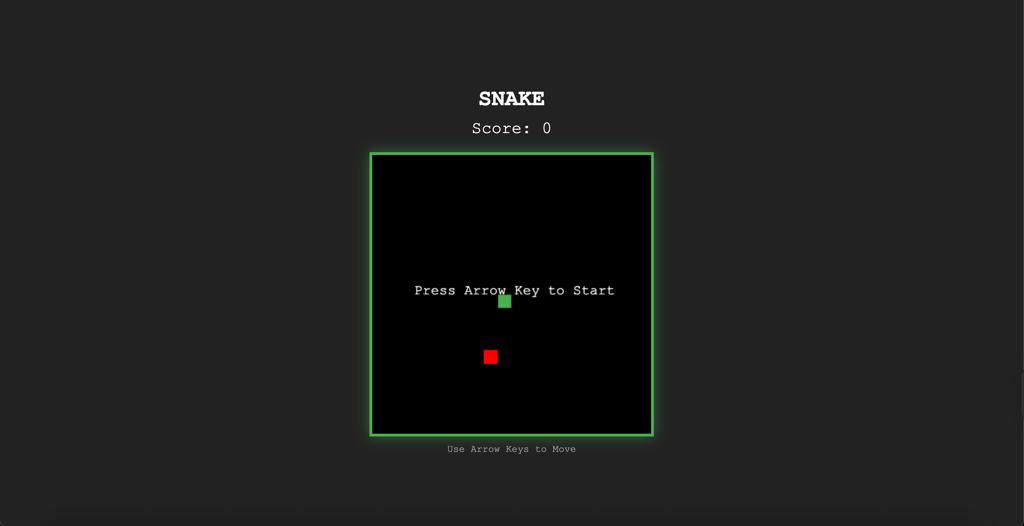
Overall, Gemini 3 Flash performed better at generating the snake game from a single prompt. However, my test shows that further prompting and proper prompt engineering are a must for quality coding. Although Gemini 3 Pro failed on the first try, it debugged the code correctly, and the final result looked more advanced. Flash also debugged the code successfully, but the final solution was simpler and didn’t have any additional features.
Short-form writing
I tested how good Gemini 3 Flash is in short-form writing and gave it the following prompt:
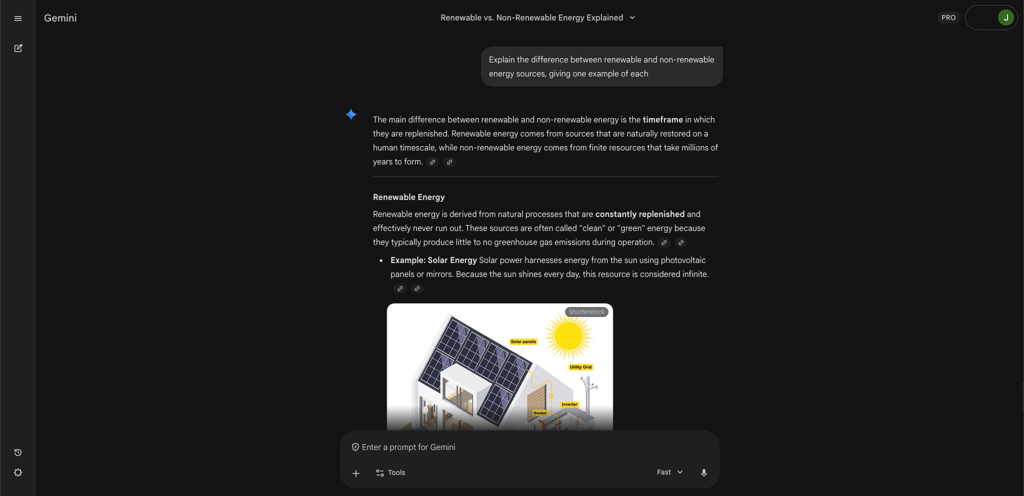
Explain the difference between renewable and non-renewable energy sources, giving one example of each.
Flash’s output was extensive and practical, with essential details on renewable energy sources. The generated text was helpful, but it also had a few generalizations, which made it less accurate than it could be. Also, the model produced high-quality visualizations for each type of renewable energy source with legible in-image text.
Gemini 3 Pro’s text was tighter and more definition-focused, withand had a simple table. Such an output made the topic clear and had a low risk for oversimplified claims. It also generated high-quality visualizations.
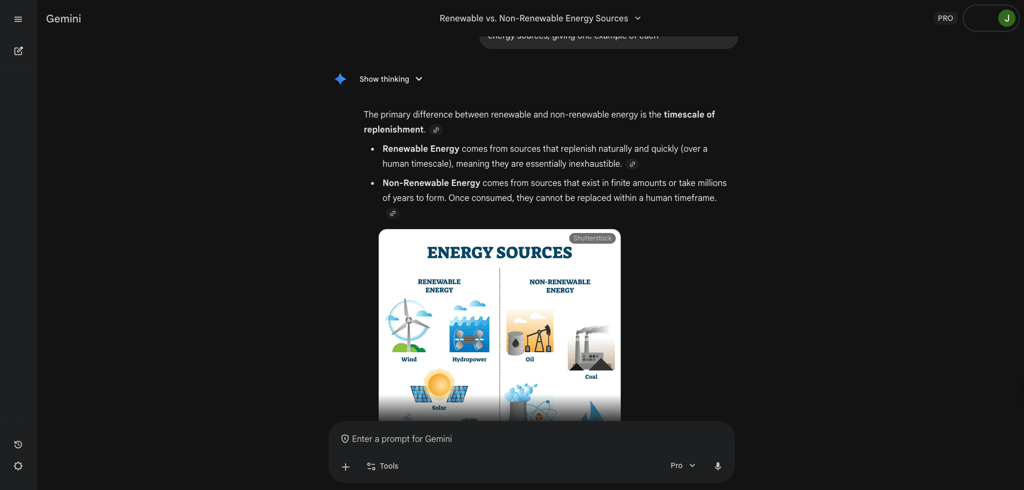
Still, both models performed similarly, explained the same core idea correctly, and used the same examples.
Summarization
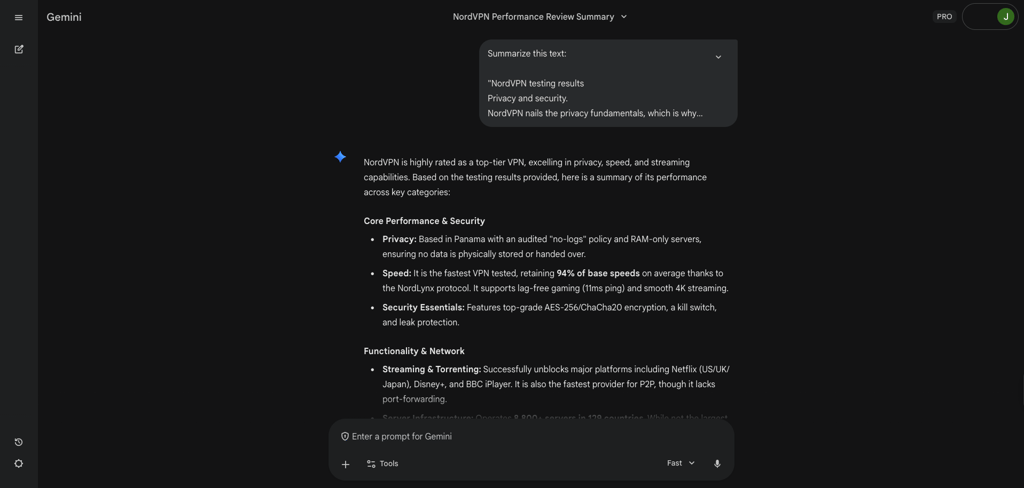
Then, I asked both tools to summarize a text about NordVPN. Gemini 3 Flash generated a clean, high-level overview that reads more like a product pitch and relies on broad claims.
The Pro’s summary was more credible and useful because it grounded the text in exact test results and stated NordVPN’s limitations clearly.
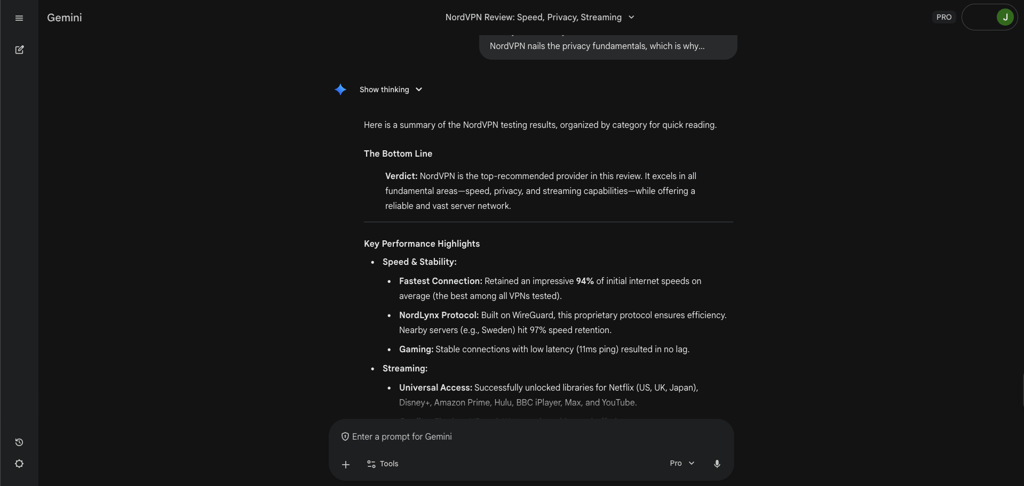
Overall, I think Pro is better for decision-making tasks, while Flash is best only when you need a very short, executive-style blurb.
Multi-step prompts
I tested how well the models handle multi-step prompts and logical reasoning by asking each to act as a senior marketing strategist and create a digital campaign. I also specified the steps they should follow when building the strategy.
Flash’s plan was easy to follow, well-organized, and focused on business results, not just ideas. However, it was rather short and largely abstract. On the other hand, Pro provided a longer, more detailed, and much more comprehensive plan.
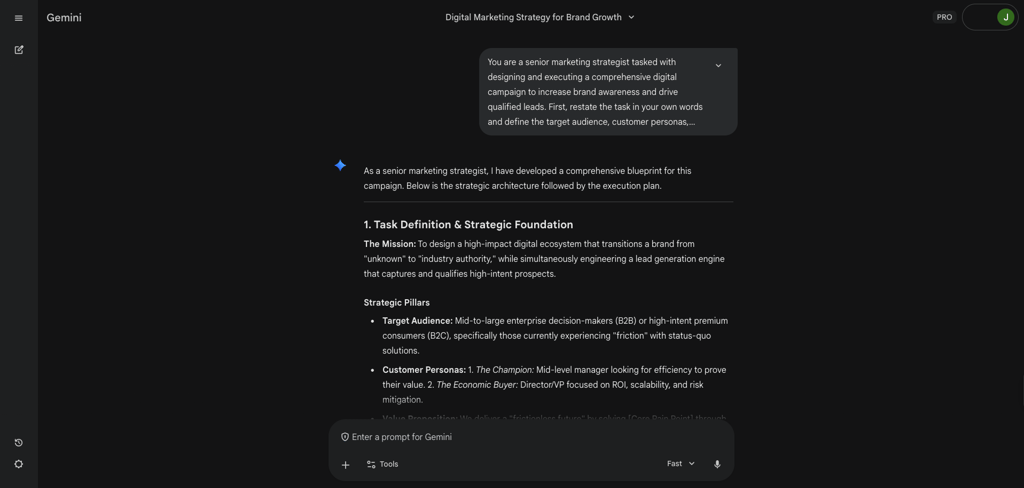
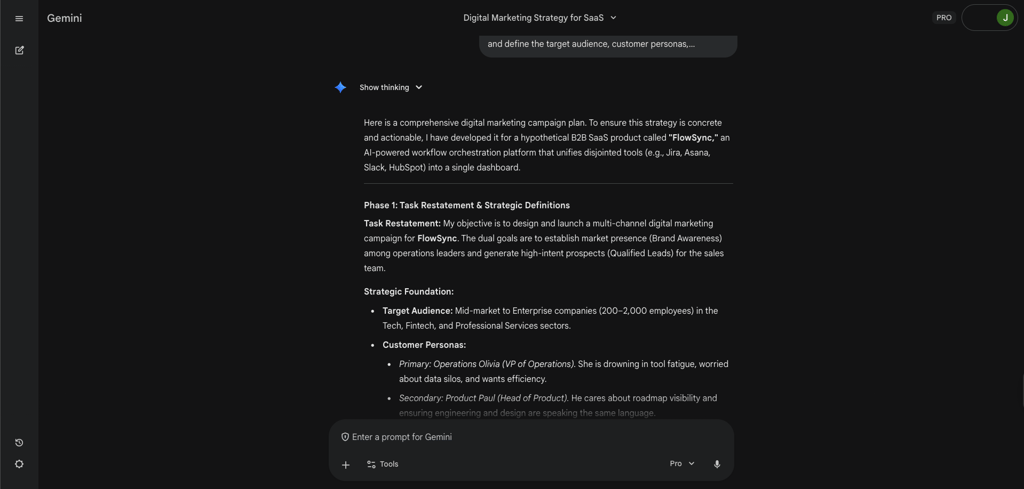
Both models did the job well and followed every step of my prompt. The general response pattern remained the same: Flash provided quick, clean answers, while Pro generated longer, more comprehensive, and highly detailed solutions.
Multimodal inputs
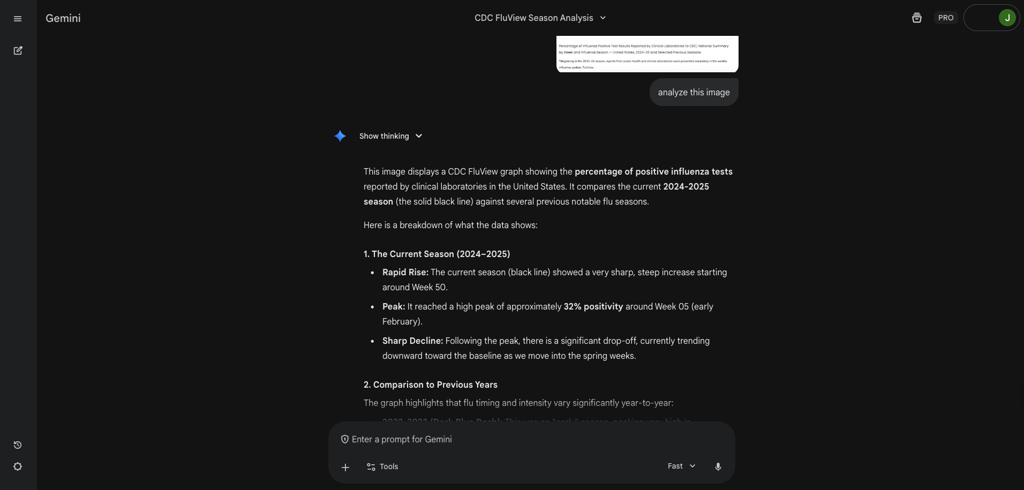
The main selling point of Gemini 3 Flash is that it excels in multimodal analysis. I decided to start with something simple: I uploaded a graph of influenza positive test results fluctuation from 2015 to 2025 and asked the model to analyze it. Gemini 3 Flash generated a more descriptive analysis with highlights on major patterns, such as the rapid rise, sharp decline, and general variability in seasons.
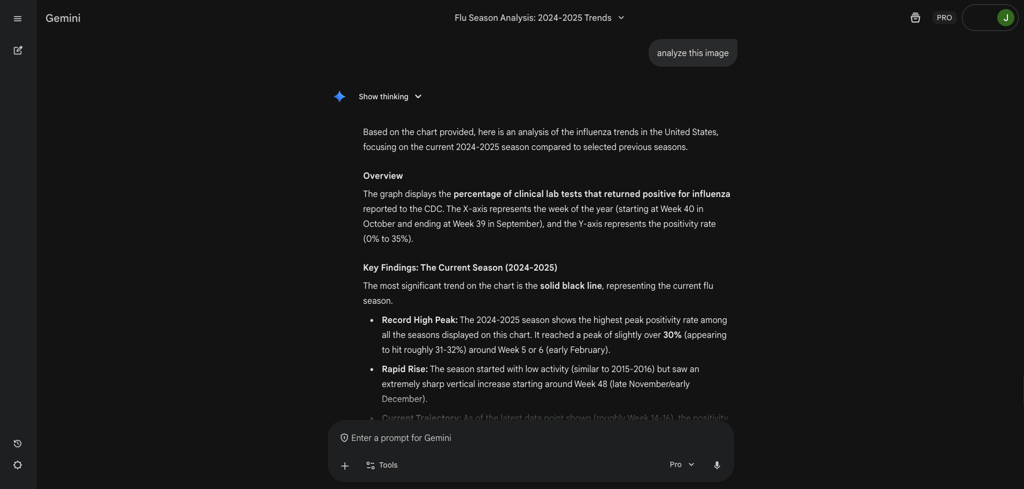
Pro analyzed the same image in a more structured and comparative way, precisely highlighting the quantitative metrics and side-by-side comparisons of seasons. It makes it more analytical and data-driven compared to Flash.
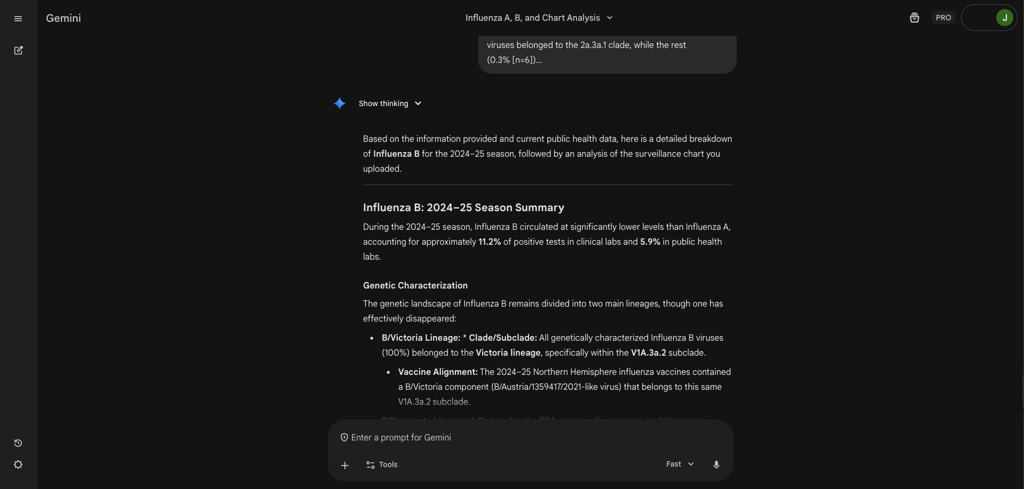
Then, I uploaded a graph and a short text about Influenza A (H3N2) to check how Gemini 3 Flash handles multiple inputs at once. I prompted the tool to analyze the graph and describe a different virus, Influenza B, in the same style as the uploaded text.
Flash did a good job explaining Influenza B in a clear and organized way and correctly matched the level of discussion used in the provided text. It accurately described the specifics of its trends and circulation, while the explanation of vaccines and antigens was easy to understand and fully matched real facts. The image analysis was also strong, as Flash deciphered the general trends correctly.
The only thing Flash fell short on is that it didn’t cite the sources when stating numbers and percentages. Also, it didn’t go into as much scientific detail compared to the provided description of Influenza A (H3N2).
Ambiguous and underspecified questions
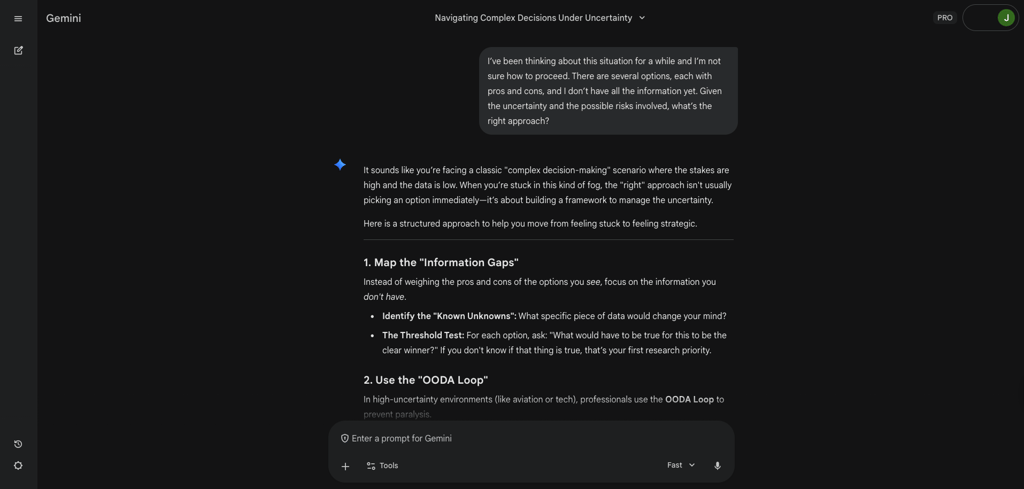
I checked something tricky for AI models and asked a question with no substance to see if Gemini 3 Flash makes things up. I gave it the following prompt:
I’ve been thinking about this situation for a while and I’m not sure how to proceed. There are several options, each with pros and cons, and I don’t have all the information yet. Given the uncertainty and the possible risks involved, what’s the right approach?
I liked that Flash didn’t pretend there’s a single right answer. Instead, it proposed managing uncertainty with specific, actionable steps. The generated strategy fits into every domain, so the model didn’t fabricate any unnecessary details or specifications. The answer itself was written in a rather sophisticated style, but the tone can be customized in the settings.
Hallucination risk
Finally, I tested the main pitfall of Gemini 3 Flash – hallucination. I gave it a spot-the-difference task along with a picture. I didn’t provide any information on how many differences Flash should expect.
According to the author, there should be eight differences, but Flash counted 28. At first, it counted five differences, but then I provoked it and asked if there were any more. Flash added five more after every consecutive prompt. Eventually, it managed to find 28 differences.


In the last answer, the tool explained that your brain experiences pattern fatigue when things appear different simply because you’ve examined them for too long. So, most probably, the tool could continue finding new differences if I kept questioning its outputs. This little experiment shows that we should still fact-check the model’s answers, especially as the context and conversation grow larger.
Accuracy vs speed trade-off
Gemini 3 Flash clearly positions itself as a fast model with sturdy reasoning, and my tests show that it delivers on its promises. As a user, you don’t perceive the thinking period of a model, as the answer arrives instantly.
I didn’t notice any striking inaccuracies or misinformation in more serious, real-world tests, even though some data suggests that Gemini 3 Flash has a 91% hallucination rate. The only time the tool really struggled was in my spot-the-difference experiment above with a highly detailed image.
Flash is great for simple writing, coding, and analyzing data in various formats. Its outputs are generally accurate, clear, and to the point. That said, due to the nature of Gemini 3 Flash, they often lack details and precision – in the end, the focus is mostly on speed.
So, users who need deeper research with exhaustive detail should opt for Pro. It’s slower and more expensive, but it can tackle both simple and complex tasks more reliably. Google itself still warns users that all its AI models may produce hallucinations, so you should always double-check any critical AI-generated data.
Pricing of Gemini 3 Flash
Gemini 3 Flash is available by default for free in the Gemini app with dynamic limits. It means that daily limits change based on the current demand and your region. There, you can also use Gemini 3 Pro for free, but with stricter limits, ranging from 5 to 10 prompts per day.
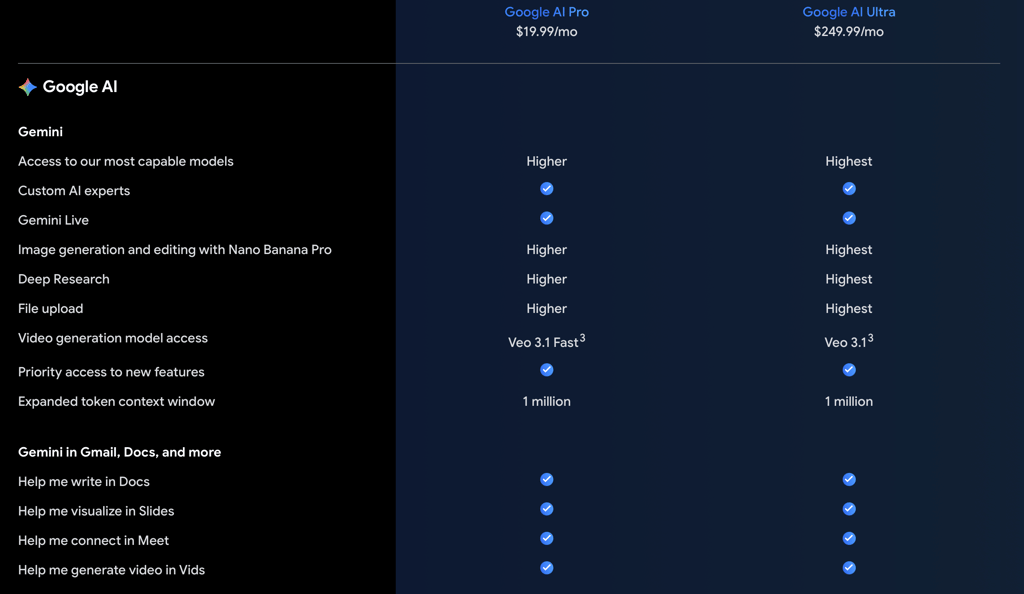
If you need a Gemini app with fewer restrictions on speed and the number of prompts, you can buy a Google AI subscription. The cost is $19.99/month for Google AI Pro and $249.99/month for Google AI Ultra. Google AI Pro is just enough for daily usage, while Google AI Ultra is designed for professional developers, filmmakers, and data scientists.
As a developer, you can get a Gemini API through Google AI Studio. It works on a pay-as-you-go system, which can be more cost-effective for active users. Here, you pay $0.50 per 1 million input tokens and $3.00 per 1 million output tokens. It means that the larger your inputs and outputs, the more you pay, as they require more computing power. To be clear, 100 tokens are equal to about 60–-80 English words.
| Input price per 1 million tokens | Output price per 1 million tokens | |
| Gemini 3 Flash | $0.50 | $3.00 |
| Gemini 3 Pro | $2.00 | $12.00 |
| Gemini 2.5 Flash | $0.30 | $2.50 |
| Gamini 2.5 Pro | $1.25 | $10 |
Gemini 3 Flash is four times cheaper than Gemini 3 Pro for both input and output. But the third generation of Gemini is generally more expensive than the previous models.
Limitations and considerations
In my testing, I found that Gemini 3 Flash has three noticeable drawbacks:
- May hallucinate when unsure. It’s not always the case, but when the context isn’t clear or there isn’t enough information from the input, Gemini 3 Pro can make things up. The AA-Omniscience Hallucination Rate measured a 91% hallucination rate, ranking it first among 16 leading AI models. It only proves the importance of correct prompt engineering and using Gemini 3 Flash for simpler tasks.
- Shallow reasoning in complex tasks. The point of Flash is to be fast, so don’t expect it to produce in-depth research or resource-intensive reasoning. At least from the first prompt, Flash tends to make accurate but high-level analyses and broad overviews. It’s often insufficient for complex tasks or critical decision-making without additional prompting or manual enhancement.
- Overconfidence in responses. Gemini 3 Flash tends to overgeneralize information and make factually unsupported claims with confidence. Again, as the focus is on speed, it often doesn’t engage additional computing power in convoluted explanations or nuances.
How Gemini 3 Flash compares to competing fast models
As of January 2026, Gemini 3 Flash remains the most intelligent among the fast models, according to GPQA (Graduate-Level Google-Proof Q&A), which measures how well an AI model can understand and reason through scientific tasks. So, it’s capable of resolving more complex problems and producing deeper analysis.
There are a few alternatives to Gemini 3 Flash, each with a slightly different focus. Grok 4.1 Fast is good for online sentiment analysis, as it can pull in data directly from X. Also, it has a much larger context window for processing massive datasets. Claude 3.5 Haiku is one of the best models for producing human-sounding texts, including emails, replies, and narrations.
GPT-4o mini is the cheapest and consistently reliable option for high-volume automation tasks. Finally, Llama 4 Maverick is all about privacy. It’s open-source and can be hosted on your own hardware, which gives you more control over your data. You can read more about Llama 4 models in our review.
| Best for | Context window | Reasoning score | Cost | Included in the free plan | |
| Gemini 3 Flash | Multimodal processing and more complex logic compared to other fast models | 1 million tokens | High (89.9% GPQA) |
| ✅ Yes |
| Grok 4.1 Fast | Monitoring trends in real time and sentiment analysis in the emotionally intelligent chatbot | 2 million tokens | High (85.3% GPQA) |
| ✅ Yes |
| Claude 3.5 Haiku | Writing tasks in a human, natural tone and customer support | 200,000 tokens | Medium (73% GPQA) |
| ✅ Yes |
| GPT-4o mini | Reliable automation of routine tasks and smooth integration with OpenAI and Microsoft ecosystems | 128,000 tokens | Low (40.2% GPQA) |
| ✅ Yes |
| Llama 4 Maverick | Personal, unrestricted AI running on your custom servers and processing sensitive legal data | 1 million tokens | Medium (69.8% GPQA) |
| Open-source model available through multiple providers |
Final verdict: is Gemini 3 Flash worth it?
My research shows that Gemini 3 Flash is worth using, given its lower price than Pro and reasoning abilities, which outperform those of other fast AI models. It’s practical in simple coding tasks, condensed summaries, and multimodal analysis – all with instant response time.
By nature, though, Gemini 3 Flash isn’t built for complex, deep-reasoning tasks that require a lot of computing power. Its hallucination rate is relatively high, so it may sound confident even if it doesn’t know the answer, especially when the context is too vague or limited.
The overall accuracy and efficiency heavily depend on your prompting skills and the tasks you give it. So, I advise testing Gemini 3 Flash yourself, as it’s available for free in the Gemini app. This way can you decide whether it’s suitable for your personal workflow or you’d like to switch to Gemini 3 Pro or other alternatives I described above.
FAQ
Is Gemini 3 Flash better than Gemini Pro?
No, Gemini 3 Flash isn’t better than Gemini 3 Pro. These models serve different purposes: Flash wins in terms of speed, while Pro excels in deep reasoning. The choice depends on the type of task you’re giving it.
Is Gemini 3 Flash suitable for coding tasks?
Yes, Gemini 3 Flash works well for simple coding tasks. Similar to our Gemini 3 Pro testing results, manual involvement and careful prompt engineering are still needed.
Does Gemini 3 Flash hallucinate more than other models?
Yes, in at least one benchmark (the AA-Omniscience Hallucination Rate) Gemini 3 Flash has a 91% hallucination rate, which makes it the most hallucinating among all frontier AI models. This issue mainly appears when the prompt lacks context, is ambiguous, or is outside the model’s knowledge range.
How fast is Gemini 3 Flash compared to GPT models?
Gemini 3 Flash processes 218 output tokens per second, while the fastest GPT models (GPT-4o mini and GPT-4o) are slightly slower, processing 143 tokens per second. All these models start streaming answers in milliseconds, so a user usually doesn’t wait for the tool to respond. However, that ultimate speed depends on the current server load and the complexity of your prompt.
Can Gemini 3 Flash be used in production systems?
Yes, it can be used in production systems. Gemini 3 Flash can automate workflows, be integrated as intelligent in-game assistants, be used for A/B testing, process videos, and automatically handle simple coding tasks.