Langdock review 2026
Being behind major reports like The Mother of All Breaches and RockYou2024, our in-house cybersecurity experts and journalists provide unbiased, real-world testing and in-depth analysis.
We maintain complete transparency by openly sharing our testing methodologies with our audience.
Learn more

Langdock is a privacy-compliant AI workspace built for secure corporate use. It offers companies various AI solutions, ranging from AI-powered assistants and chatbots to intelligent search capabilities. As I noticed this tool gaining popularity, I was curious to get my hands on it and see whether it’s as safe, compliant, and fit for enterprise use as it markets itself to be.
To answer these questions, I worked together with our research team to thoroughly test this tool for my Langdock review. We evaluated it from three angles that matter most to businesses: real-world usability for teams, security and privacy safeguards, and overall value for money.
My verdict, in short: Langdock is a strong choice for privacy-conscious teams and organizations that need secure AI collaboration without compromising compliance. However, it might not be the best fit for solo users, casual experimentation, or teams looking for the lowest-cost option above all else.
Quick overview of Langdock
| Rating | |
| Best for | Privacy-focused teams that need a secure, compliant AI workspace without risking sensitive data exposure |
| Key features | Enterprise-grade privacy, AI-powered team collaboration, secure knowledge management, role-based access, and compliance monitoring |
| Free version | ✅ Yes |
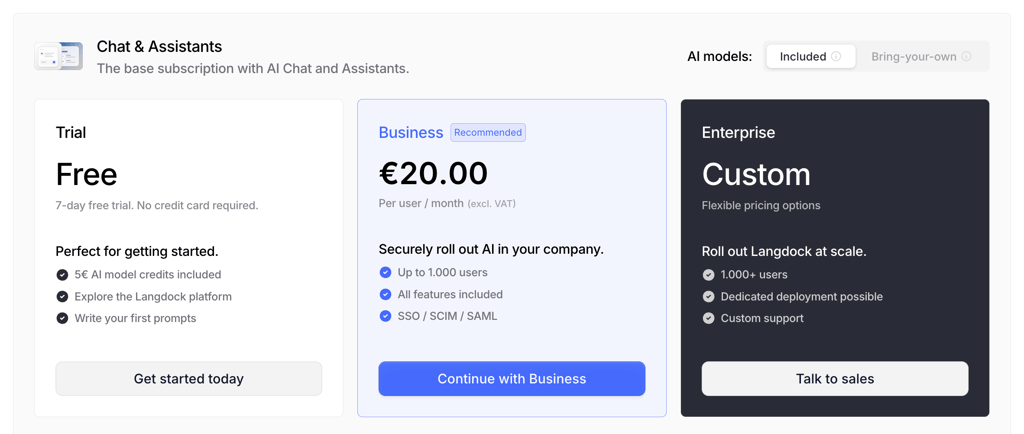
| Starting price | From €20.00/month/user (around $23.26) |
Pros and cons of Langdock

What Langdock is (and what it’s not)
Langdock is an AI workspace specifically developed for teams to use LLMs (large language models) in a controlled and collaborative environment. It sits on top of underlying AI models and provides a unified interface for team chat, custom assistants, automated workflows, and document search – with a strong focus on privacy and compliance. Langdock connects to company data and allows teams to query and act on that data with AI while enforcing security policies and GDPR-compliant controls.
It’s worth noting that it isn’t a standalone AI model or a simple chatbot for casual use. So, it doesn’t replace the foundational models themselves or serve as a basic consumer chat interface. Instead, Langdock is a practical layer that helps teams deploy, govern, and integrate LLM capabilities into real workflows without exposing sensitive information.
How Langdock is built
Langdock is structured as a workspace-centric AI layer that teams use to access and manage LLMs in a controlled way. At its core, Langdock doesn’t host its own AI model – instead, it connects to multiple external models (like OpenAI or Antropic) through a unified interface. For organizations, this means they can select the most suitable AI model for each task without being tied to a single provider.
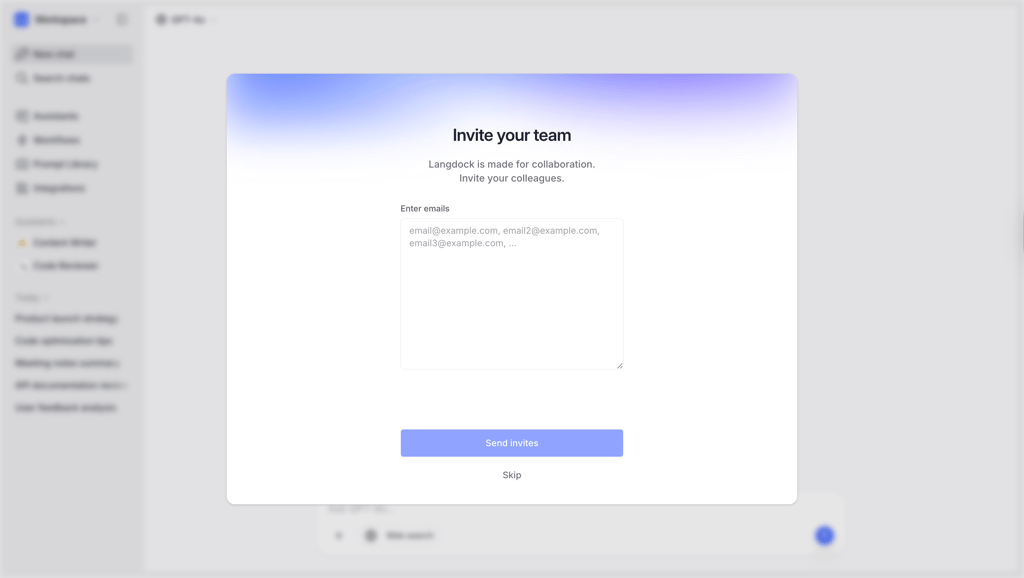
Work happens inside workspaces, which are like secure company zones. Within a workspace, teams can set up chats, AI assistants, custom workflows, and knowledge access that reflect their internal needs and data sources.
Admins control who has access and what each role can do, ensuring that only authorized users can manage settings, create assistants, or access sensitive information. Workspace roles (admins, editors, and users) come with distinct permissions that govern actions such as sharing resources and connecting integrations.
Underlying this is enterprise-grade governance: centralized permission logic, encrypted data flows, and compliance features designed for team environments and real business needs, rather than casual use.
Who Langdock is best for
It’s clear that Langdock is better suited for teams and organizations instead of individual, casual users who don’t need many fancy, business-oriented features. So, here’s who might find the best value using this AI tool:
- Small to mid-sized teams. Langdock can help teams collaborate securely, share AI assistants, and simplify knowledge sharing without exposing sensitive data.
- Enterprises with compliance concerns. Thanks to GDPR, SOC 2, and other privacy-focused features, larger companies can use this tool to adopt AI without risking regulatory issues.
- Developers and product teams. IT professionals can leverage AI to automate workflows, prototype features, and integrate model outputs into internal tools or documentation.
In contrast, I found that these users might benefit least from Langdock and might need to look for an alternative:
- Solo casual users. Individuals experimenting with AI or using it for personal projects won’t get the most out of Langdock’s team-focused features.
- Users only seeking free AI chat tools. If your main goal is casual AI conversations, simpler and free alternatives may be a better fit.
Core features that matter for teams
Langdock easily integrates into your team’s workflows, offering a unified interface and a range of AI tools to boost productivity. For instance, you can use it to automate routine tasks or rely on a chat assistant for everyday work. There are a few core features for teams that caught my eye, which I’ll go through below.
AI workspace and prompt management
Langdock works as a shared AI workspace where prompts, outputs, and workflows are organized centrally rather than living in individual user accounts. This setup makes it easier for teams to manage AI usage consistently and avoid fragmented or duplicated work.
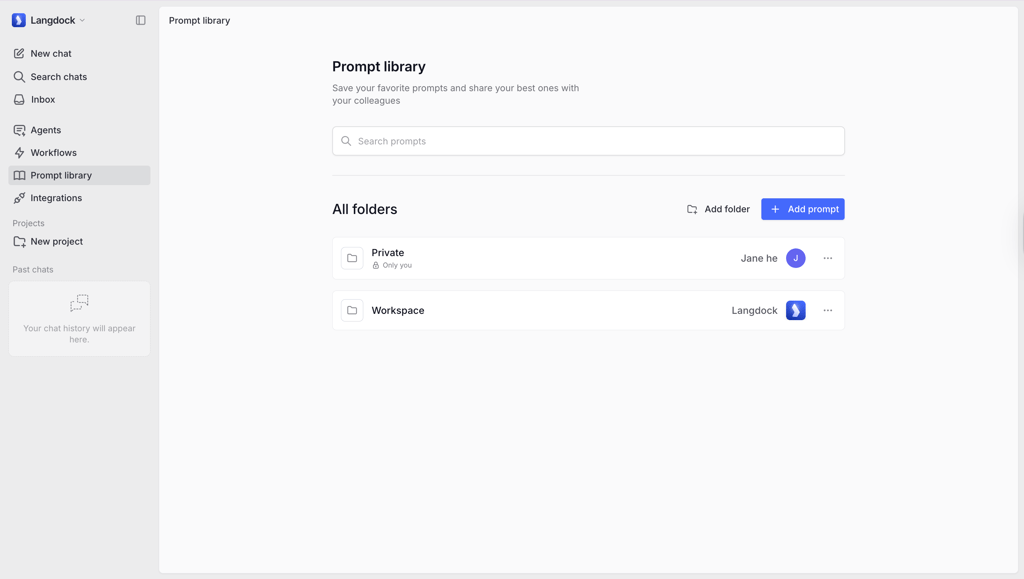
I found that you can create, store, and reuse shared prompts across the organization, which helps standardize AI outputs for customer support replies, code explanations, or internal documentation. Instead of everyone writing their own prompts from scratch, teams can rely on proven templates that deliver consistent results.
Because multiple users work within the same workspace, team members can access the same prompt libraries and build on each other’s work. Langdock also supports prompt versioning, so you can iterate safely over time. Older versions can be reviewed or restored, which is especially important when prompts are tied to production workflows or internal processes that need stability and traceability.
Model access and flexibility
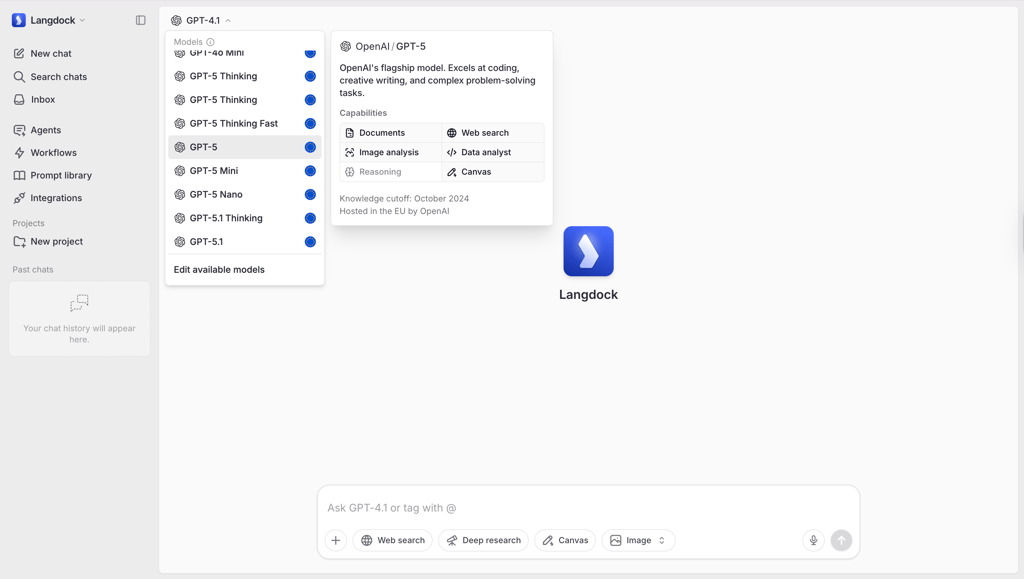
Langdock is a model-agnostic platform, meaning it doesn’t tie teams into a single AI model. Instead, it acts as a flexible layer on top of multiple LLMs, giving you control over how and where AI is used.
Depending on the setup, Langdock gives access to leading models like OpenAI and Anthropic. You can choose models based on what matters most for your task – output, quality, cost, performance, or privacy requirements – rather than choosing a one-size-fits-all option.
I liked that you can switch between models within the same interface or workflow, so it’s easy to compare outputs and adjust if needed. You can use this flexibility to reduce vendor lock-in and adapt to evolving AI capabilities, pricing, or internal policies without having to rebuild workflows from scratch.
Access control and permissions
One of the main reasons companies choose Langdock over consumer AI tools is access control. When everyone’s using AI independently, it’s easy to slip away and accidentally expose sensitive data. Langdock gives organizations clear governance over who can do what inside the platform, minimizing the risk of corporate data exposure.
When testing Langdock, I was able to assign different roles, such as admins, editors, and viewers. To put it shortly, admins manage workspace settings, models, and permissions, while editors can create and modify prompts or workflows. Viewers typically have read-only access, which is useful for stakeholders who need results but shouldn’t change configurations. This role-based setup is invaluable for companies, as it helps limit access to sensitive workflows and reduces the risk of accidental changes.
At the team level, admins can control how AI is used across the workspace. This includes deciding which models are available, who can access them, and what actions users are allowed to take. These controls support compliance requirements, create accountability, and ensure AI usage stays consistent and predictable across teams rather than becoming fragmented or unmanaged.
Privacy and data handling
Unlike consumer AI tools, Langdock invests heavily in privacy and data handling. It keeps business data isolated within workspaces rather than mixed across users or organizations. Naturally, that appeals to companies working with sensitive or internal data.
If you analyze its infrastructure, you’ll see that Langdock handles data by prioritizing control and separation, and it doesn’t use company inputs to train public AI models by default. So, companies using the tool can benefit from AI without risking data leakage or unintended reuse of proprietary information. The platform is also built with EU privacy expectations in mind, aligning with GDPR requirements and enterprise security standards.
These safeguards matter most for regulated industries such as finance, healthcare, legal, and enterprise IT, where uncontrolled AI usage can create compliance risks. By addressing privacy and data handling upfront, Langdock makes AI adoption more realistic for organizations that can’t rely on public chatbots.
Scalability and team adoption
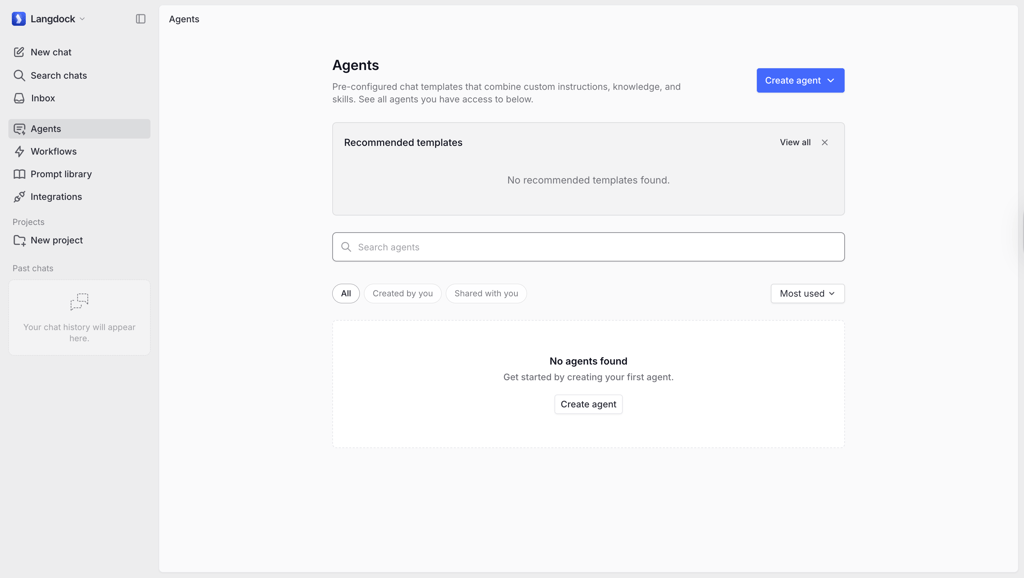
One more feature that makes Langdock suited for companies is its scalability. It’s built to scale as organizations grow, so even when AI usage expands, companies don’t lose control. New team members can be onboarded into existing workspaces, where they get access to shared prompts, workflows, and approved models.
As teams grow, workspaces can be expanded or structured to match departments, projects, or use cases. Centralized management allows admins to control access, permissions, and model usage across the organization, even as the number of users increases. This prevents AI usage from becoming fragmented or inconsistent.
By providing a single, approved AI environment, Langdock also helps reduce shadow AI usage – where employees rely on unapproved tools outside company policies. Instead, teams are more likely to adopt AI consistently across departments, improving collaboration, oversight, and long-term value as usage scales.
Where would you actually use Langdock?
Langdock is more than an AI chatbox. You can use it when your team needs structured, secure, and shared AI support in daily work. Below are specific scenarios where it adds the most value:
- Internal knowledge assistance for teams. Use Langdock as a searchable AI layer over company data so product, support, or operations teams can quickly find answers without digging through documents.
- Shared prompt workflows for content tasks. Teams can build and reuse standardized prompt workflows for marketing copy, documentation, or research to ensure consistency.
- Secure AI usage for compliance-sensitive companies. When public chatbots aren’t allowed, organizations can use AI in a privacy-compliant way with enterprise security controls.
- Developer and technical team support. Developers and product teams can standardize AI-assisted tasks, build custom assistants, and integrate them into existing toolchains.
- Cross-team collaboration. In environments where consistency of AI outputs matters across departments, teams can securely share agents, workflows, and best practices.
Pricing of Langdock
Langdock offers a variety of plans, with different pricing that depends on your business needs. If you only need a base subscription with AI chat and an assistant, you can opt for the Business plan for €20.00/month/user (around $23.26) or the Enterprise plan with custom pricing. With these plans, you can have a multitude of users, all features included, SSO, SCIM, and SAML.
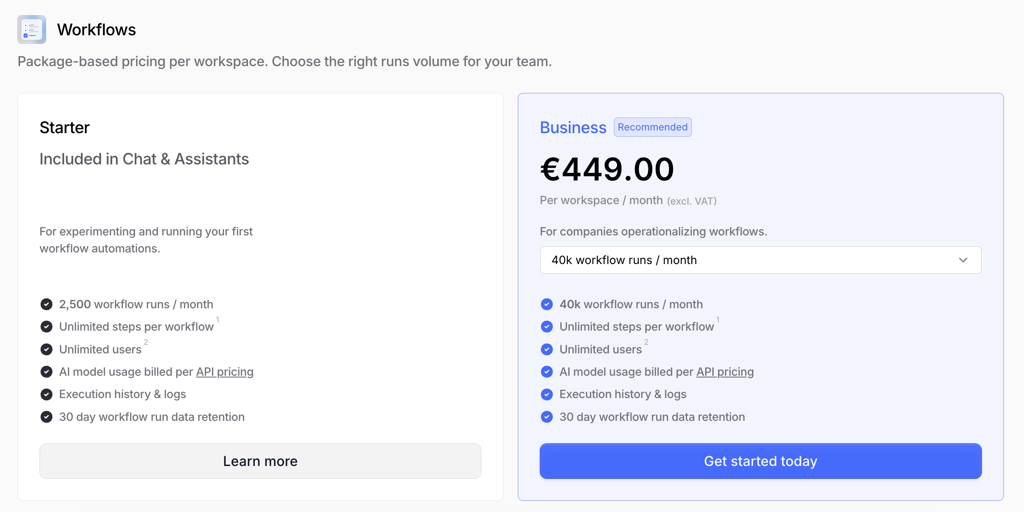
However, if you need more, you can choose one of its workspace packages. Whether you go for the Starter or Business plan, you get considerably greater resources – starting at 2500 workflow runs per month, unlimited steps per workflow, unlimited users, AI model usage billed per API pricing, execution history and logs, and 30-day workflow run data retention.
While all of this sounds great, the price for workflow packages isn’t the cheapest. For instance, if you opt for its Business plan, you need to pay €449.00/month/workspace (around $522.27) for 40,000 workflow runs. This might be too expensive for individual users or small businesses, limiting its use to larger organizations.
If you’d like to test the service before committing, you can also use its 7-day free trial. This is perfect for exploring the platform and its capabilities. You can write your first prompts and use up €5.00 (around $5.82) of AI model credits included.
What real users say about Langdock
I was curious to learn what real users say about Langdock, so I did some research across the internet, checking reviews on G2, Product Hunt, and LinkedIn. I found that they consistently praise Langdock for its ease of use, smooth integrations, and strong focus on privacy and enterprise‑ready workflows. Teams love how it connects company data with AI assistants, saves time on routine tasks, and offers responsive support that actually helps when issues pop up.
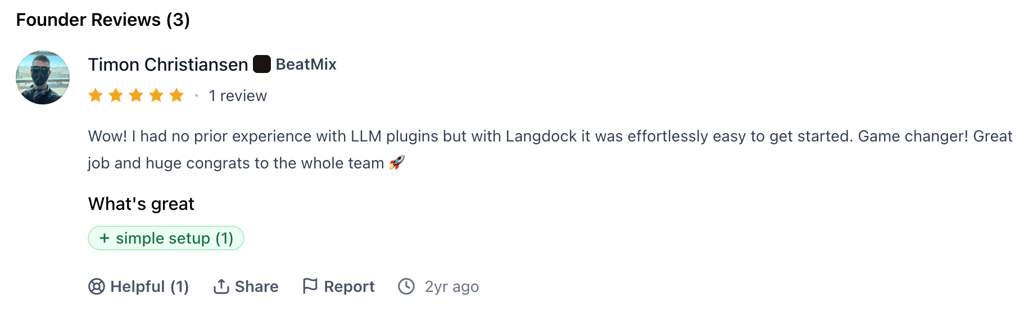
On the flip side, some reviewers flag a learning curve for advanced features, occasional missing tools, and feature requests that hint the platform is still maturing.
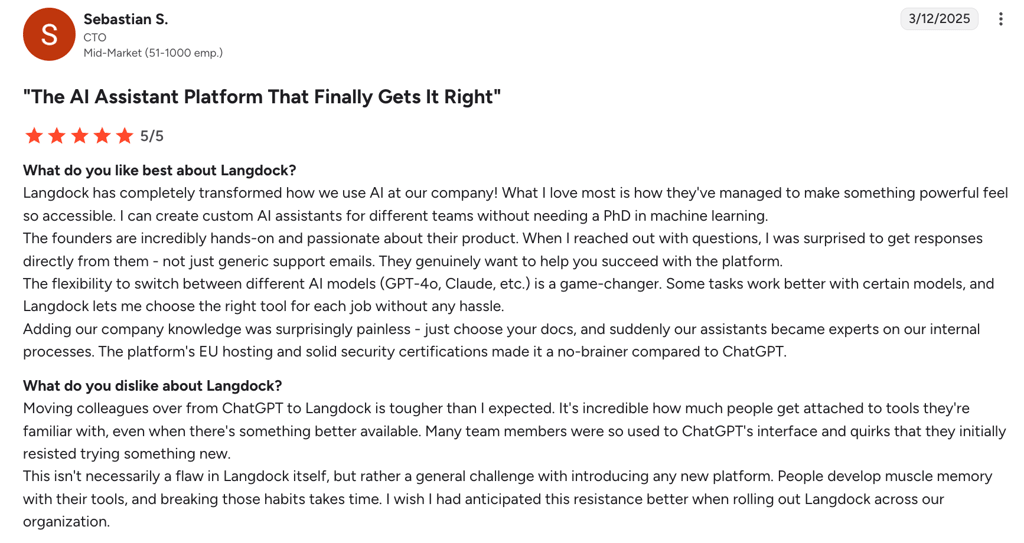
The pattern is clear: real users are impressed with what Langdock delivers today, while recognizing it’s a work in progress. Even skeptics admit initial doubts gave way to genuine appreciation after hands‑on use, showing that Langdock is winning over professionals who need secure and team-friendly AI.
Langdock vs similar tools
In comparison, Langdock targets privacy-focused teams that need secure, governed AI collaboration. Amazon Bedrock is better suited for highly technical teams demanding maximum flexibility, while Simplified prioritizes fast, low-effort AI adoption over enterprise-grade controls. Here’s how they compare when put side by side:
| Tool | Privacy | Team controls | Customization | Cost |
| Langdock | Strong privacy and GDPR-compliant workspace with EU hosting and data policies | Seat-based roles, admin permissions, workspace sharing, centralized management | Custom assistants, workflows, integrations, and knowledge bases | Seat-based and API usage with predictable monthly fees; fixed pricing per user |
| Amazon Bedrock | Depends on AWS configuration; enterprise-grade but data passes through AWS infrastructure | AWS IAM roles and policies but requires AWS expertise to configure | Deep model customization and prompt caching but no built-in workspace layer | Pay-per-use token pricing; can be unpredictable at scale |
| Simplified | Basic privacy controls typical of SaaS tools; not enterprise-focused | Team features present but limited compared with enterprise governance | Templates and presets, less depth for technical customization | Typically subscription-based with tiered plans; fewer options for usage scaling |
Best alternative: nexos.ai
Different automation platforms are built with different priorities in mind. Some users prefer structured, enterprise-focused workspaces, while others need more flexibility in how tools and workflows connect. That’s why it can be useful to consider alternatives based on how your team actually works.
In my testing, what stood out to me about nexos.ai is that it feels more focused on how teams work across multiple tools rather than structured workspace management. Compared to Langdock, it is more centered around connecting different systems and handling AI-driven tasks in daily operations.
nexos.ai combines workflow automation, no-code AI agents, and multiple model options into a single platform. It connects with external tools and lets teams run automated processes like data handling, content creation, and internal tasks. Everything runs in a single environment without needing to switch between tools.
Final verdict: is Langdock worth it?
Langdock is an AI-powered workspace that can help teams collaborate securely with LLMs while keeping sensitive corporate data protected. It delivers strong privacy controls, team governance, and customization that justify its premium pricing for business use.
Who gets the most value: small to mid-sized teams, enterprises with compliance needs, and technical groups that benefit from shared AI workflows and integrations.
Who should look elsewhere: solo users, casual AI experimenters, and those seeking only free or lightweight chatbot tools will likely find simpler, cheaper options that better fit their needs.
FAQ
Is Langdock suitable for enterprise teams?
Yes, Langdock is suitable for enterprise teams, offering scalable AI assistants, workflow automation, and centralized control built for company-wide deployment. It also delivers enterprise-grade security, compliance (GDPR, ISO 27001, SOC 2), and flexible hosting options, making it a strong fit for large organizations with strict data requirements.
How secure is Langdock compared to other AI tools?
Langdock is more secure than most general-purpose AI tools, as it’s built with enterprises in mind. It offers ISO 27001, SOC 2 Type II, and GDPR compliance alongside encrypted data handling and strict access controls. Compared to consumer-focused AI platforms, it prioritizes data sovereignty and compliance over experimental features, making it a safer choice for regulated teams.
Does Langdock store or reuse prompts?
No, Langdock doesn’t use your prompts to train models or improve services, and it commits to not using model interactions for training or redistribution through its agreements with major model hosts. It does let you manually save and reuse prompts in a prompt library for convenience, but prompt storage there is for your reuse and workspace functionality, not for external training.
Is Langdock safe and legit?
Yes, Langdock is widely regarded as a safe and legitimate enterprise AI platform. However, as with any business AI tool, organizations should validate it against their own governance needs and risk profile before full deployment.
Can Langdock replace ChatGPT for teams?
Yes, Langdock can act as a team’s internal alternative to ChatGPT by offering shared AI chat, custom assistants, workflows, and unified access to multiple large language models within a secure, compliant platform. However, it isn’t literally a drop-in replacement for ChatGPT in every way – its focus is on enterprise deployment, data governance, and team workflows rather than simply replicating the ChatGPT consumer experience.