Trendos vs Peec AI: which AI search visibility tool is better in 2026?
Being behind major reports like The Mother of All Breaches and RockYou2024, our in-house cybersecurity experts and journalists provide unbiased, real-world testing and in-depth analysis.
We maintain complete transparency by openly sharing our testing methodologies with our audience.
Learn more
Nowadays, being visible online requires more than just ranking on Google or building a presence on social media. As AI search tools become more popular, businesses also need to think about generative engine optimization (GEO) and AI search visibility to stay competitive.
The challenge is that AI search is still relatively new, so there isn't much clear guidance on how to improve your visibility. That's where AI search visibility platforms come in. They help you understand how AI models perceive your brand, track your performance, and identify ways to increase your visibility.
In this article, I'll compare Trendos vs Peec AI to see how these two popular AI search visibility tools stack up. I'll break down their features, ease of use, reporting, pricing, and more to help you decide which one is the better fit.
Trendos vs Peec AI: overview
Trendos offers more advanced reporting and insights, making it a strong choice for teams that need deeper AI visibility analytics. Peec AI focuses on simplicity, with an easy-to-navigate dashboard that makes tracking AI visibility straightforward.
| Trendos | Peec AI | |
| Rating | ||
| Key features | AI brand mention tracking, Ad Radar, citation insights, competitor monitoring, sentiment analysis, prompt tracking across LLMs, AI visibility reports, alerts, and team collaboration | AI visibility tracking, prompt monitoring, competitor analysis, performance dashboards, AI search analytics, reporting |
| Pros | Comprehensive AI visibility data, excellent competitor insights, frequent updates, strong reporting, and alerts | Clean dashboard, solid visibility tracking, good reporting, suitable for large teams |
| Cons | No content creation, the knowledge base is still limited | Premium pricing, no content creation |
| Who it’s best for | Marketing teams, SEO professionals, agencies, and businesses that want detailed AI search visibility and competitive intelligence | Medium and large businesses, content marketers, and teams looking for an easy way to monitor AI search visibility |
| Free version or trial | Free version | 7-day free trial |
| Price | From $30.00/month | From $80.00/month |

Quick verdict: Trendos takes the lead
After testing both platforms, I found Trendos to be the stronger option for most marketing teams. It gives you much deeper AI visibility tracking, supports more AI models, and presents the data in a way that's easy to turn into real optimization opportunities.
Peec AI is still a good pick if you want a lightweight AI visibility tool without a lot of complexity. But if your goal is comprehensive monitoring and actionable insights that can guide your strategy, Trendos is the platform I'd choose.
Trendos vs Peec AI: AI visibility tracking
Trendos wins in AI visibility tracking, offering more complete insights, flexible tracking options, and better value than Peec AI.
Peec AI tracks visibility across ChatGPT, Google AI Overview and AI Mode, Perplexity, Gemini, Copilot, and more with its enterprise plan. Trendos, on the other hand, expands on this by tracking across ChatGPT, Perplexity, Google AI Mode and Overview, DeepSeek, Grok, and Claude on all plans.
One thing I liked about Trendos is that even the free plan includes 20 custom prompts, which feels generous compared to Peec AI, whose entry plan offers 50 prompts for $80/month.
Trendos also provides historical and real-time visibility data for more than 2.5 million brands, with up to 10 brands available on the free plan. It tracks metrics like share of voice and Trendos Score, but what stood out to me were the AI visibility insights into what’s happening, which help you understand how to optimize.
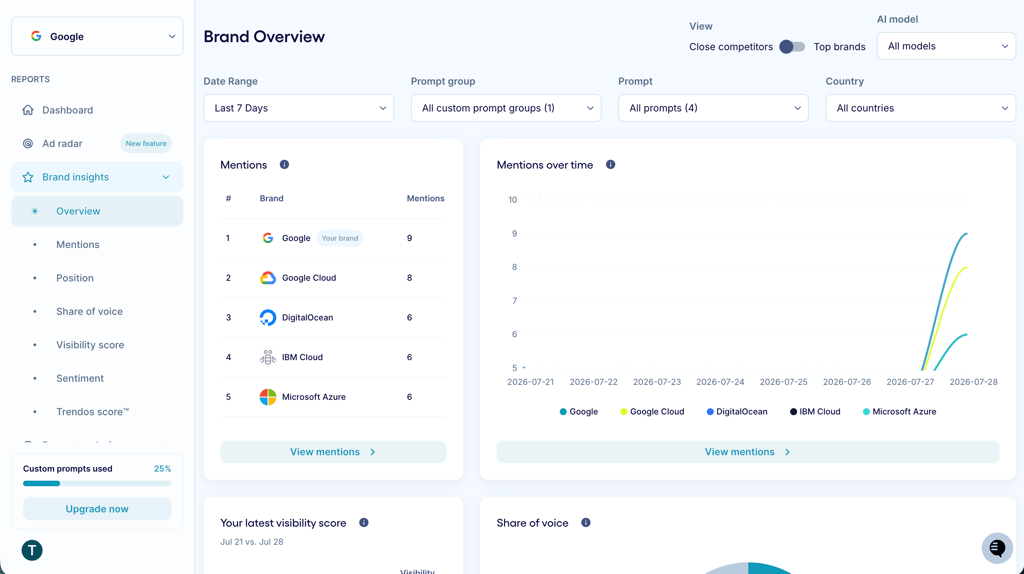
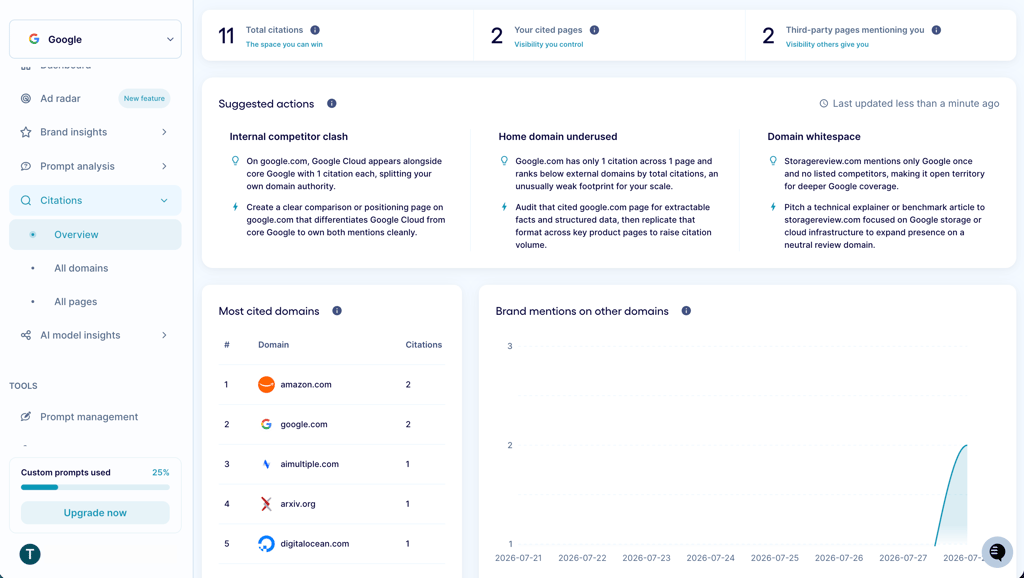
Both Trendos and Peec AI provide competitor comparisons and show the sources behind AI-generated answers. Peec AI presents these insights in a straightforward way, making it easy to compare your brand against competitors and identify the websites influencing LLM responses. Trendos offers similar capabilities through its Citations Overview, but goes a step further by providing actionable recommendations on what to improve next, which I found more useful when identifying optimization opportunities.
Its Chat feature was another highlight, as it shows real conversations with LLMs where your brand appears. I could review the answers, see the context behind each mention, and understand how my brand is represented across different AI platforms.
I also appreciated that Trendos lets you sign up with any email address and track any brand, while Peec AI requires a work email and only allows you to monitor your own domain.
Trendos vs Peec AI: prompt monitoring
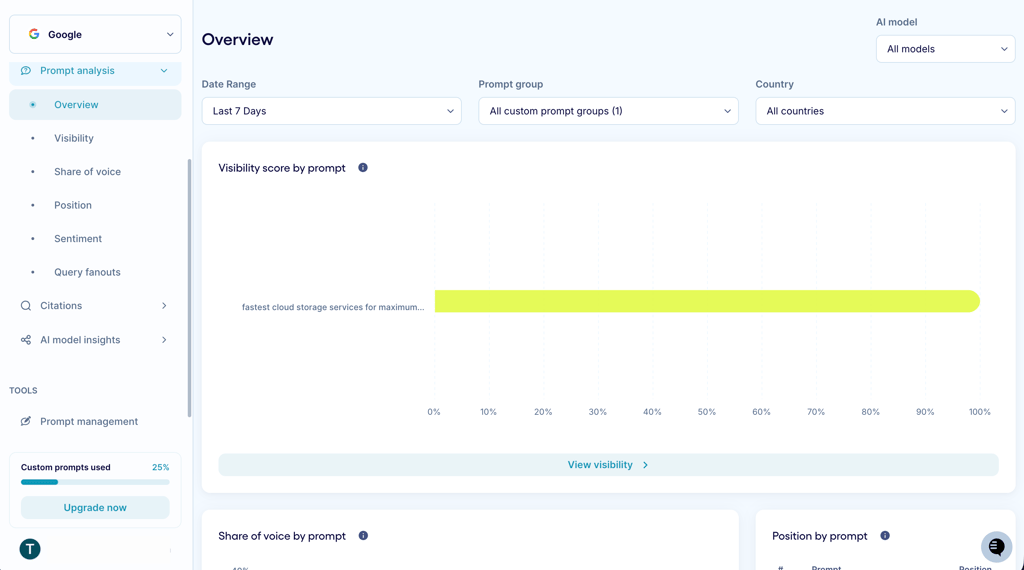
When it comes to prompt monitoring, Trendos offers more complete prompt management. I could add, remove, and organize prompts into groups, which made it much easier to keep large prompt libraries organized. I also liked that I could import prompts from other providers or create prompts with its prompt generator.
Once the prompts are set up, the prompt analysis section shows exactly how my brand performs for each one. I could see metrics like visibility, share of voice, position, sentiment, and a visibility score.
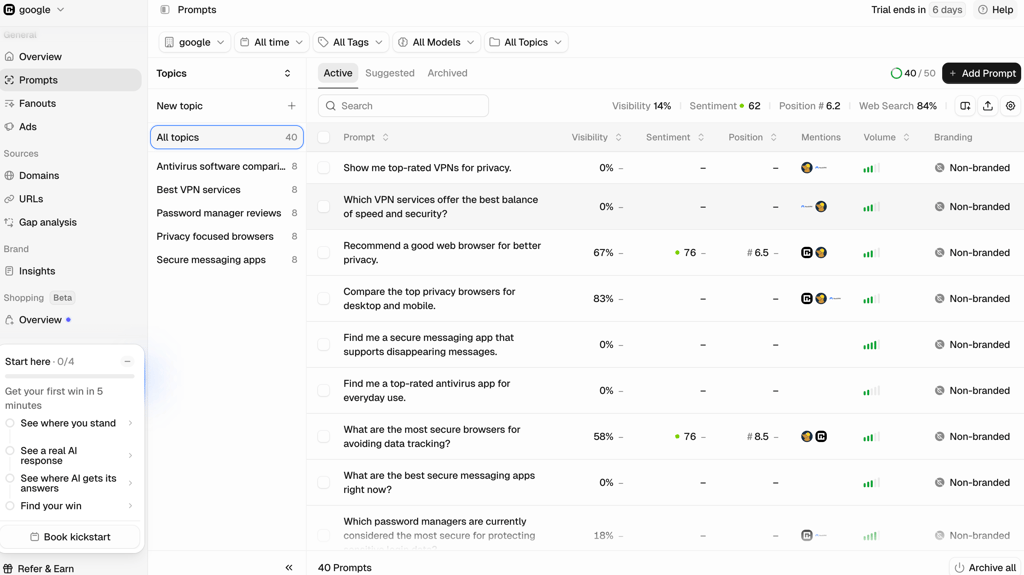
Peec AI also handles prompt monitoring well. I could add prompts individually or upload them in bulk, then track metrics like visibility, sentiment, position, search volume, web search mentions, and share of voice.
Trendos vs Peec AI: competitor analysis
Both Trendos and Peec AI make it easy to compare your brand against competitors, but I found Trendos slightly more useful for day-to-day monitoring.
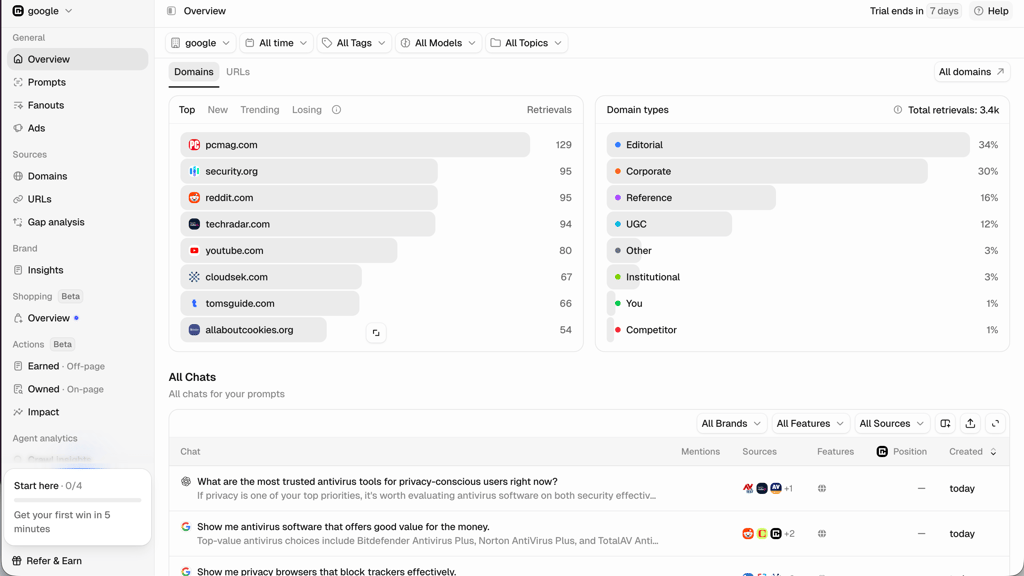
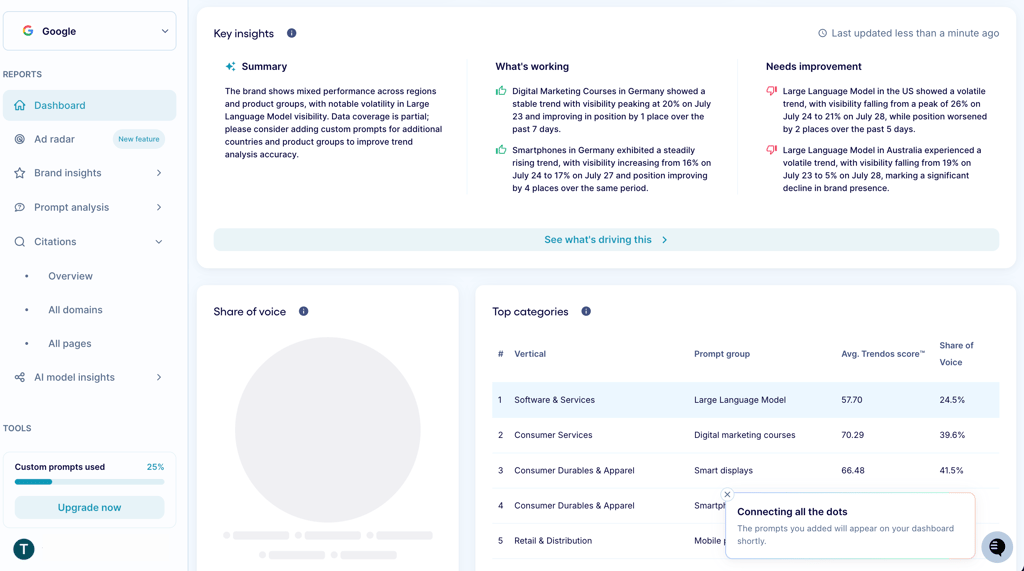
Right from the dashboard, it highlights your top 5 competitors in a clean graph, so you can immediately see who's gaining or losing visibility without clicking through multiple reports. If you want a deeper look, the Share of Voice section compares every tracked competitor and shows their latest, highest, lowest, and average visibility over time. I ended up checking this view the most because it gives a quick snapshot of the competitive landscape.
Peec AI also includes competitor analysis in its Overview dashboard. It displays each competitor's visibility, share of voice, sentiment, and ranking, alongside a graph showing visibility trends over time. The data is useful and easy to understand, but I felt it leaned more toward reporting metrics than giving me an instant overview of where my brand stood compared to the competition.
Peec AI vs Trendos: historical data
I found that monitoring historical data is more convenient with Peec AI. It offers more flexibility by letting you choose from 7, 14, 30, 90, 180, or 365-day timeframes. Better yet, these filters are available across all major metrics, making it easy to analyze performance over exactly the period you need.
Trendos also lets you look back at historical data and select any time frame, from one day to a year. Like Peec AI, the selected period applies across all tracked metrics, including visibility, share of voice, sentiment, and mentions. My only real frustration was with the custom date picker. During testing, it didn't work as expected. Every time I tried to change the month, the calendar reset instead of letting me select a custom date range, which made it difficult to use.

Trendos vs Peec AI: reporting
Trendos is the clear winner when it comes to reporting. One thing I immediately liked is that almost every metric is presented visually, making it much easier to spot trends without digging through numbers. As a visual person, that made a big difference during testing.
Some of the charts also stand out from what I've seen in similar tools. For example, sentiment is displayed as a spider chart that breaks down the different qualities associated with your brand, making it easy to understand how AI models describe you.
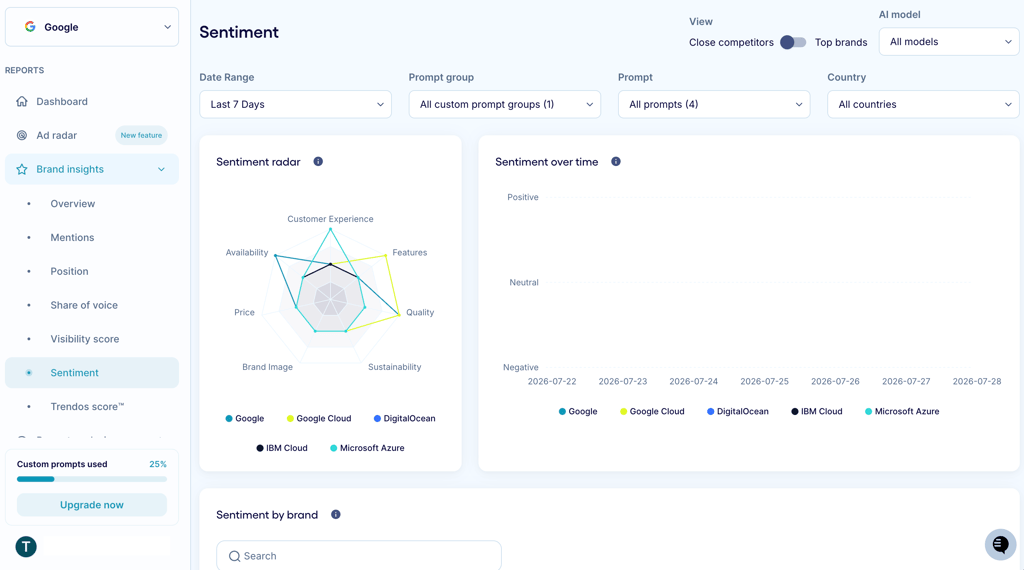
There's also a citation treemap that quickly shows which sources mention your brand the most. The rest of the reports use familiar line, pie, and other charts that are clear and easy to read.
Peec AI, on the other hand, takes a simpler approach. It mainly relies on line graphs and bar charts, while much of the remaining data is presented as text instead of visuals. I still found the reports easy to understand, but they weren't as quick to scan or as engaging as Trendos'.
Trendos vs Peec AI: dashboard usability
When it comes to dashboard usability, I preferred Peec AI. Its guided onboarding experience makes a big difference, especially for first-time users. The platform walks you through each step, making it easier to understand where to start and what each section does. The dashboard itself is also straightforward to navigate, although it has more sections to go through compared to Trendos.
One downside is that some data visualization areas include informational tables that only show question marks rather than providing additional context. However, Peec AI’s help center is much more comprehensive, which makes it easier to find answers.
Trendos, on the other hand, takes you straight to the dashboard after you create an account, with no onboarding process. While the interface is clean and easy to use once you understand it, I feel like the lack of guidance can make it feel overwhelming for new users. Some data points include helpful notes, but others leave you to figure things out yourself. The help center also feels like a work in progress, as some documentation is still missing.
Trendos vs Peec AI: workflow
When comparing workflows, I'd say both providers are pretty even here.
One feature I found useful in Peec AI was the Sources section. It clearly shows which third-party websites LLMs cite, whether that's Reddit, G2, or industry blogs. I could quickly compare my brand against competitors and identify content gaps, which made it easier to spot potential outreach or content opportunities.
Trendos offers similar functionality through its Citations Overview, where I could also see the sources influencing AI-generated answers, compare citations across brands, review source types, and share. I also liked that it provided actionable recommendations alongside the data, making it easier to understand what to improve next instead of simply presenting the raw information.
Both platforms also support more advanced workflows. Peec AI and Trendos let you generate API keys, integrate with MCP-compatible tools, and export data, making it easy to connect AI visibility data with external dashboards or reporting workflows.
The main difference comes down to how the insights are presented. Peec AI organizes its workflow around source analysis and competitor comparisons, while Trendos combines similar capabilities with broader market intelligence and optimization guidance. In practice, I found both platforms capable of supporting ongoing AI visibility monitoring and content strategy, with each emphasizing different aspects of the workflow.
Peec AI vs Trendos: team collaboration
I didn't notice a huge difference between the two tools here. Both make it easy to collaborate with teammates, and neither one felt limiting during testing.
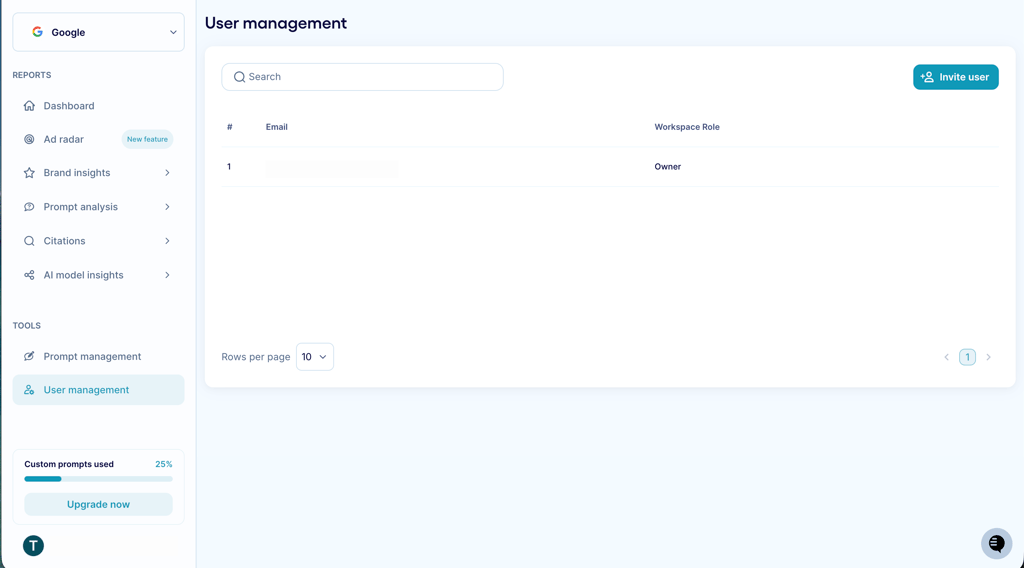
Trendos lets you add people from the User Management section, where you can assign them either an editor or a viewer role. I also liked that you can invite people by email or simply share an invite link, which makes onboarding a little faster.
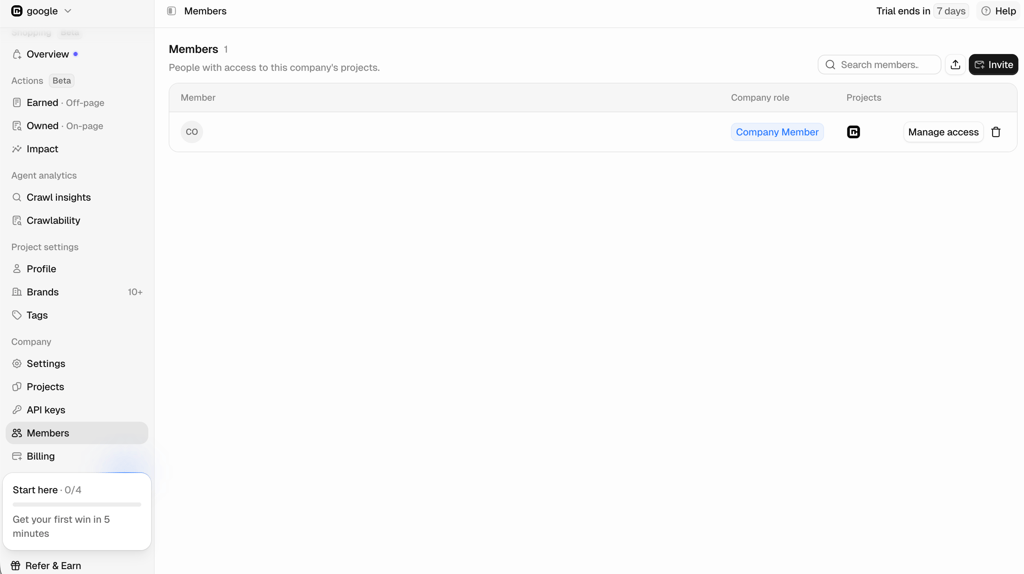
Peec AI handles collaboration through its Members section. Invites are email-only, but they offer more granular permission levels. You can add someone as a full company member with access to your entire workspace and billing, or limit their access by making them a project member or project viewer.
Trendos vs Peec AI: pricing
Pricing is one area where I didn't have to think twice. After comparing both platforms, Trendos offers noticeably better value.
What stood out to me first was the free plan. Trendos gives you 20 custom prompts, analyzes up to 600 AI answers per month, and lets you track up to 10 brands without paying anything or entering payment data. Peec AI doesn't offer a free plan, only a 7-day free trial, which requires a credit card, so you have much less room to explore the platform before committing.
Both providers discount their annual subscriptions. Peec AI's annual billing saves you around 15% compared to paying monthly, while Trendos's annual plans average about a 17% discount.
Looking at the paid plans, Trendos remains the more affordable option across every tier.
| Trendos | Peec AI | |
| Basic/Starter | $30.00/month | $80.00/month |
| Starter/Pro | $140.00/month | $205.00/month |
| Pro/Advanced | $320.00/month | $420.00/month |
The price difference becomes even more obvious once you compare what you actually get. Trendos's Basic plan includes 100 custom prompts and tracks results across six AI models. Peec AI's Starter plan costs more than twice as much, yet includes just 50 prompts and supports three AI models. In my opinion, that's a hard price gap to justify, especially if you're monitoring multiple brands or running AI visibility checks regularly.
Final recommendation
Comparing Trendos vs Peec AI made it clear that each platform excels in different areas. One is a better fit for fast, affordable AI visibility tracking, while the other is designed for more in-depth analysis and ongoing optimization.
Choose Trendos if you:
- Want a generous free plan without committing to a paid subscription
- Need a quick way to research brands, even if you don't know their website or domain
- Value clean, visual reports that are easy to understand at a glance
- Work in PR, brand management, SEO, or marketing, and regularly monitor multiple brands
- Want to explore AI visibility across a database of 2.5 million brands for market research
Choose Peec AI if you:
- Prefer a guided onboarding experience that's easy to follow, especially if you're new to AI visibility tools
- Want a dashboard with more sections and detailed controls for exploring your data
- Have the budget for a more premium-priced platform and don't mind paying extra for the experience it offers
- Need detailed insights to guide ongoing optimization rather than high-level monitoring
FAQ
Is Trendos better than Peec AI?
Yes, Trendos is the better choice thanks to its lower pricing, generous free plan, broader AI model coverage, and more visual reporting. It delivers better value for most businesses looking to improve AI search visibility.
Which AI tool is more affordable – Trendos or Peec AI?
Trendos is significantly more affordable. It offers a free plan and paid plans starting at $30.00/month, while Peec AI starts at $80.00/month and only includes a 7-day free trial.
What is the difference between Peec AI and Trendos?
Trendos focuses on affordable AI visibility tracking with strong reporting and broad AI model support. Peec AI offers deeper workflow features, source analysis, and integrations, making it better suited for advanced optimization and enterprise teams.