ExpressVPN vs VyprVPN comparison: which one is better?
Our in-house cybersecurity experts and journalists, renowned for major reports like The Mother of All Breaches, conduct transparent, unbiased VPN testing and in-depth analysis.
With 750+ articles crafted based on real-world research, we empower readers to make informed purchasing decisions through first-hand expertise.
Learn more

Choosing between ExpressVPN vs VyprVPN can be tricky, as both are established VPN providers with solid reputations. ExpressVPN is widely recognized as a premium, performance‑focused service, while VyprVPN positions itself as a more budget‑friendly option with proprietary technology at its core. Depending on what you prioritize – speed, streaming, or savings – either could fit your needs.
In this comparison, I tested ExpressVPN and VyprVPN across key real‑world metrics, including connection speeds, streaming performance, and feature availability. The tests were run on the same devices and networks, using each provider’s fastest tunneling protocol and typical VPN‑friendly server locations. I also checked how well both unblocked major streaming platforms and how their apps performed on desktop, mobile, and Linux.
If you’re trying to decide which service is right for you, keep reading. By the end of this overview, you’ll see how ExpressVPN vs VyprVPN stack up in speed, streaming, features, and value, so you can pick the VPN that aligns best with your online habits.
ExpressVPN vs VyprVPN overview
ExpressVPN and VyprVPN are both reliable, but with different strengths. ExpressVPN offers faster speeds and better streaming support, while VyprVPN is more budget‑friendly and allows up to 10 simultaneous connections, compared to ExpressVPN’s 14. Overall, ExpressVPN delivers better performance and value for most users, while VyprVPN suits those prioritizing lower cost and solid multi‑device coverage.
| ExpressVPN | VyprVPN | |
| ⭐ Rating: | ||
| 🥇 Overall rank: | #4 out of #41 | #12 out of #41 |
| 🖥️ Servers: | 3,000+ servers in 113 countries | 700+ servers in 70 countries |
| 📖 No logs policy: | No logs | No logs |
| 💵 Price: | From $2.99/month | from $3.00/month |
| 🔥 Coupons: | ExpressVPN coupon 80% OFF | VyprVPN coupon 50% OFF |
| 🔒 VPN protocols: | OpenVPN, WireGuard, Lightway | IKEv2, Chameleon, OpenVPN |
| 🍿 Streaming services: | Netflix, Hulu, BBC iPlayer, Disney+, and more | Netflix, Hulu, BBC iPlayer, YouTube |
| 🖥️ Platforms: | Windows, macOS, Linux, Android, iOS | Windows, Mac, Linux, Android, and iOS |
| 📥 Simultaneous connections: | 14 | 10 |
| 💁🏻 Support: | Knowledge base, email, 24/7 live chat | Knowledge base, FAQs, 24/7 live chat |

Recent Updates




We spare no effort to test the products & their features. All information is gathered by our in-house research team & fact-checked by our team of experts. Discover the ins and outs of our testing procedures.
ExpressVPN vs VyprVPN: key differences
ExpressVPN and VyprVPN are both among the best VPNs available, but they cater to different priorities.
Choose ExpressVPN if:
- You want faster, more consistent speeds. In our tests, ExpressVPN averaged around 490 Mbps, with low latency and stable connections even on distant servers thanks to its Lightway protocol.
- You care about streaming and global access. ExpressVPN consistently unblocks major platforms like Netflix US, BBC iPlayer, Hulu, and others in full HD, without frequent slowdowns or failures.
- You use multiple devices and a wide range of apps. ExpressVPN supports up to 14 simultaneous connections and offers polished apps plus browser extensions across Windows, macOS, Linux, Android, iOS, and popular smart‑TV and router setups.
Check out our full ExpressVPN review for detailed test results and feature breakdowns.
Choose VyprVPN if:
- You want a more affordable VPN with solid privacy. VyprVPN is usually cheaper than ExpressVPN and still delivers strong encryption, Swiss‑based operations, and good long‑term value for casual users.
- You rely on proprietary protocol and obfuscation. VyprVPN’s Chameleon protocol helps bypass restrictive networks and deep‑packet inspection, which can be useful for accessing the internet in heavily censored environments.
- You don’t need a high device limit. VyprVPN lets you connect up to 10 devices simultaneously, which works well for small households or power users who want to cover phones, tablets, desktops, and consoles under one account.
Speed, streaming, and torrenting performance
I tested ExpressVPN vs VyprVPN for speed, performance, and streaming. Below you can see what I found.
Speed comparison
To access real‑world performance, we tested ExpressVPN vs VyprVPN for speed, latency, and long‑distance stability across multiple server locations.
ExpressVPN speed test results:
| Server location | Download speed | Upload speed | Ping |
| Local | 724.19Mbps | 370.83Mbps | 17ms |
| London, UK | 573.30Mbps | 459.13Mbps | 40ms |
| New York, US | 468.69Mbps | 200.41Mbps | 97ms |
| Perth, Australia | 382.37Mbps | 91.45Mbps | 220ms |
| Tokyo, Japan | 301.21Mbps | 77.06Mbps | 255ms |
VyprVPN speed test results:
| Server location | Download speed | Upload speed | Ping |
| London, UK | 634Mbps | 825Mbps | 38ms |
| New York, US | 515Mbps | 501Mbps | 150ms |
| Perth, Australia | 284Mbps | 123Mbps | 218ms |
| Tokyo, Japan | 308Mbps | 90Mbps | 319ms |
VyprVPN delivers solid speeds on nearby servers, but performance drops noticeably over long‑distance routes. In our tests, VyprVPN averaged around 380Mbps, with pings rising from 38ms in the UK to roughly 150–319 ms in New York, Perth, and Tokyo.
By contrast, ExpressVPN maintained consistently high speeds regardless of server distance. Across the same locations, it averaged about 490Mbps, with pings starting at just 17ms locally and peaking at 255ms in Tokyo. This consistency owes a lot to its Lightway protocol, which keeps latency low and connections stable.
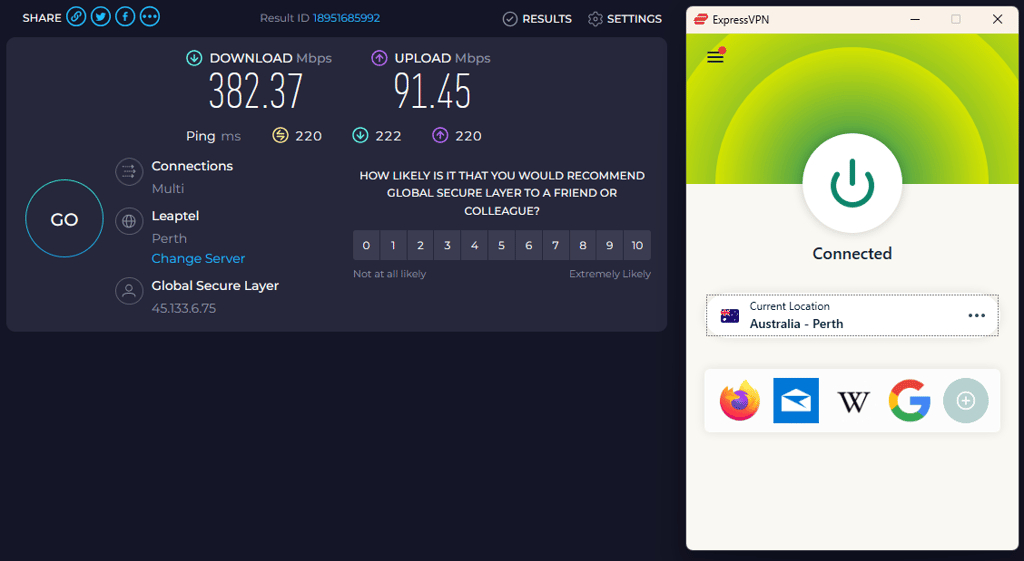
Overall, ExpressVPN clearly outperformed VyprVPN in every region, with faster downloads, steadier uploads, and lower, more predictable ping. If you’re chasing the absolute fastest possible connection speed, you’ll still find even faster alternatives in our speediest VPN list, but between these two, ExpressVPN is the clear winner.
Streaming performance
VyprVPN and ExpressVPN have significant differences regarding streaming capabilities, with the latter performing better.
| Platform | ExpressVPN | VyprVPN |
| Netflix | ✅ Yes | ✅ Yes |
| Hulu | ✅ Yes | ❌ No |
| BBC iPlayer | ✅ Yes | ❌ No |
| Amazon Prime Video | ✅ Yes | ✅ Yes |
| YouTube | ✅ Yes | ✅ Yes |
Both services successfully unlocked various Netflix libraries, however, VyprVPN struggled with US and UK regions. Meanwhile, ExpressVPN effortlessly unblocked Japanese Netflix on every tested server, and produced the same great results for other regions.
ExpressVPN offers apps for Roku, Fire TV Stick, Apple TV, and Nvidia Shield, and has a MediaStreamer feature, which works similarly to a more well-known SmartDNS. It's a robust tool for accessing geo-restricted sites on devices that don't support VPN connections. However, during our tests, MediaStreamer failed to perform on Xbox.
VyprVPN, on the other hand, does not offer SmartDNS services, so you will have to rely on its standard protocol. However, the VyprVPN app works well on Amazon Fire Stick, and you can integrate it on Kodi.
Both services performed admirably with YouTube, BBC iPlayer, and Amazon Prime Videos. Yet VyprVPN failed to unlock Hulu, which ExpressVPN had no trouble with. Furthermore, the VyprVPN IKEv2 protocol was identified as an "unblocker or proxy" error – an issue that SmartDNS technology would solve.
The limited number of servers, struggles with Hulu, and lack of SmartDNS feature prevent VyprVPN from appearing on our list of the best streaming VPNs.
Torrenting
During our tests, all ExpressVPN and VyprVPN servers supported P2P connections. Although it took some time to wind up, ExpressVPN download speed fluctuated between 48 and 120Mbps. Meanwhile, VyprVPN never exceeded 40 Mbps, which was not surprising considering its overall low speeds.
You can use both services for torrenting due to their robust online privacy features and proven no-logs policies. However, if that's your primary goal, there are better options on our best VPN for torrenting list, such as NordVPN, which provides a SOCKS5 proxy for faster downloads.
Pricing
ExpressVPN uses a three‑tier system – Basic, Advanced, and Pro – while VyprVPN keeps things simple with a single plan. The table below shows how their monthly, yearly, and 2‑year prices compare.
| Plan | Monthly billing | Yearly billing | 2-year billing |
| ExpressVPN Basic | $14.99/month | $4.99/month | $2.99/month |
| ExpressVPN Advanced | $16.99/month | $5.99/month | $4.49/month |
| ExpressVPN Pro | $22.99/month | $8.99/month | $7.49/month |
| VyprVPN | $5.00/month | $4.00/month | $3.00/month |
Both services follow a similar long‑term discount model, but ExpressVPN ends up slightly cheaper at the bottom tier. ExpressVPN pricing starts at $2.99/month on the 2‑year Basic tier, while VyprVPN’s best deal is $3.00/month on the 2‑year plan. Monthly pricing is higher for ExpressVPN (from $14.99) than VyprVPN’s $5.00 flat rate, but those who commit long‑term will pay less per month with ExpressVPN’s lowest tier.
Both providers include the full feature set across all plans and offer the best value on longer subscriptions. It’s worth noting that these prices are generally in line with the market average, with alternatives such as NordVPN offering 2‑year plans starting at $3.49/month.
ExpressVPN edges ahead on payment flexibility, accepting crypto payments in addition to PayPal, credit cards, and UnionPay, which helps if you want a more private purchase. VyprVPN similarly supports PayPal and UnionPay but does not offer cryptocurrency options. Both services include a 30‑day money‑back guarantee, allowing you to test the VPNs with little risk.
Server locations
| ExpressVPN | VyprVPN | |
| Servers | Undisclosed number | 700+ |
| Countries (total) | 113 | 70 |
| Virtual locations | ✅ Yes | ✅ Yes |
| Specialty servers | ❌ No | ❌ No |
ExpressVPN remains an industry leader in terms of server coverage, even though it no longer publicly discloses its exact server count. It operates in 113 countries and uses virtual server locations, which it claims represent a small portion of the network. This broad footprint makes it one of the most versatile VPNs for bypassing geo‑blocks across regions.
VyprVPN offers a more modest 700+ servers and covers only 70 countries, which is sufficient for most users. The provider owns and manages its servers in‑house and pairs them with dedicated DNS servers, helping maintain consistent performance and improve the odds of bypassing strict geo‑restrictions.
ExpressVPN vs VyprVPN: features overview
Both ExpressVPN and VyprVPN come loaded with additional features but might leave you wanting more if you're looking for something specific.
| ExpressVPN | VyprVPN | |
| SmartDNS | ✅ Yes | ❌ No |
| Private DNS servers | ✅ Yes | ✅ Yes |
| Split tunneling | ✅ Yes | ✅ Yes |
| Obfuscated servers | ✅ Yes | ✅ Yes |
SmartDNS
Many users use VPNs to access geographically restricted content, as well as for the security they provide. Moreover, your streaming experience will be much better if there’s a SmartDNS feature for devices that don't support VPN connections.
ExpressVPN provides MediaStreamer, another name for SmartDNS. It bypasses the encryption part but modifies your DNS metrics to grant access to geo-blocked sites. However, MediaStreamer primarily supports US‑based streaming libraries and may offer limited support for a few other regions.
VyprVPN doesn't offer a built‑in SmartDNS feature, so you must rely on its VPN servers to bypass geo‑blocks. Some third‑party router setups can mimic SmartDNS behavior, but this is not an official VyprVPN service.
Private DNS servers
Even VPNs with the strongest encryption algorithms will fail to protect your data if they leak DNS data. Your online activities will remain obfuscated, but the DNS server will reveal the websites you visit, undermining your online safety.
VyprVPN uses an advanced DNS relay system that prevents DNS leaks and can help obscure VyprDNS‑based traffic, sometimes making it appear as if you’re using common DNS providers like Google or Amazon. However, it cannot fully hide VPN usage from sophisticated DPI or certificate‑based inspection
As expected, ExpressVPN also has its own DNS servers. They are encrypted and void all the requests after the browsing session to adhere to no-logs policies, but do not support the DNS relay function.
Split tunneling
VPNs often reduce connection speed due to hops through additional servers and additional encryption. Split tunneling lets you control the VPN data stream and choose which application traffic can flow through the standard ISP channel.
VyprVPN calls this feature Connection Per App, letting you choose which apps use the VPN tunnel while the rest use your regular connection. It is primarily available on macOS, as split‑tunneling support on Windows has been limited or inconsistent in recent versions.
On the contrary, ExpressVPN split tunneling is available on Windows and some mobile platforms, but its interface was removed from the latest macOS app for macOS 11 and newer, limiting its use on that operating system
If split tunneling is the key feature you’re looking for, the better VPN here will depend on your computer’s operating system.
Obfuscated servers
ExpressVPN does not allow activating its Stealth Servers (their name for obfuscated servers) manually, but claims to activate them anytime it detects DPI. However, because its website lacks information, it's hard to tell exactly how ExpressVPN identifies such occasions. Stealth servers modify your online traffic to resemble standard encrypted information flow, avoiding authoritarian governments' espionage or any online service that uses DPI to control access points.
VyprVPN works slightly differently with the same end goal. Its Chameleon protocol modifies OpenVPN metadata to ensure it is not recognizable by DPI systems, thereby bypassing restrictive networks. You can activate the Chameleon protocol in the app at any time, which I find to be more practical than the ExpressVPN mode that activates automatically.
ExpressVPN vs VyprVPN: which is more secure?
VyprVPN and ExpressVPN are secure providers that will protect your online traffic from undesired attention and prevent data leaks.
| ExpressVPN | VyprVPN | |
| Encryption | AES‑256‑GCM, ChaCha20 | AES-256-CBC |
| Hash | SHA-512 | SHA-256 |
| RAM servers | ✅ Yes | ❌ No |
| A member of the 14-eyes alliance? | ❌ No | ❌ No |
| No-logs policy | Audited | Audited |
| Kill switch | ✅ Yes | ✅ Yes |
| Ad blocker | ✅ Yes | ❌ No |
| DNS leak protection | Standard | DNS relay system |
ExpressVPN uses AES‑256‑GCM encryption by default on most devices, with ChaCha20 only on low‑end hardware, which is faster and more resource-friendly than VyprVPN's AES-256-CBC. However, both algorithms perform similarly well, protecting your online data flow from cyber threats.
To prove their mettle, both providers have undergone independent no‑logs audits, which support their claims of not storing user‑level activity or connection logs. VyprVPN chose Leviathan Security. Meanwhile, ExpressVPN opted for PricewaterhouseCoopers and KPMG.
VyprVPN doesn't include an ad blocker in its otherwise rich feature set, while ExpressVPN includes Lite Protection in its Basic plan and Advanced Protection in higher tiers. ExpressVPN focuses more on security, including a bug bounty program that helps identify and fix vulnerabilities as quickly as possible. VyprVPN does not have such a program, but offers advanced DNS leak protection – these two try to steal each other's thunder at every corner.
Infrastructure
Even though neither is based in a Fourteen-Eyes Alliance country, VyprVPN does not operate a RAM‑only server infrastructure like ExpressVPN, which means its servers rely on traditional storage rather than volatile memory. Still. an independent audit supports VyprVPN’s no‑logs claims, reinforcing that the service does not retain user‑level connection or activity logs.
Meanwhile, ExpressVPN’s RAM‑only TrustedServer infrastructure stores data only in volatile memory, which is erased on reboot, making persistent logs or malware storage practically impossible. However, this does not guarantee complete immunity from other attack vectors, such as software‑level exploits.
Privacy
ExpressVPN is based in British Virgin Islands with no data retention laws. The British Virgin Islands are not a part of the Fourteen-Eyes Alliance or any other online surveillance group, and when Turkish authorities seized one of ExpressVPN’s servers in 2017, they found no logs on it.
However, in 2021 this VPN service was acquired by Kape Technologies, a security and digital privacy company that also owns CyberGhost VPN, ZenMate, and Private Internet Access (PIA).
Meanwhile, VyprVPN is located in Switzerland, with favorable privacy laws suited for a no-logs VPN. Its privacy policy document clearly outlines the no-logs claim, backed by an independent audit.
Even though both services have proven they are privacy-friendly, ExpressVPN gains the edge with its RAM-only servers.
Logging
Both VyprVPN and ExpressVPN offer no-logs VPN services, and each has facts to back it up. They chose base operation locations with privacy-friendly laws, and each went through independent no-logs audits.
However, VyprVPN chose not to transit to RAM-only servers, putting it behind ExpressVPN. Instead, it owns and operates all of its servers. As applaudable as it is, it does not compensate for the robust security of the RAM-only server structure, called TrustedServer technology in the ExpressVPN app.
China and countries with restricted internet access
Even though using VPNs in China is legal, their usage is severely restricted, and only a few manage to get through their Great Firewall.
VyprVPN is one of the best VPNs for China because of its Chameleon protocol, which helps evade DPI‑based VPN blocking, but success is not guaranteed and can vary over time
Simultaneously, ExpressVPN offers many regional servers and strong connection speeds, and its traffic can often evade DPI‑based detection, but performance in heavily restricted networks such as China can vary.
However, it's best to download and install both apps before arriving, as China often blocks or heavily restricts access to VPN‑related websites and app stores.


Platforms, interface, and ease of use
VyprVPN and ExpressVPN work well on all major operating systems. However, VyprVPN has only one browser extension, lacks WireGuard support on Linux, and offers fewer simultaneous connections.
| ExpressVPN | VyprVPN | |
| Supported OS | Windows, macOS, Linux, Android, iOS | Windows, macOS, Linux, Android, iOS |
| Other software and devices | Android TV, Kindle Fire, Chromebook | Kodi, Fire devices |
| Browser extensions | Chrome, Firefox, Edge | Chrome |
| Simultaneous connections | 14 | 10 |
| Usability level | Easy | Average |
The main difference between the two is the availability of a split-tunneling feature, with each provider prioritizing a different operating system. All in all, the difference is too small and will depend on your hardware.
Desktop apps
Both VPNs provide an easy-to-use Windows application. However, the VyprVPN Windows version lacks anti-malware and split tunneling features, which are significant disadvantages. Split tunneling, however, is available on Mac.
On the other hand, ExpressVPN does not support split tunneling on macOS 11 or later, making these two providers quite the opposite. You won't find a server map of either app, but that's compensated for by the ability to sort or quick-search the servers for easier access.
VyprVPN Linux app is available on Ubuntu and Mint distributions. Meanwhile, ExpressVPN adds Fedora, Debian, RedHat, and Arch-based distributions to the list. You can use ExpressVPN's proprietary Lightway protocol on Linux, but you will have to rely on OpenVPN if you want to use the VyprVPN Linux version.
Lastly, controlling the ExpressVPN Linux app through a browser extension is possible, avoiding the terminal. This provider excels in nearly all desktop-app aspects, except for split-tunneling availability on macOS newer versions.
Mobile apps
Both providers offer quite similar mobile apps without huge differences between Android and iOS versions. They are intuitive and don't stray far from their desktop counterparts.
ExpressVPN and VyprVPN Android versions provide split-tunneling and a kill switch, which you won't find on iOS devices. Even though it's due to how Apple handles developer instructions, iPhone users will have a slightly worse experience.
VyprVPN does not offer an IKEv2 protocol on Android, but you can choose WireGuard, Chameleon, or OpenVPN instead. Simultaneously, ExpressVPN offers a variety of Android tunneling protocols. Overall, both service's mobile apps offer sufficient features and function similarly well.
Customer support
| ExpressVPN | VyprVPN | |
| 24/7 live chat | ✅ Yes | ✅ Yes |
| ✅ Yes | ✅ Yes | |
| Phone line | ❌ No | ❌ No |
| Guides or articles | ✅ Yes | ✅ Yes |
| FAQs | ✅ Yes | ✅ Yes |
A professional and helpful customer support agent is at each end of the table. You can reach ExpressVPN or VyprVPN via the 24/7 live chat or email if the situation requires a more detailed explanation.
I had no trouble contacting each support team directly and received accurate explanations for my technical queries. Furthermore, both websites provide additional documentation and troubleshooting guides.
Both service providers ask for an email address to verify account status, which is a standard procedure. Overall, the excellent service of each support team will not leave you wanting more.
ExpressVPN vs VyprVPN – which one wins?
ExpressVPN takes the lead overall thanks to its faster speeds, superior streaming performance, and richer feature set. It unblocks more streaming platforms reliably, supports SmartDNS for non‑VPN devices, and offers a wider range of browser extensions plus a more polished Linux app.
By contrast, VyprVPN stands out mainly for its strong macOS‑focused experience, where it offers a solid, user‑friendly interface and the Chameleon obfuscation protocol, making it a good fit for users in restrictive networks. However, it does so at a slightly higher monthly price than ExpressVPN’s lowest 2‑year tier and with fewer simultaneous connections (10 vs 14).
Because both services offer similar core security and privacy protections, the deciding factors are streaming, features, and long‑term value. With more consistent unblocking, extra tools like SmartDNS, and better‑distributed device limits, ExpressVPN is the clear winner between the two.
| Feature | ExpressVPN | VyprVPN | Verdict |
| Pricing | ExpressVPN wins on long‑term value, with its 2‑year Basic plan at $2.99/month, slightly cheaper than VyprVPN’s $3.00/month. VyprVPN is cheaper month‑to‑month, but ExpressVPN offers better pricing at the bottom tier. | ||
| Speed | ExpressVPN averages 490Mbps with lower, more stable latency. VyprVPN averages 380Mbps and experiences higher ping on long‑distance routes. | ||
| Streaming performance | ExpressVPN wins decisively: it unblocks Netflix, Hulu, BBC iPlayer, Amazon Prime, and YouTube reliably, while VyprVPN fails with Hulu and some Netflix/UK libraries and lacks SmartDNS, which hurts its flexibility. | ||
| Torrenting | Both support P2P on all servers with strong no‑logs policies. ExpressVPN delivers faster download speeds (48–120Mbps), while VyprVPN caps around 40Mbps, but neither is a top‑tier torrent‑specific VPN. | ||
| Server locations | ExpressVPN wins on coverage, with 113 countries vs VyprVPN’s 70. | ||
| Features | ExpressVPN offers SmartDNS, Lite/Advanced Protection ad‑blocking‑style tools, split tunneling on Windows, and a wider range of browser extensions. VyprVPN counters with Chameleon obfuscation and a solid DNS relay system, but overall offers fewer polished extras. | ||
| Privacy & security | ExpressVPN uses RAM‑only TrustedServer infrastructure, is based in the British Virgin Islands (non‑Fourteen‑Eyes), and has audited no‑logs policies. VyprVPN is also secure, but without RAM‑only servers. | ||
| Apps & ease of use | ExpressVPN wins on overall polish, with more refined Windows, Linux, and mobile apps, as well as broader browser‑extension support. VyprVPN is fine on macOS and some routers, but its Linux and mobile clients are a bit less feature‑rich and have fewer connections overall (10 vs 14). | ||
| Customer support | ExpressVPN wins slightly, with 24/7 live chat, email, and thorough guides, plus a track record of quick, accurate help. With VyprVPN, more complex queries can take longer to resolve. |
FAQ
Which is better: VyprVPN or ExpressVPN?
ExpressVPN is better because it provides better connection speed and a bigger server pool. Furthermore, it offers more browser extensions, fully-developed Linux support, and a SmartDNS feature that VyprVPN lacks. The latter offers a slightly better macOS app but falls behind in other OS.
Is ExpressVPN or VyprVPN better for online privacy?
While both providers are solid in this regard, ExpressVPN is better for overall online privacy. Both services have audited no-logs policies and reside in privacy-friendly jurisdictions. However, ExpressVPN gains the edge thanks to its RAM-only servers.
Which is better for torrenting: VyprvPN or ExpressVPN?
ExpressVPN is better for torrenting because it offers a better Internet connection speed and more worldwide servers. However, neither provides SOCKS5 proxy support and is not considered the prime choice for a torrenting VPN. For example, an industry leader NordVPN offers a better torrenting toolkit for a more affordable price.