Surfshark Dausos protocol review
Our in-house cybersecurity experts and journalists, renowned for major reports like The Mother of All Breaches, conduct transparent, unbiased VPN testing and in-depth analysis.
With 750+ articles crafted based on real-world research, we empower readers to make informed purchasing decisions through first-hand expertise.
Learn more

Surfshark’s new Dausos protocol arrives wrapped in two big promises: faster speeds and protection against a post-quantum future. That combination, performance plus forward-looking cryptography, signals something bigger than a routine VPN update. It suggests a shift in how privacy tools are being built for the next decade.
It isn’t just whether Dausos hits a specific speed benchmark. It’s that VPN providers are starting to design for a world where today’s encryption might not be enough.
What is Dausos and how does it work?
At its core, Dausos is a custom protocol that integrates post-quantum cryptographic methods.
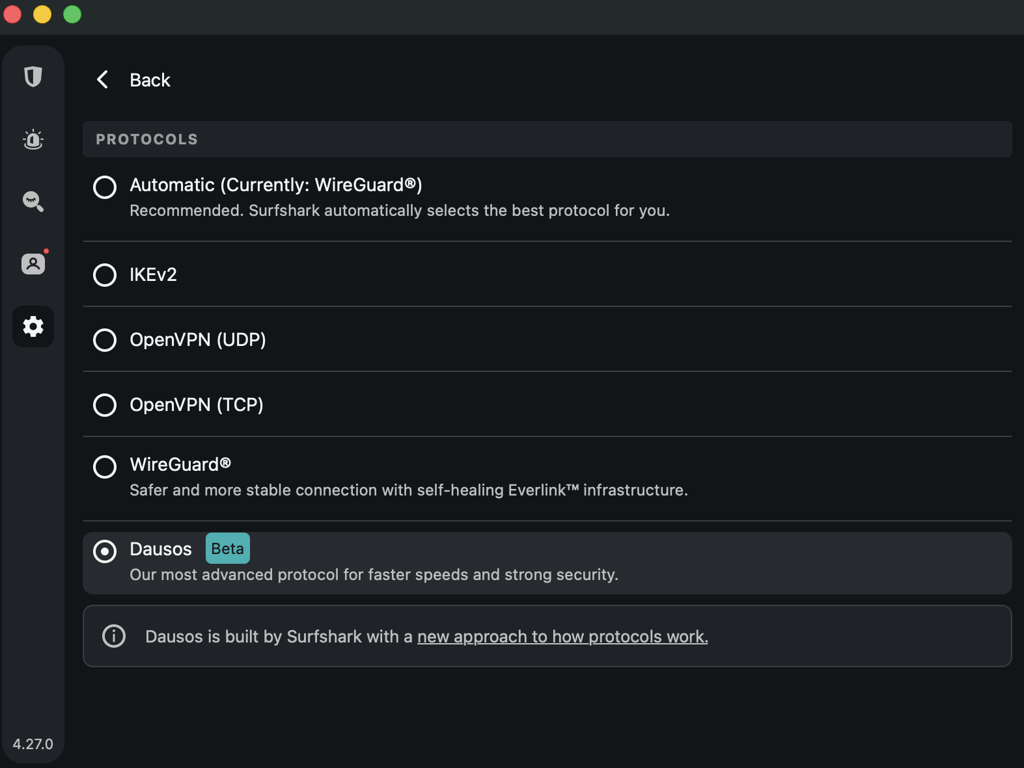
Instead of pooling traffic, it creates a dedicated tunnel per user session. That means your data isn’t just encrypted – it’s isolated at the architectural level.
From what I can tell, this has two immediate effects:
- Traffic flows more cleanly without competing with other users
- The system can optimize performance per connection instead of averaging across many
It’s a subtle shift, but it changes how the network behaves. Less like a crowded highway, more like your own private lane.
A security model designed for the post-quantum era
Surfshark didn’t just bolt on post-quantum security, they built around it. Here’s what that actually means:
- A hybrid key exchange (ML-KEM + X25519) combining current and post-quantum standards
- A post-quantum signature system (ML-DSA) used in its certificate infrastructure
- AEGIS-256X2 encryption, which is optimized for both speed and strong authenticated encryption
That combination protects against both today’s attackers and tomorrow’s capabilities without sacrificing performance.
And then there’s the part I didn’t expect: post-compromise security.
Every session generates entirely new cryptographic keys, completely unrelated to previous ones. So even if something were exposed, it wouldn’t cascade.
That’s a step beyond the standard “damage control” model most VPNs rely on.
In this case, Dausos was audited by Cure53, a well-known security firm. The result: no critical or high-severity issues found.
Real-world performance
Looking at the raw numbers first, Dausos delivers strong consistency across regions. Average download speeds reached ~698 Mbps with ~74% retention, while uploads averaged ~398 Mbps with ~42% retention. Latency stayed reasonable in closer regions (as low as 18–41 ms across Europe), but naturally increased with distance.
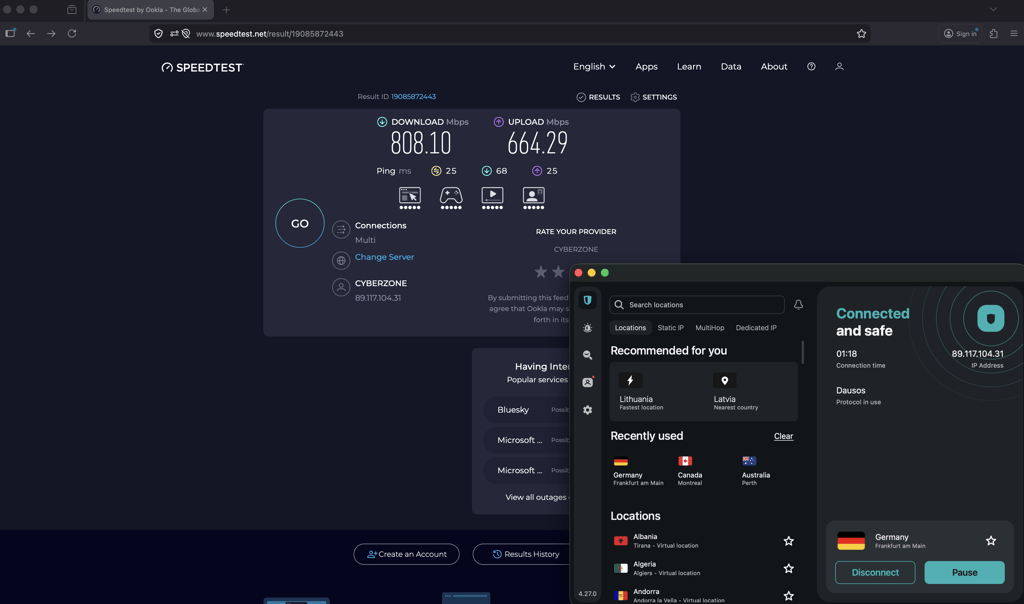
What stood out to me wasn’t just peak speed, it was how stable the performance felt across different use cases.
Everyday use
In day-to-day tasks, Dausos was effectively invisible:
- Browsing: opening multiple tabs, switching between pages, and loading content-heavy sites felt identical to a non-VPN connection
- Video calls: no lag, buffering, or quality drops during calls with camera and mic enabled
-
Streaming:
- 4K Netflix playback ran smoothly
- 2160p60 YouTube videos loaded without interruption
- 1080p60 Twitch streams stayed stable
Across both nearby (Vilnius) and transatlantic (Boston) servers, I didn’t run into noticeable slowdowns. That level of consistency is exactly what you want from a VPN, it’s there, but it doesn’t get in your way.
Gaming
Gaming is where things become more nuanced and more interesting.
- No VPN: ~25 ms
- Nearby server (Vilnius): ~30 ms
- Distant server (Boston): ~137–150 ms
When connected to a nearby server, gameplay felt essentially unchanged.
Switching to a geographically distant server, though, introduced a clear jump in latency. That’s expected behavior for any VPN, but it reinforces an important point: Dausos maintains performance extremely well when distance is optimized.
All of this testing was done on office Wi-Fi with a relatively fast but somewhat unstable baseline (~265 Mbps download / 300 Mbps upload). That variability makes the consistency even more notable.
At the same time, results will always depend on:
- Your baseline connection
- Server distance
- Network conditions
What I can say confidently is that Dausos handled real-world usage scenarios with a level of stability that’s easy to appreciate, and hard to notice, which is exactly the point.
Final thoughts
Surfshark’s Dausos protocol presents a well-executed step forward in VPN design, combining performance optimization with forward-looking cryptography. Its integrated approach to speed, security, and traffic handling reflects a clear shift toward more resilient, future-ready connectivity.
While results will vary by environment, the underlying architecture positions Dausos as a strong indicator of where consumer VPN technology is heading.
FAQ
What is Surfshark Dausos?
Dausos is Surfshark’s custom VPN protocol designed to deliver faster speeds and enhanced security using post-quantum cryptography. It introduces a new architecture that optimizes how data is transmitted and protected.
Is Dausos faster than other VPN protocols?
Yes, Dausos is designed to be faster than many existing VPN protocols, with claims of up to 30% improvement. In real-world use, it provides consistently high speeds and stable performance, especially on nearby servers.
Is Dausos protocol good for gaming?
Yes, Dausos works well for gaming when connected to nearby servers, maintaining low latency and stable connections. Performance depends on distance, with higher latency on far-away servers.
What makes Dausos different from other VPN protocols?
Dausos stands out by using a dedicated tunnel for each user session and dynamically adapting to network conditions. It also integrates advanced cryptographic methods for improved performance and security.
Is Dausos available on all devices?
No, Dausos is currently available on macOS, with support for additional platforms expected in the future.