Best VPNs for pfSense router in 2026
Our in-house cybersecurity experts and journalists, renowned for major reports like The Mother of All Breaches, conduct transparent, unbiased VPN testing and in-depth analysis.
With 750+ articles crafted based on real-world research, we empower readers to make informed purchasing decisions through first-hand expertise.
Learn more

Securing your network starts at the router level, and pfSense already offers far more control and protection than most off-the-shelf devices. But even this powerful open-source firewall benefits from an added layer of encryption. Pairing it with a high-quality VPN helps safeguard your traffic, block surveillance, and unlock worldwide content directly at the network edge – no extra apps required.
In this guide, I break down the best VPNs for pfSense router setups, all thoroughly tested with the Cybernews research team for seamless integration, fast speeds, robust security, and advanced features. These picks deliver reliable performance and maximum protection for any pfSense deployment.
Top 5 best VPNs for pfSense – my shortlist
- NordVPN – best overall VPN for pfSense router
- Surfshark – affordable yet feature-packed choice for pfSense setups
- Proton VPN – privacy-focused VPN compatible with pfSense
- IPVanish – simple and secure pfSense VPN
- PureVPN – easy-to-configure VPN to secure your pfSense router
How to use a VPN with pfSense
To use a VPN with your pfSense router, you need to manually create a VPN connection – most commonly using the OpenVPN protocol. I recommend NordVPN for its compatibility and robust security with pfSense. Here’s what you need to do:
- Get a pfSense-compatible VPN – NordVPN is my top pick for its compatibility and robust security with pfSense
- Log in to your VPN account dashboard and find the manual setup section
- Download the OpenVPN configuration files for your preferred server
- Access the pfSense dashboard in your web browser
- Import the OpenVPN files and follow your VPN provider’s pfSense setup guide to complete the configuration
By following these steps, your pfSense router will securely transmit your network traffic through a reliable VPN, protecting your privacy and security. A more detailed setup guide is available at the end of this article.




We spare no effort to test the products & their features. All information is gathered by our in-house research team & fact-checked by our team of experts. Discover the ins and outs of our testing procedures.
The best VPNs for pfSense router – my detailed list
Together with the Cybernews research team, I tested 41 of the best VPN providers to narrow down the list to only the best VPNs for the pfSense router. The top 5 providers in this list are compatible with the pfSense router and provide setup guides. In addition, they all have great security features, offer fast connection speeds, and other useful extras for a great price.
1. NordVPN – best VPN overall for pfSense router

| Rating: | |
| pfSense compatible: | Yes |
| Servers/countries: | 8,000+ servers in 149 countries |
| No-logs: | No-logs, independently audited |
| Price: | $3.49/month |
| Current deal: | Get 75% OFF NordVPN + 3 months free |
NordVPN is my number one VPN choice for pfSense, as it offers full compatibility with the latest software versions, top-tier security against data leaks and DDoS attacks, and blazing-fast speeds for smooth browsing and streaming.
NordVPN is a leading choice for securing your pfSense router thanks to its strong compatibility, proven privacy protections, and impressive server coverage. It supports manual OpenVPN configuration on pfSense routers, with detailed setup guides available for different software versions. While NordVPN’s proprietary NordLynx protocol offers top-tier speeds on its apps, only OpenVPN is available for manual router setups like pfSense. That said, OpenVPN still delivers stable and fast performance for streaming, browsing, and everyday use.
NordVPN’s network of 8,000+ servers across 149 locations offers broad global access, including specialized obfuscated servers for privacy in restrictive regions. These servers help disguise VPN traffic as regular traffic, which is useful for setting up pfSense in regions where VPN blocking is used.
NordVPN uses AES-256 encryption, RAM-only servers that wipe data on reboot, and an independently audited no-logs policy, operating from privacy-friendly Panama. NordVPN’s apps include Threat Protection and kill switches, though router setups like pfSense rely mainly on firewall rules.
The in-house tests show that NordVPN delivers fast speeds with NordLynx (87.78% download retention) and OpenVPN (84.22%), ensuring secure, lag-free streaming.
Plans start at $3.49/month and include coverage up to 10 simultaneous connections. Additionally, there's a 3-day free trial for Android devices and a 30-day money-back guarantee, so you can try it risk-free before committing.
Learn more in our NordVPN review.
2. Surfshark – budget-friendly and feature-rich VPN for pfSense routers

| Rating: | |
| pfSense compatible: | Yes |
| Servers/countries: | 4,500+ servers in 100 countries |
| No-logs: | No-logs, independently audited |
| Price: | $2.49/month |
| Current deal: | Now up to 87% OFF Surfshark + 3 months FREE |
Surfshark is my second choice for pfSense routers thanks to its strong security, easy manual setup, and budget-friendly pricing – perfect for protecting your entire network.
Surfshark is affordable, supports pfSense 2.4.4 and later, and can be manually set up via clear OpenVPN guides. Dedicated apps are available for all major operating systems, so you can protect each device individually. However, pfSense allows for full network coverage through a single connection.
With over 4,500 servers in more than 100 countries, Surfshark gives you wide global access to bypass geo-blocks and explore content from popular streaming platforms like Netflix, Disney+, Amazon Prime Video, and more. This broad network also supports stable and fast connections, making Surfshark a strong option for households that stream, game, or browse regularly using multiple devices.
Surfshark uses AES-256 encryption, RAM-only servers, and a no-logs policy audited independently. It protects against DNS and IPv6 leaks – key for router-level VPNs. Some features, like GPS spoofing or an app-based kill switch, aren't available on pfSense, but the VPN still delivers excellent router-level protection and performance.
Speaking of which, Surfshark is one of the speediest providers on the market, boasting 93.32% download retention, so you’re certain to get amazing connection speeds without buffers or lags.
Pricing is another major plus: Surfshark offers plans starting at just $2.49/month with its 2-year subscription and supports unlimited device connections under one account. Every plan includes a 30-day money-back guarantee, but you can also test it with your pfSense setup using a 7-day free trial.
To get a better understanding, read our comprehensive Surfshark VPN review or compare it with the top choice in our Surfshark vs NordVPN analysis.
3. Proton VPN – privacy-first VPN for pfSense

| Rating: | |
| pfSense compatible: | Yes |
| Servers/countries: | 20,700+ servers in 149 countries |
| No-logs: | No-logs, independently audited |
| Price: | $2.99/month |
| Current deal: | Get up to 70% OFF Proton VPN |
Proton VPN offers strong encryption, zero-logs, and advanced protocol support, making it ideal for privacy-focused pfSense users.
Compatible with OpenVPN and WireGuard, Proton VPN works seamlessly with pfSense and provides step-by-step setup guides. Based in Switzerland, it benefits from strict privacy laws and offers a publicly available, audited no-logs policy for added transparency.
Its infrastructure stands out, featuring full-disk encrypted, bare-metal-only servers and Secure Core functionality, which routes traffic through privacy-focused countries for advanced protection against sophisticated attacks.
Proton VPN runs 20,700+ servers in 149 countries, with 10Gbps speeds and VPN Accelerator for consistent performance. It reliably unblocks Netflix, BBC iPlayer, Disney+, and other major platforms, which is great for streaming and browsing with minimal slowdowns.
Proton VPN’s advanced security features include AES-256 encryption, DNS leak protection, and DNS-based NetShield, which works on pfSense. While split tunneling and port forwarding are app-based, router-level protection remains strong across all network-connected devices.
During the in-house speed tests, Proton VPN’s performance using the WireGuard protocol showed much better results than those on OpenVPN – 85.78% and 45.7% download retention, respectively. This significant performance difference makes WireGuard the preferred choice if you’re seeking smoother streaming, downloads, and overall responsiveness on your network.
Pricing for Proton VPN starts at $9.99/month for monthly plans, with annual and two-year options offering better savings – $3.99/month and $2.99/month, respectively. Notably, Proton VPN is one of the only reputable providers with a genuinely free plan, which includes no ads, speed throttling, or data selling. All premium plans come with 10 simultaneous connections and a 30-day money-back guarantee.
Read our comprehensive Proton VPN review to get a more in-depth understanding of this provider.
4. IPVanish – secure, fast, and feature-rich VPN for pfSense routers

| Rating: | |
| pfSense compatible: | Yes |
| Servers/countries: | 3,400+ servers in 112 countries |
| No-logs: | No-logs, independently audited |
| Price: | $2.39/month |
| Current deal: | Now up to 84% OFF IPVanish |
IPVanish stands out for pfSense thanks to its straightforward OpenVPN compatibility, strong encryption, and reliable speeds – all at a wallet-friendly price.
While IPVanish does not offer a dedicated pfSense setup guide, users can access OpenVPN configuration files from the provider’s website and import them into pfSense. This means IPVanish is compatible with pfSense, but you need to be willing to follow a few extra manual steps. Native apps are available for major platforms.
The IPVanish server network includes over 3,400 servers in 112 locations worldwide, providing decent global access for bypassing region blocks, streaming, and general browsing. While this fleet is smaller than top competitors such as NordVPN or Proton VPN, it still offers plenty of choices for most users.
Security-wise, it uses AES-256 encryption and an independently audited no-logs policy. Features like kill switch and threat protection are app-based and not available on pfSense. Double VPN is not supported, as I found that its OpenVPN config files aren’t available for these servers.
While IPVanish is outpaced by the incredibly fast Surfshark, it performed remarkably well in the in-house speed tests, with 91.86% average download retention using the WireGuard protocol. However, its performance using OpenVPN only reached 20.33% average download retention. Although it may not reach the absolute top speeds of market leaders, most users will find it more than adequate for daily use.
IPVanish is priced competitively, with plans starting around $2.39/month for a two-year subscription. All subscriptions come with unlimited simultaneous connections and a 30-day money-back guarantee.
Gain better insight into the provider by reading our comprehensive IPVanish review.
5. PureVPN – secure VPN for pfSense routers

| Rating: | |
| pfSense compatible: | Yes |
| Servers/countries: | 6,000+ servers in 65 countries |
| No-logs: | No-logs, always-on audit |
| Price: | $1.99/month |
| Current deal: | Now $1.99/month with 87% OFF |
Closing my list, PureVPN is another great choice for pfSense users, as it offers straightforward compatibility, dedicated setup guides, and a wide server network for robust privacy and access.
With its user-friendly manual for OpenVPN configuration and comprehensive platform support, PureVPN makes securing your entire network through pfSense both easy and effective. Native apps are also available for Windows, macOS, Linux, Android, and iOS.
With an extensive network of over 6,000 servers in 65 countries and 80+ locations, PureVPN makes it easy to bypass geo-restrictions and access global content. Notably, it offers quantum-resistant servers for users seeking an extra layer of security against future computing threats.
PureVPN is committed to privacy and security, utilizing AES-256 encryption and operating from a privacy-friendly jurisdiction. The VPN maintains a strict no-logs policy backed by an always-on audit, ensuring your activities remain private at all times. While the provider offers additional features such as a password manager and various security options like a kill switch, split tunneling, and port forwarding, they do not apply to pfSense setups.
PureVPN provides stable connection speeds and supports different tunneling protocols. Using the WireGuard protocol, it averaged 93.06% download retention in the in-house tests. With OpenVPN, on the other hand, the average download retention reached only 39.69%. Still, you shouldn’t have anything to worry about to get a lag-free streaming experience.
Pricing is competitive, with subscriptions starting at just $1.99/month and supporting up to 10 simultaneous connections. You can try PureVPN risk-free, thanks to a generous 31-day money-back guarantee.
Check out our in-depth PureVPN review for more information.
How we tested and selected the best VPNs for pfSense
While selecting the best VPNs for pfSense routers, together with the Cybernews team, I used a comprehensive, weighted set of criteria to identify providers that deliver the best balance of security, performance, and usability for network-wide protection:
- Compatibility (25%). Ensuring the VPN integrates smoothly with the latest pfSense versions and offers clear setup instructions was my top priority. I only chose VPNs that support manual OpenVPN and/or WireGuard configuration on pfSense.
- Security (25%). I looked for providers with robust security features like the market-standard encryption and tunneling protocols list, no-logs policy, security audits, and secure infrastructure, like RAM-only servers.
- Speed (20%). Fast, reliable connections are crucial for avoiding drops, buffering, and slowdowns during activities like streaming or large file transfers. I selected only those VPNs that consistently performed well in the in-house speed tests with router-level deployments.
- Ease of setup (15%). Setting up a VPN on pfSense can be technically challenging, so I gave extra weight to providers with simple, step-by-step configuration guides and accessible support. Intuitive, well-documented installation is critical for both beginners and power users.
- Additional features (15%). While not directly tied to pfSense itself, I considered the overall value of each service, such as access to optimized streaming servers, reliable customer support, malware and ad-blocking options (where DNS-level filtering is available), and flexible subscription plans.
Our testing methodology allows for balancing core pfSense VPN requirements – like compatibility, speed, and airtight security – while also factoring in practical extras and user experience to present only the very best choices.
Best VPNs for pfSense routers compared
Below, you’ll find a table comparing the best VPNs for a pfSense router.
| Brand | Rating | Price | Compatible with pfSense | Based in | Servers/countries | Devices supported | No-logs policy | Streaming capabilities | Money-back guarantee |
| 1. NordVPN | From $3.49/month | Yes | Panama | 8,000+ servers in 149 countries | Windows, macOS, Linux, Chromebook, Android, iOS, routers, and gaming consoles | No-logs, independently audited by PwC | Netflix, Hulu, BBC iPlayer, Disney+, and more | 30-day | |
| 2. Surfshark | From $2.49/month | Yes | Netherlands | 4,500+ servers in 100 countries | Windows, macOS, Linux, Android, iOS, smart TVs, and routers | No-logs, independently audited by Deloitte | Netflix, Disney+, Amazon Prime Video, Hulu, and more | 30-day | |
| 3. Proton VPN | From $2.99/month | Yes | Switzerland | 20,700+ servers in 149 countries | Windows, macOS, Linux, Android, iOS, smart TVs, and | No-logs, independently audited by Securitum | Netflix, BBC iPlayer, YouTube, HBO Max, Disney+, and more | 30-day | |
| 4. IPVanish | From $2.39/month | Yes | United States | 3,400+ servers in 112 countries | Windows, macOS, Linux, Android, iOS, smart TVs, and routers | No-logs, independently audited | Netflix, BBC iPlayer, YouTube, Disney+, and more | 30-day | |
| 5. PureVPN | From $1.99/month | Yes | British Virgin Islands | 6,000+ servers in 65 countries | Windows, macOS, Linux, Android, iOS, smart TVs, and routers | No-logs, always-on audit | Netflix, BBC iPlayer, YouTube | 31-day |

Why should you use a VPN for pfSense?
Using a VPN with your pfSense router is one of the best ways to strengthen your network’s security and privacy. While pfSense is powerful and regularly updated, routers are still common targets for cybercriminals. A VPN helps protect you by encrypting your internet traffic – meaning that even if someone tries to spy on your connection, they won’t be able to read your data.
A VPN also hides your online activity from your internet service provider (ISP), so they can’t see what you’re doing or slow down your connection based on your usage, like streaming or downloading. Many top VPNs come with extra security features like protection against DNS leaks and IP leaks, which help keep your real location private. Some even offer DDoS protection to block unwanted attacks and DNS-level malware and ad blockers to keep your entire network safer.
Another great benefit is that a VPN lets you choose a different server location, so you can access websites and content that might be blocked in your country. This is especially helpful if you want to stream from different regions or bypass internet censorship. And if you want more control, some VPNs support split tunneling, which lets you choose which traffic goes through the VPN and which uses your regular internet connection.
As such, adding a VPN to your pfSense router keeps your entire network more private, secure, and flexible while letting you enjoy more internet freedom with just one setup.
Can a VPN protect the pfSense router?
Yes, a VPN can protect your pfSense router, especially from possible DDoS attacks. A secure VPN encrypts your traffic, so it becomes unhackable. So if any threats target your connections and get access to your logs, they are unreadable.
In addition, all best-rated VPNs have a reliable kill switch to prevent accidental data leaks. So, even with a VPN configured on your pfSense router, the kill switch works the same – it stops your internet connection if your connection with a VPN is disrupted.
Using a VPN for pfSense: things to consider
Even though pfSense is more secure than other routers and is updated regularly, a VPN is the best way to strengthen your pfSense router security. However, you shouldn’t blindly pick a VPN and hope it will work.
Some of the main things you should consider when using a VPN for pfSense routers are:
- Compatibility with pfSense. Before purchasing your VPN subscription, ensure that the VPN is compatible with pfSense and has setup guides.
- VPN security features. If you intend to secure your router software, you need a secure VPN with strong encryption, secure tunneling protocols, a no-logs policy, and other security features.
- Connection speeds. To enjoy browsing securely, you need stable connection speeds. Therefore, when picking your VPN provider, you must check that they provide stable connections for lag-free browsing and streaming.
- Additional features. You’re most likely not getting a VPN only for the pfSense router but also your daily use. So check to see if the VPN meets all your requirements, unblocks different streaming sites, has an ad blocker, and others.
How to set up a VPN with pfSense router
The steps for setting up a VPN on your pfSense router vary based on which VPN service you choose. Most reputable VPN providers that support pfSense offer a dedicated setup guide with all the details and files you need to follow, making the installation process much smoother and more reliable.
Here’s a guide on how to set up NordVPN on the pfSense router:
- Choose a VPN compatible with pfSense software – my top pick is NordVPN, now 75% OFF
- Download the configuration files for the selected server location from your VPN provider’s website
- Log in to the pfSense dashboard and head over to Systems > Cert. Manager
-
Under Certificate authority (CA), select Add to add a new CA

- Name your CA and select Import an existing Certificate Authority from the method dropdown
- For the Certificate data field, add the data from the section of the VPN configuration files, and click Save
- Add your VPN client by going to VPN > OpenVPN > Clients and selecting Add
- To add the OpenVPN network interface, head to the Interfaces section > Interface Assignments and add the new VPN network port. At the assigned interface section, add the description of your provider
- Configure the DNS resolver and Firewall rule section following your VPN provider's instructions
-
Add the needed information from your VPN setup guide: General Information, User Authentication Settings, Cryptographic Settings, Tunnel Settings, and Advanced Configuration.

-
Check if you successfully connected to the OpenVPN protocol by going to Settings > OpenVPN. In the Client Instance Statistics tab, you find Status and the word up to confirm your secure connection
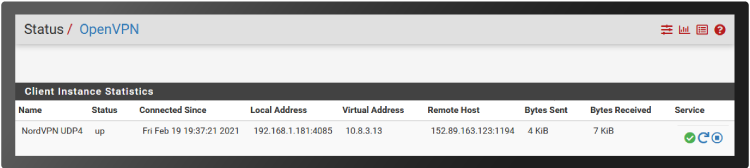
If your IP address doesn’t change after all these steps and after setting up your VPN, try restarting the pfSense router and rechecking the IP address.
If you need more setup help, head to NordVPN’s extensive setup guide for the pfSense router.
Final thoughts
Adding a reliable VPN to your pfSense router is one of the best ways to protect your entire network from cyberthreats and safeguard your personal data. It encrypts all traffic passing through your router, helps prevent ISP tracking, and allows access to geo-restricted content worldwide.
My top choice for pfSense is NordVPN. It’s fully compatible with recent pfSense versions and offers detailed OpenVPN setup guides. With strong encryption, an audited no-logs policy, fast speeds, and over 8,000 servers, NordVPN ensures secure, private, and buffer-free browsing for all connected devices.
FAQ
What is pfSense used for?
pfSense is a free, open-source software primarily used as a virtual router and firewall. So, you can even set up your laptop as a router.
Does pfSense support VPN?
Yes, pfSense supports VPNs. However, you need to pick a VPN provider compatible with this router. Our top pick is NordVPN since it is compatible with different pfSense versions, is the top-rated VPN, and provides the best and most secure browsing experience.
Which VPN is the best for pfSense routers?
NordVPN is my top pick for pfSense routers. This provider has setup instructions for different pfSense versions, blazing-fast connection speeds, and is highly secure.
How do I use a VPN with pfSense?
First, you need to set up your VPN on your pfSense router – follow our step-by-step guide for that. After setting up your VPN servers, connect to the router and browse online with the IP address of the location you’ve set your server on.
Does pfSense have OpenVPN?
Yes, pfSense does have the OpenVPN protocol allowed. It’s the default tunneling protocol for the VPN connection.