Bitcoin will become quantum-resistant when it solves a human problem
Here we go again. Bitcoiners have been discussing quantum computing risks to this now-largest cryptocurrency network for more than a decade, with varying intensity. Now, this has once again become the top Bitcoin-related topic, besides the price. What’s more, it’s relevant for other cryptoassets as well, not to mention the traditional finance world.

Image by Cybernews.

 Follow us
Here we go again. Bitcoiners have been discussing quantum computing risks to this now-largest cryptocurrency network for more than a decade, with varying intensity. Now, this has once again become the top Bitcoin-related topic, besides the price. What’s more, it’s relevant for other cryptoassets as well, not to mention the traditional finance world.
- While the quantum threat to Bitcoin is increasingly discussed, we still don’t know whether a cryptographically relevant quantum computer can exist at all and when it might happen.
- Technical solutions are emerging, while the Bitcoin community faces a more serious political question that might hurt BTC holders either way.
- Bitcoin’s real challenge may be its decentralized governance nature, not cryptography alone.
However, the great Bitcoin (BTC) quantum problem is more about human nature than a technical challenge.
In the past decade, three important things have changed concerning this discussion:
- Quantum researchers have made progress in the quantum computing (QC) field.
- Eencryption researchers and Bitcoin developers have advanced post-quantum solutions.
- Public awareness of this issue has increased considerably.






What hasn’t changed is that we still don’t know whether a cryptographically relevant quantum computer (CRQC) is possible at all. Despite this, estimated timelines for a CRQC have shortened and now range from several years to, well, still decades. This has been fueled by recent advancements in QC development, as well as by estimates that AI can help researchers solve technical problems more efficiently.
All this has forced BTC investors, developers, ecosystem participants, and Bitcoin skeptics to reassess threats to the Bitcoin network and their BTC holdings, and to accelerate the development of possible solutions.

The risks and headaches
Why are these solutions needed? In theory, a CRQC would be able to steal BTC. This would be done by deriving a so-called private key, which gives access to your BTC, from a public key, which helps you receive BTC. The public key is derived from the private key and is, as the name suggests, publicly exposed; however, today’s computers can’t reverse engineer it. What’s more, this kind of protection of private keys is not the only quantum headache Bitcoin developers have to deal with.
Besides solving this issue, the Bitcoin community needs to decide what happens with around 1.7 million BTC ($152 billion), earned by early Bitcoin miners, including around 1 million BTC attributed to Bitcoin creator Satoshi Nakamoto, and sitting in quantum computer–vulnerable Bitcoin addresses. If these coins are left as they are now, a CRQC could be used to steal them and crash the BTC price.

"I cannot see how the currency can maintain any value at all in such a setting. And this affects everyone; even those [who] diligently moved their coins to [post-quantum-computing]-protected schemes," Bitcoin developer Pieter Wuille, who also agrees that there is no urgency to make Bitcoin quantum-resistant right now, said a year ago.
Therefore, among the debated solutions is either freezing the coins or leaving them as they are, while allowing market forces to play out, without hurting the Bitcoin ethos as decentralized and censorship-resistant money, and potentially cementing Bitcoin's value long-term.
Total estimates of BTC currently sitting in vulnerable addresses are now above 6.8 million BTC ($598 billion), as there are more than 13.79 million BTC addresses with a non-zero balance and exposed public key, per Project Eleven data.
Annoyance and FUD
In either case, after heated debates for months, the status quo on quantum threats is as follows: some criticize Bitcoin developers for “sleepwalking towards collapse,” and signs are starting to appear that some investors might be selling BTC or refraining from investments due to quantum fears. This is all while developers agree that the quantum threat is an important issue, but urge people to stop spreading FUD (fear, uncertainty, doubt), while also working on possible solutions.

“What annoys me most about this is how uncharacteristically indifferent Bitcoin developers are to the creeping risk of quantum computing. Ordinarily, Bitcoin development culture is maximally paranoid, almost to the point of farce,” Bitcoiner venture capitalist Nic Carter, known for his advocacy to accelerate post-quantum Bitcoin solutions, wrote in his recent piece. Carter has also invested in Project Eleven, a startup developing post-quantum solutions for digital assets
The investor was accused of spreading FUD by another prominent Bitcoiner, Adam Back, CEO of major Bitcoin infrastructure company Blockstream, who is also mentioned in the original Bitcoin Whitepaper. According to Back, Bitcoin will become quantum resistant "decades before cryptographically relevant quantum computers exist."
Quantum-resistant solutions
While deemed insufficient efforts by Carter, Bitcoin developers continue working on various solutions that could help address quantum threats.
Last week, Bitcoin analyst Willy Woo shared data showing that quantum risk–related discussions among Bitcoin developers have accelerated quickly over the last year. In the past two months, 20–30% of all messages on the Bitcoin developer mailing list were related to quantum resistance.
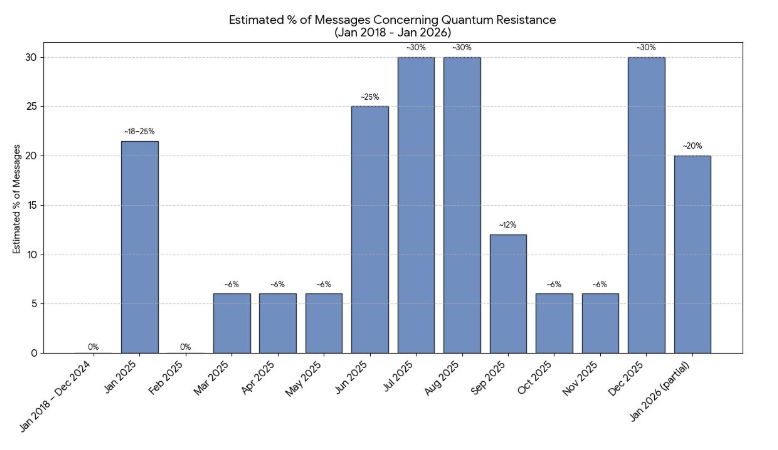
One of the most advanced ideas is Bitcoin Improvement Proposal 360 (BIP 360). If implemented, it would create a BTC output type that would be resistant to so-called long-exposure attacks, where a public key is exposed even before a transaction, “as a first step in hardening Bitcoin against the potential threat of quantum computers.”
This type of attack is relevant to BTC stored in the above-mentioned addresses (Pay-to-Public-Key, P2PK), belonging, for example, to early Bitcoin miners, as well as so-called Taproot addresses, which are another address format that starts with “bc1p.” (Therefore, as a temporary solution, it’s advisable to move BTC from these addresses to, e.g., SegWit addresses that start with “3” or “bc1q”.)
Meanwhile, a short-exposure attack is possible with BTC addresses (including SegWit), where the public key is exposed only after a transaction is broadcast, giving an attacker some time to steal BTC until the transaction is confirmed.
Another proposal, Hourglass, would limit the rate at which BTC stored in P2PK addresses can be spent, reducing the market impact should someone attempt to steal these coins.
Also, in December 2025, researchers at Blockstream published a paper on Bitcoin moving toward quantum readiness.






Moreover, as pointed out by BitMEX Research, in the broader market, there has already been significant technological progress in quantum-resistant signature schemes that Bitcoin could use.
The decentralization challenge
In any case, the Bitcoin community mostly agrees that the biggest issue with preparing Bitcoin for the quantum era, should it emerge, is not technical but human: the community is notorious for year-long debates and fierce disagreements, while the implementation of possible solutions could also take years.
For example, Chaincode Labs, a Bitcoin research and development center, has recommended a 2-year contingency plan and a 7-year comprehensive plan.

Given that no one knows when the first CRQC might appear, this long and complicated decentralized governance and implementation process is the reason why some Bitcoiners are urging acceleration.
However, as with this entire debate, accelerating the process is not so simple and may even be risky. Implementing solutions too early might hurt Bitcoin development and adoption, making the network less efficient and more expensive to use.
“The worst-case scenario we see for quantum risk is that a solution is implemented prematurely, with an exponentially lower efficiency trade-off had we waited longer before implementing,” a Bitcoin venture capital firm, Epoch, said in a recent report.
Therefore, Bitcoin developers are under pressure from all sides.
"This is not a simple problem. Bitcoin is not simple. Bitcoin governance is not simple. Distributed systems, applied cryptography, post-quantum cryptography, and even a decent understanding of quantum mechanics and economic theory... None of that is simple or succinct if accurate answers are desired," the co-author of BIP 360, Hunter Beast, said.
Preparations beyond Bitcoin
Meanwhile, other blockchain networks are also working on their own solutions. Last Friday, developers of a smart contract platform and the second-largest cryptoasset network by market capitalization, Ethereum (ETH), announced they’ve formed a new Post-Quantum (PQ) team under the Ethereum Foundation, as its management "has officially declared PQ security a top strategic priority."
Their main competitor in the smart contract industry, Solana (SOL), deployed post-quantum signatures on a Solana testnet last December. Some other cryptoasset networks have also taken steps toward protecting themselves from a CRQC.

Even new cryptocurrencies are emerging in an attempt to capitalize on quantum worries. In January, Nasdaq-listed BTQ Technologies Corp. (BTQ), a quantum technology company, launched a testnet of Bitcoin Quantum, a new cryptocurrency and "the first quantum-safe fork of Bitcoin", designed to test this supposedly quantum-resistant network.
Also last week, major crypto exchange Coinbase announced it has established the Independent Advisory Board on Quantum Computing and Blockchain, comprised of "a group of world-renowned experts."
The board is tasked with assessing the state of quantum computing and its impact on blockchain systems, issuing recommendations to safeguard against long-term quantum risks, and responding in real time to major quantum computing breakthroughs.
While some Bitcoiners point out that quantum computing threatens other sectors as well, including banking, centralized systems can implement solutions faster than decentralized networks such as Bitcoin.
“Quantum is a technical problem. Migration is a human one. Unless we prepare before we need it, Bitcoin’s greatest risk isn’t that quantum breaks the cryptography, it’s that we won’t be able to move fast enough when it does,” Hunter Beast concluded.
Unlock more exclusive Cybernews content on YouTube.