Iran relied on stablecoins to bypass sanctions despite security risks
The Central Bank of Iran has tried to use stablecoins to circumvent sanctions and prop up the local market, ignoring multiple stories of frozen stablecoin accounts, including its own.

Image by Juan Roballo | Shutterstock

 Follow us
The Central Bank of Iran has tried to use stablecoins to circumvent sanctions and prop up the local market, ignoring multiple stories of frozen stablecoin accounts, including its own.
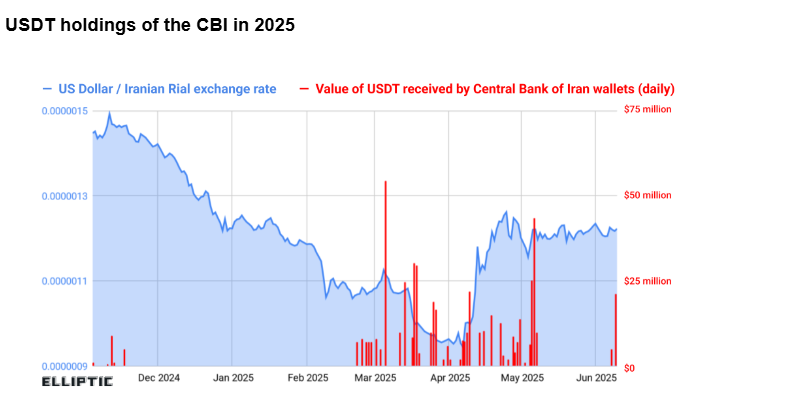
Analysts at the blockchain intelligence firm Elliptic used unspecified leaked documents about two purchases of the most popular stablecoin, tether (USDT), by the Central Bank of Iran (CBI) in April and May 2025 to identify that the bank acquired at least $507 million in USDT.
While the analysts said they do not have enough data to identify exactly how the funds were used, the two most likely use cases were supporting the collapsing local currency and settling international trade. Iran is also accepting payments in crypto assets for its weapons systems to bypass international sanctions.
Meanwhile, by using USDT, Iran has been risking losing access to these funds, as centralized stablecoin operators are able to freeze user accounts. Cybernews has already reported on multiple instances where such funds were frozen at the request of law enforcement, despite criticism that stablecoin companies are often too slow to act.
Moreover, CBI’s stablecoin accounts were also targeted by law enforcement. For example, in June 2025, several wallets linked to the bank were blacklisted, and $37 million in USDT was frozen.











The analysis also showed that, until that June, the majority of the acquired USDT was sent to an infamous Iranian crypto exchange Nobitex, which was hacked to the tune of $90 million by the pro-Israel group Gonjeshke Darandeh in the same month.
According to analysts, the bank was possibly buying rials with USDT on Nobitex while trying to support the collapsing local currency.USDT holdings of the CBI in 2025
"But from June 2025, the flow of funds changed abruptly: The USDT was sent to a cross-chain bridge service to move the funds from TRON to Ethereum," Elliptic said, adding that throughout the year, the assets have been swapped into other assets on decentralized exchanges, moved to other blockchains, and passed through centralized exchanges.
Meanwhile, a recent separate report by another blockchain analysis company, Chainalysis, showed that during the recent mass protests, Iranians rushed to move their BTC from exchanges into personal wallets. Iran’s crypto ecosystem is estimated to have reached over $7.78 billion in 2025.
Unlock more exclusive Cybernews content on YouTube.